Who Was Elijah in the Bible? Memory-Based Scripture Study
His story connects to later biblical figures, including his appearance with Moses at the Transfiguration of Jesus in the New Testament.
Posted by
 Eden
EdenRelated reading
Are Dinosaurs Mentioned in the Bible? A Retention Guide
The Bible does not explain how these creatures came to an end.
How Did Samuel Die in the Bible? Memory Science Guide
Samuel was buried at his own house in Ramah, the town connected to most of his life and work, according to the account of his death and burial in 1 Samuel 25.
How Did Saul Die in the Bible? Scripture Memory Method
The death of King Saul marks the end of Israel's first monarchy in the Old Testament.
TL;DR
- Elijah was a Hebrew prophet who served in the northern kingdom of Israel during the ninth century BC, during the reign of King Ahab.
- Elijah the prophet is known for major events recorded in the Old Testament, including stopping rain for three years, being fed by ravens, and raising a widow's son from the dead.
- His most famous act was the contest on Mount Carmel, where he challenged 450 prophets of Baal and proved the power of the God of Israel through fire from heaven.
- Elijah did not die a normal death; the Hebrew Bible states he was taken up to heaven in a whirlwind, with a chariot of fire.
- His story connects to later biblical figures, including his appearance with Moses at the Transfiguration of Jesus in the New Testament.
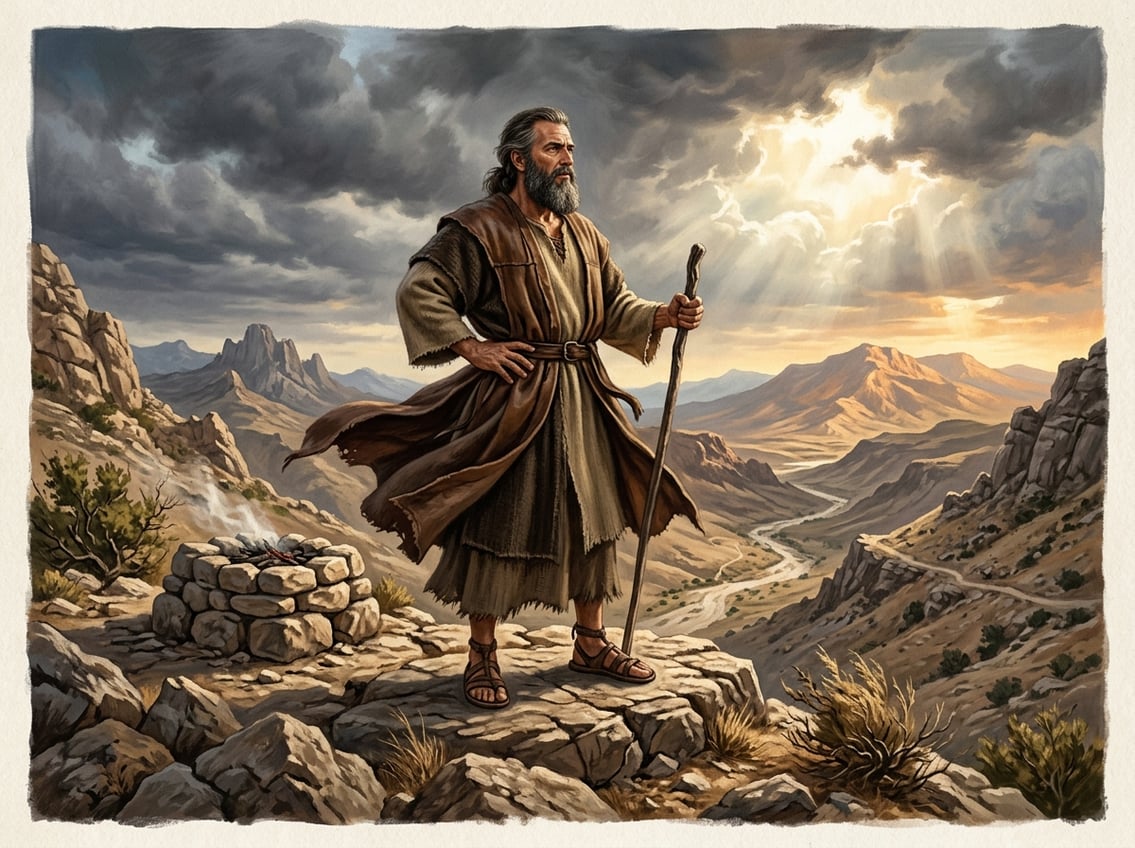
Identity, Setting, and Primary Bible Passages
Elijah's name, hometown, and historical setting all connect to his role as God's messenger during a time of national crisis. His story appears in specific chapters of the Bible that readers can locate and study directly.
The Meaning of Elijah's Name
Elijah's name comes from Hebrew and carries a direct message.
| Element | Meaning |
|---|---|
| Elijah (Hebrew) | "Yahweh is my God" or "My God is Yahweh" |
| Elias | Greek form of the name used in the New Testament |
| Core message | A declaration of loyalty to God alone |
The name itself works as a statement against idol worship. During Elijah's lifetime, many people in Israel worshipped Baal instead of God. The name Elijah stood in direct opposition to that practice, based on details found in this overview of Elijah's life and story.
Elijah the Tishbite From Gilead
The Bible identifies Elijah by a specific title and location.
- Full title: Elijah the Tishbite
- Hometown: Tishbe, a town in the region of Gilead
- First appearance: 1 Kings 17:1
- Region description: Gilead sat east of the Jordan River, outside the main population centers of Israel
This location matters. Elijah came from a rural area, not from Samaria or Jerusalem, which were the political and religious centers of the divided kingdom. Details on his tribal background and family connections are covered in this Bible character profile of Elijah.
Israel Under Ahab and Jezebel
Elijah's ministry took place during one of the lowest points in the history of the Northern Kingdom of Israel.
| Figure | Role |
|---|---|
| King Ahab | Ruler of the Northern Kingdom of Israel |
| Queen Jezebel | Ahab's wife, a promoter of Baal worship |
| Jeroboam | Earlier king who set up rival worship sites, a practice later kings continued |
Ahab and Jezebel expanded Baal worship across the Northern Kingdom of Israel. This kingdom, separate from the Kingdom of Judah in the south, had a long pattern of kings who rejected God. The background on this period of decline is explained in this historical setting for Elijah.
Where to Read Elijah's Story
Elijah's story is contained in the Books of Kings, split across specific chapters.
- 1 Kings 17 – Elijah announces a drought and is fed by ravens
- 1 Kings 18 – The contest with the prophets of Baal on Mount Carmel
- 1 Kings 19 – Elijah flees from Jezebel and meets God at Horeb
- 2 Kings 2 – Elijah is taken up to heaven, and Elisha continues his work
These four chapters form the core narrative. Readers looking for the full account should start with 1 Kings 17:1 and read through 2 Kings 2, since this Bible study series on Elijah's life breaks down each passage in sequence.
Drought, Provision, and the Widow of Zarephath
A severe drought struck Israel as a direct challenge to Baal worship, while Elijah survived first by ravens at a hidden brook and then through a widow's small store of flour and oil. These events, recorded in 1 Kings 17, show how Elijah's role as a miracle worker was tied closely to prayer and trust in God's provision.
The Drought as a Challenge to Baal
Baal was worshipped as the god of storm and rain in ancient Canaan. Elijah's announcement of a drought directly challenged that belief system.
| Detail | Description |
|---|---|
| Cause | Widespread idolatry and Baal worship in Israel |
| Prophet's role | Elijah warned King Ahab of the coming drought and famine |
| Length | No rain or dew until Elijah later announced its end |
| Purpose | Show that Yahweh, not Baal, controlled rain and harvest |
The drought was not random weather. It was a public test between two gods, with Israel's land and food supply at stake.
Ravens at the Brook Cherith
Before the widow of Zarephath, God sent Elijah to a smaller, quieter test of provision.
- Elijah hid at the Brook Cherith, east of the Jordan River
- Ravens brought him bread and meat each morning and evening
- He drank from the brook itself for water
- The brook eventually dried up because the drought and famine had worsened
- This shortage forced Elijah to move toward Sidon, in the region of Phoenicia
This stage set up the next miracle. When the brook failed, God did not abandon Elijah. Instead, He directed him toward a new and unexpected source of food.
Flour, Oil, and a Son Restored to Life
God sent Elijah to Zarephath, a town near Tyre.
Mount Carmel and the Conflict Over Worship
Mount Carmel marks the turning point in Elijah's ministry, where he confronted King Ahab and challenged all of Israel to choose between Yahweh and Baal. The events recorded in 1 Kings 18 show a direct test of divine power, ending in fire from heaven and the return of rain after a long drought.
Elijah's Challenge to a Divided Israel
Israel had drifted into idolatry under Ahab's rule, mixing worship of Yahweh with Baal worship. Elijah called the people to a decision.
| Verse | Statement | Meaning |
|---|---|---|
| 1 Kings 18:21 | "How long will you waver between two opinions?" | Israel could not serve two gods at once |
| Exodus 20:3 | "You shall have no other gods before me" | Direct link to the Ten Commandments |
The people stayed silent when Elijah spoke. Their silence showed how deep the confusion over worship had become.
The Prophets of Baal and Asherah
Elijah proposed a public test involving Ahab's religious officials.
- 450 prophets of Baal were summoned to Mount Carmel
- Prophets of Asherah were also present, though they did not take part in the sacrifice test
- Two bulls were prepared: one for Baal, one for Yahweh
- Each side would call on their god to send fire, with no human ignition allowed
The prophets of Baal cried out from morning until noon. No fire came. Elijah then mocked their god's silence, saying Baal might be sleeping or away on a journey (1 Kings 18:27).
Fire From Heaven and the Return of Rain
Elijah rebuilt the altar of Yahweh using twelve stones, one for each tribe of Israel. He soaked the offering and wood with water three times before praying.
| Event | Result |
|---|---|
| Elijah's prayer (1 Kings 18:36-37) | Fire consumed the sacrifice, wood, stones, and water |
| People's response | They fell down and declared, "The Lord, he is God" |
| False prophets | Executed at the Kishon River, fulfilling the penalty for false prophets |
| Rain | Returned after Elijah prayed seven times atop Carmel, ending the three-year drought |
The fire proved Yahweh's power over nature, directly contradicting Baal's claimed role as a storm and fertility god.
The Meaning of the Carmel Account
The Carmel event served as both judgment and revival for Israel. It exposed the failure of Baal worship and restored public recognition of Yahweh as the true God.
Key outcomes include:
- Public confirmation that Yahweh controls fire, rain, and fertility—claims previously credited to Baal
- Removal of the prophets of Baal as a corrupting influence in Israel
- Renewed rain signaling the end of divine judgment tied to the drought
- Elijah's authority as a prophet confirmed before king and nation
The narrative later connects to Jezreel, where Ahab traveled after the rain began, continuing the unfolding conflict between the throne and the prophetic office.
Fear, Wilderness, and God's Voice at Horeb
After Elijah's victory over the prophets of Baal on Mount Carmel, he faced a personal crisis of fear and doubt. This part of his story, found in 1 Kings 19, shows a side of the prophet that many readers relate to: exhaustion, despair, and the need for God's comfort.
Jezebel's Threat and Elijah's Despair
Queen Jezebel sent Elijah a message after learning he had killed her prophets. She swore to kill him within a day.
What happened next:
- Elijah became afraid and ran for his life.
- He traveled to Beersheba in Judah and left his servant there.
- He walked alone into the wilderness, a full day's journey.
- He sat under a broom bush and asked God to let him die.
- He said, "I have had enough, Lord... I am no better than my ancestors."
This moment shows a sharp contrast. The same prophet who called down fire from heaven on Carmel now felt like giving up. His fear did not erase his faith, but it did bring him to a low point, as noted in this breakdown of Elijah's fear and flight.
Rest and Renewal in the Wilderness
God did not scold Elijah for his fear. Instead, God gave him rest and food.
| Event | Detail
Justice, Succession, and Elijah’s Departure
Elijah spent his final years standing up for justice, warning kings, and preparing Elisha to take his place. His story ends with one of the most dramatic scenes in the Bible, when he was taken up to heaven without dying.
Confronting Ahab Over Naboth’s Vineyard
In 1 Kings 21, King Ahab wanted a vineyard owned by a man named Naboth. Naboth refused to sell it because the land had belonged to his family for generations.
Jezebel, Ahab’s wife, had Naboth falsely accused and killed so Ahab could take the land. God sent Elijah to confront Ahab directly.
| Person | Role in the Story |
|---|---|
| Ahab | King who wanted the vineyard |
Elijah's Legacy in Jewish and Christian Scripture
Elijah's influence extends far beyond his own lifetime, appearing in prophecy, gospel narrative, and later rabbinic and Christian writing. The verses below show how his name and role carry forward across the Old and New Testament.
Malachi's Promise Before the Day of the Lord
| Verse | Text (Plain-English Meaning) |
|---|---|
| Malachi 4:5 | God will send Elijah before the "day of the Lord" — a future time of judgment. |
| Malachi 4:6 | Elijah's role: turn the hearts of parents and children toward each other, so the land is not struck with a curse. |
Key points:
- Malachi 4:5–6 closes the Old Testament with a forward-looking promise, not a final farewell.
- The phrase "day of the Lord" refers to a coming moment of divine action, not a specific calendar date.
- This promise sets up direct references to Elijah in the New Testament.
John the Baptist and the Spirit and Power of Elijah
| Reference | What It Says |
|---|---|
| Luke 1:17 | John the Baptist will go before the Lord "in the spirit and power of Elijah." |
| Matthew 11:14 | Jesus states that John is "the Elijah who was to come." |
| John 1:21 | John the Baptist is asked directly if he is Elijah; he answers no. |
How to read these together:
- Luke 1:17 and Matthew 11:14 connect John's ministry to Elijah's role, not his identity.
- John 1:21 shows John rejecting a literal identification.
- The resolution: John fulfills Elijah's function — preparing people for the Lord — without being Elijah reincarnated.
Elijah With Moses at the Transfiguration
- Event: Elijah and Moses appear with Jesus Christ on the Mount of Transfiguration.
- Figures present: Jesus, Moses, Elijah, and the disciples Peter, James, and John.
- Meaning: Moses represents the Law; Elijah represents the Prophets. Their appearance links Elijah's ministry to the full sweep of Old Testament revelation.
- Result: Jesus is shown as the fulfillment of both the Law and the Prophets, with Elijah standing as a witness to that continuity.
This scene is one of the clearest New Testament moments where Elijah's life connects directly to Jesus's identity.
Prayer, Prophecy, and Later Interpretation
| Reference | Detail |
|---|---|
| James 5:17 | Elijah is described as "a man with a nature like ours" who prayed and stopped the rain for three and a half years. |
| Revelation 11 | Many interpreters link the "two witnesses" in this chapter to figures with powers similar to Elijah's, including control over rain. |
Later interpretation:
- James 5:17 uses Elijah as an example that ordinary people can pray with effect — not just prophets with special status.
- Jewish tradition, separate from the New Testament, holds that Elijah will announce the coming of the messiah, a belief reflected in Havdalah and Passover customs.
- Elijah's ascension into heaven, rather than death, shaped later views of him as a figure who remains active and can still appear or intervene.
Frequently Asked Questions
These questions cover Elijah's role, his key story events, his miracles, and his connection to New Testament figures like Jesus.
What role did Elijah played in the Bible?
Elijah served as a prophet during the reign of King Ahab in the northern kingdom of Israel. His main job was to speak God's message during a time when many people worshipped a false god named Baal.
He challenged the king and queen directly. He also worked to turn the nation back to worshipping the God of Israel.
What is the story of Elijah in the Bible?
Elijah's story starts in 1 Kings 17. Here is a simple breakdown of the main events:
| Event | What Happened |
|---|---|
| The Drought | Elijah told Ahab that no rain would fall until he said so |
| Fed by Ravens | God sent ravens to bring Elijah food by a brook |
| The Widow | Elijah stayed with a widow whose flour and oil never ran out |
| Mount Carmel | Elijah challenged 450 prophets of Baal to a contest |
| Fleeing Jezebel | Elijah ran into the desert after Jezebel threatened his life |
| The Still Small Voice | God spoke to Elijah in a quiet whisper, not in wind or fire |
| Taken to Heaven | Elijah did not die; he was taken up in a whirlwind |
What miracles did Elijah perform?
Elijah performed several miracles during his ministry. These acts showed God's power over nature and even over life and death.
- Called down fire from heaven on Mount Carmel
- Stopped rain for three years, then brought it back
- Multiplied a widow's flour and oil so it never ran out
- Raised a widow's dead son back to life
- Parted the Jordan River with his cloak
According to one source, Elijah is credited with seven miracles total during his lifetime.
How was Elijah called by God?
Elijah's calling is not explained in detail. The Bible simply introduces him already speaking for God.
- He appears without warning in 1 Kings 17:1
- He announces a drought to King Ahab
- He hides near a brook as instructed by God
- He follows God's directions through each major event that follows
Nothing is recorded about his birth, family, or how he first heard from God. He simply appears to challenge Ahab at the start of his story.
Why was Elijah important to Jesus?
Elijah connects to Jesus through prophecy and through John the Baptist. Here are the key links:
- Malachi 4:5-6 predicted an "Elijah" figure would come before a major day of the Lord
- Luke 1:17 says John the Baptist came in the "spirit and power of Elijah"
- Elijah appeared with Moses at Jesus' transfiguration in the New Testament
- James 5:17-18 uses Elijah as an example of the power of prayer
These connections show that Elijah's role did not end in the Old Testament. His story pointed forward to events in the life of Jesus.