Are Dinosaurs Mentioned in the Bible? A Retention Guide
The Bible does not explain how these creatures came to an end.
Posted by
 Eden
EdenRelated reading
How Did Samuel Die in the Bible? Memory Science Guide
Samuel was buried at his own house in Ramah, the town connected to most of his life and work, according to the account of his death and burial in 1 Samuel 25.
How Did Saul Die in the Bible? Scripture Memory Method
The death of King Saul marks the end of Israel's first monarchy in the Old Testament.
How Do You Read the Bible in Order? Memory That Sticks
No single order is required by faith traditions; the right choice depends on personal goals, prior knowledge, and how much time someone can commit to bible reading each day.
TL;DR
- The word "dinosaur" does not appear in the Bible because the term was not created until the 1800s.
- Scripture does describe large creatures like the behemoth and leviathan in Job, which some readers connect to dinosaurs.
- Old-earth and young-earth views within Christianity interpret Genesis and these creature descriptions differently.
- Ancient art and writings, including accounts from explorer Marco Polo, show cultures describing large reptile-like animals.
- The Bible does not explain how these creatures came to an end.
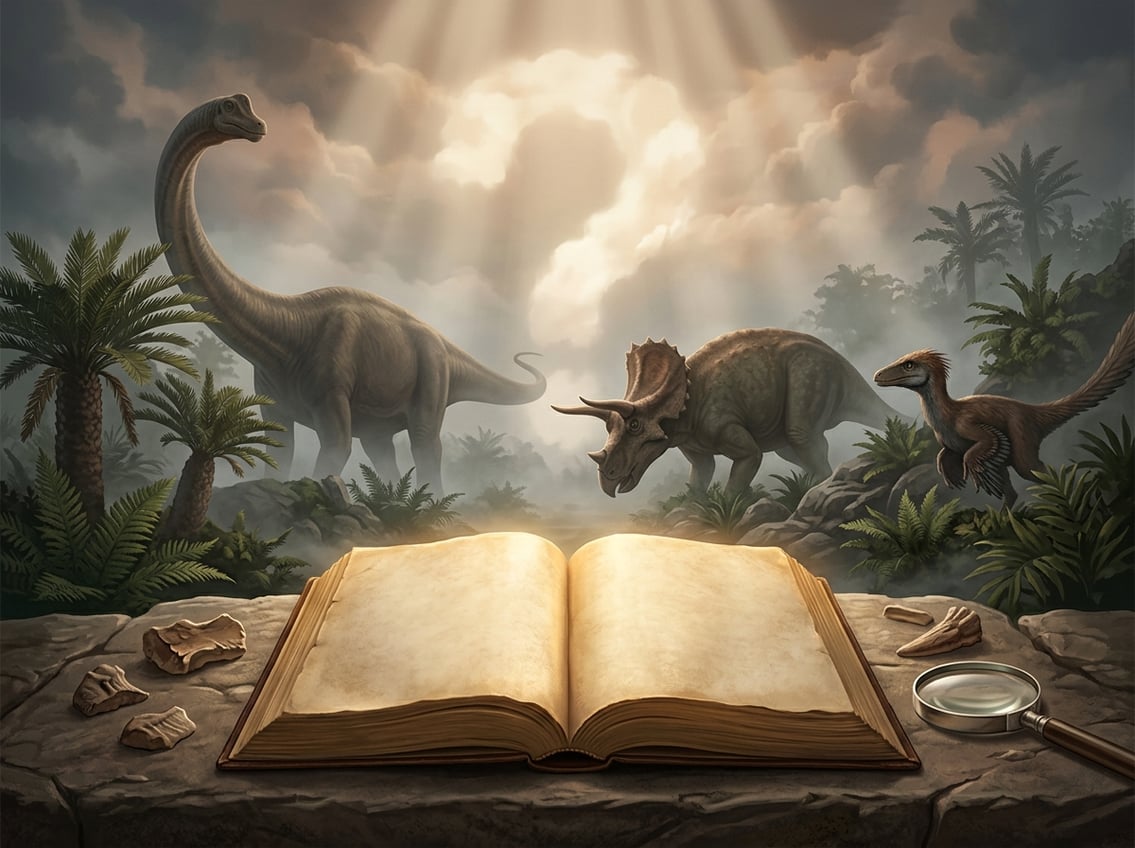
The Direct Answer and the Limits of Biblical Terms
The Bible does not use the word "dinosaur," but it does describe large, powerful creatures that some readers connect to prehistoric animals. Understanding why requires looking at language history, ancient categories of living creatures, and what scripture actually claims versus what it leaves open.
Why the Modern Word "Dinosaur" Does Not Appear
The term "dinosaur" is a modern invention. It was coined in 1841 by scientist Richard Owen, long after every book of the Bible was written.
This means no biblical author could have used a word that did not yet exist. The absence of the term is a matter of timing, not a rejection of the animals themselves.
Instead, the Bible uses other words to describe large or fearsome creatures:
- Tanniyn – often translated "sea monster," "serpent," or "dragon"
- Livyathan (Leviathan) – a large, fierce water creature
- Behemoth – a massive land animal described in detail
These Hebrew terms appear well before the word "dinosaur" existed, according to biblical creature descriptions found across nearly thirty Old Testament passages.
How Biblical Creature Categories Differ From Modern Taxonomy
Ancient writers did not classify animals the way modern science does. Scripture groups creatures by where they live and how they behave, not by species or biological order.
Common biblical groupings:
| Category | Examples | Modern Equivalent Attempted |
|---|---|---|
| Great sea creatures | Leviathan, tanniyn | Marine reptiles, sea serpents |
| Land animals | Behemoth | Large plant-eating animals |
| Wild animals | Unnamed beasts | General large predators |
This system focuses on function and habitat, not precise anatomy. A "giant reptile" or "dragon" in ancient Hebrew could describe many different real or symbolic creatures.
Because of this looser system, it's difficult to match ancient terms to exact modern dinosaur species with certainty.
What Scripture Can and Cannot Establish About Prehistoric Animals
Scripture can establish that God created all living creatures, including large and unusual ones (Genesis 1:24-25). It can also confirm that ancient texts describe animals unfamiliar to modern readers.
What the Bible does NOT establish:
- Exact species identification for any dinosaur
- A timeline matching modern paleontology
- Scientific classification of "dinosaur-like creatures"
What remains debated:
- Whether Behemoth or Leviathan describe real prehistoric creatures or symbolic images
- Whether descriptions like Job 40's account of Behemoth's cedar-like tail point to actual dinosaurs or another large animal
Scripture offers descriptions, not scientific documentation. Readers must interpret these passages using theology, language study, and personal conviction about the age of the earth.
Creation Passages That Could Include Dinosaurs
Genesis 1 describes broad groups of living creatures, and several of these groups could fit large reptiles like dinosaurs. Below is a breakdown of the key passages and what they may mean for dinosaur origins.
Land Animals in Genesis 1:24–25
Genesis 1:24-25 describes God creating land animals on day six.
Verse breakdown:
| Verse | Text | Category |
|---|---|---|
| Genesis 1:24 | "Let the land produce living creatures according to their kinds: the livestock, the creatures that move along the ground, and the wild animals" | Broad command |
| Genesis 1:25 | "God made the wild animals according to their kinds, the livestock according to their kinds, and all the creatures that move along the ground according to their kinds" | Fulfillment |
Three groups named:
- Livestock (domesticated animals)
- Creatures that move along the ground (small crawling animals)
- Wild animals (untamed, larger animals)
Dinosaurs, if they lived alongside humans, would most likely fall under "wild animals." The text does not name specific species, so this category stays open to interpretation. This flexibility is central to the young earth creationist reading that places dinosaurs within the six days of creation.
Great Sea Creatures in Genesis 1:21
Genesis 1:21 introduces a distinct category on day five.
The verse:"So God created the great creatures of the sea and every living thing with which the water teems and that moves about in it, according to their kinds."
Key term: The Hebrew word tanniyn is translated "great creatures" here. This same word appears elsewhere in Scripture and is sometimes rendered "sea monster," "serpent," or "dragon."
Why this matters for dinosaurs:
- The term describes large, powerful water-dwelling animals
- Some creationist writers link tanniyn to marine reptiles such as plesiosaurs or mosasaurs
- The passage does not specify exact species, leaving room for various interpretations
This verse gives the clearest textual opening for large prehistoric sea creatures, based on both the size implied and the Hebrew word choice used across the Old Testament.
Creation Week, Human Origins, and the Garden of Eden
Creation week timeline:
| Day | Event |
|---|---|
| 5 | Sea creatures and birds created |
| 6 | Land animals, then Adam and Eve created |
Key point: Adam and Eve are created on the same day as land animals, according to Genesis 1:24-31.
What this means for dinosaurs:
- If dinosaurs are included in "wild animals," they would have existed alongside Adam and Eve
- The Garden of Eden account does not list specific animal names
- No verse states dinosaurs died out before human creation
This timeline is the foundation for the belief that humans and dinosaurs shared the earth, a core claim within young earth creationism.
Diet, Predation, and Genesis 1:29–30
Genesis 1:29-30 describes the original diet given to all living creatures.
The verse content:"I give you every seed-bearing plant on the face of the whole earth and every tree that has fruit with seed in it. They will be yours for food. And to all the beasts of the earth and all the birds in the sky and all the creatures that move along the ground—everything that has the breath of life in it—I give every green plant for food."
Key implications:
- All animals, including large ones, are described as plant-eaters at creation
- No mention of predation or meat-eating exists in this passage
- This applies to land animals, which could include large reptiles
Connection to dinosaurs:If dinosaurs existed at this point, they would have been herbivores under this original design. Predation and meat-eating are not addressed until later in Genesis, after events tied to sin entering the world.
Behemoth in Job 40: A Possible Land-Animal Reference
The behemoth described in Job 40:15-24 stands out as one of the most detailed animal descriptions in the entire Bible. Scholars have long debated whether this creature matches known wild animals or points to something closer to dinosaur-like creatures.
Reading Job 40:15–24 in Its Literary Context
Job 40 sits at the end of God's speech to Job, right after a long list of ordinary wild animals in Job 39.
| Verse | Description |
|---|---|
| 40:15 | Eats grass like an ox |
| 40:16 | Strength in its loins and belly muscles |
| 40:17 | Tail like a cedar |
| 40:18 | Bones like tubes of bronze, limbs like bars of iron |
| 40:19 | Called "first among the works of God" |
| 40:21-22 | Lies under lotus trees, hidden by reeds and marsh |
| 40:23 | Unafraid even when the Jordan rushes against its mouth |
This placement matters. Job 39 covers real, identifiable animals like the wild donkey, the ostrich, and the horse.
The behemoth passage follows the same pattern, which suggests God is still describing an actual creature rather than switching to myth or metaphor.
The Cedar-Like Tail and the Sauropod Interpretation
The phrase "tail like a cedar" in Job 40:17 is the detail most often used to argue for a sauropod dinosaur.
Points raised in favor of this reading include:
- A cedar tree branch is long, thick, and rigid, not a description that fits a short, thin tail.
- Sauropod dinosaurs such as diplodocus and apatosaurus had long, tapering tails that could resemble a tree branch.
- Sauropods were herbivores, matching the grass-eating detail in verse 15.
- Some writers argue [14 separate
Leviathan, Dragons, and Sea-Monster Imagery
The Bible describes Leviathan as a powerful creature that lives in water. Writers used this creature to show God's strength and control over nature.
The Description of Leviathan in Job 41
Job 40-41 gives the longest description of Leviathan in the Bible. God uses this creature to show Job how small human power is compared to His own.
Key features from Job 41:
| Verse | Description |
|---|---|
| Job 41:1 | Cannot be caught with a hook |
| Job 41:7 | Skin cannot be pierced by spears |
| Job 41:14 | Has terrifying teeth |
| Job 41:18-21 | Breathes out smoke and fire |
| Job 41:22 | Has a strong neck |
| Job 41:31 | Makes the sea churn like boiling oil |
The fire and smoke imagery has led some readers to link Leviathan with dragon symbolism in the Bible. Others see this as poetic language meant to show raw power, not literal fire-breathing.
Leviathan in Psalms and Isaiah
Leviathan also shows up outside of Job. Each mention adds a different layer of meaning.
- Psalm 104:26 – Leviathan plays in the sea, showing it as part of God's creation.
- Psalm 74:14 – God crushes the heads of Leviathan, a picture of victory over chaos.
- Isaiah 27:1 – Leviathan is called a "fleeing serpent" and a "dragon" that God will punish.
These verses connect Leviathan to a wider group of sea monsters and dragons in ancient writing. The tannin word group covers dragons, serpents, and sea monsters, which explains why English Bibles sometimes use different words for similar creatures.
Whether Leviathan Is a Crocodile, Sea Creature, or Symbol
Bible scholars do not agree on what Leviathan actually was. Three main views exist:
- Crocodile – Some scholars think Leviathan describes a large Nile crocodile, since the physical traits match closely.
- Unknown sea creature – Others believe Leviathan was a real animal now extinct, possibly similar to a large marine reptile.
- Symbol of chaos or evil – Many scholars read Leviathan as a symbol, not a literal animal. This view connects to Revelation, where dragon imagery represents Satan and evil forces, not a physical creature.
The debate stays open because ancient Hebrew words for "great sea creatures" carried broad meaning, covering both real animals and symbolic monsters.
Dinosaurs, Noah's Ark, and Extinction
Genesis 6 describes a worldwide flood that required Noah to gather land animals onto the ark, a detail that many believe would have included dinosaurs. This section looks at what the text says, how young or small dinosaurs might have fit on the ark, and what may have caused their extinction after the flood.
What Genesis 6 Says About Animals on the Ark
Genesis 6:19-20 gives a clear instruction from God to Noah.
| Verse | Instruction |
|---|---|
| Genesis 6:19 | Bring two of every kind of living creature into the ark |
| Genesis 6:20 | Birds, animals, and creeping things, according to their kinds |
| Genesis 7:14-15 | All flesh with the breath of life entered the ark |
The text does not single out dinosaurs by name. But it does not exclude them either.
Since dinosaurs are classified as land animals, some readers argue that the biblical mandate gives no reason to leave them off the ark. The word "kinds" in Genesis 6:20 is broad enough to cover many species, including reptiles.
Young Animals, Kinds, and Ark Logistics
Fitting dinosaurs on the ark comes down to size, number, and age.
- Ark dimensions: 300 x 50 x 30 cubits, roughly 510 x 85 x 51 feet
- Total volume: About 2.21 million cubic feet, compared to over 500 semitrailers
- Dinosaur kinds: Around 55 distinct kinds out of 668 named species
- Estimated animal count: Up to 16,000 individual animals across 8,000 genera
Creationist researcher John Woodmorappe has calculated that this total animal load, including dinosaurs, would take up less than half the ark's space.
Most dinosaurs on board were likely young or juvenile, not full-grown adults. A young Brachiosaurus takes up far less room than a mature one. This detail matters because it directly addresses the size problem critics raise.
Proposed Post-Flood Causes of Dinosaur Extinction
Dinosaur extinction after the flood is explained through several possible factors rather than one single cause.
- Environmental change – The world after the flood had different climate and food sources than before it.
- Human encounters – Early humans may have hunted or displaced remaining dinosaur populations.
- Natural die-off – Small surviving populations may not have been able to sustain themselves long-term.
These factors are often cited together as the reason dinosaurs did not survive far past the flood, rather than any single event.
The fossil record and geological record are used by young-earth creationists to support this timeline. They argue that dinosaur fossils fit within a framework of a recent creation and a global flood, rather than millions of years of gradual extinction.
How Christian Views Reconcile Scripture and Fossils
Christians hold several distinct positions on dinosaur fossils and the age of the earth, each shaped by how they read Genesis alongside the geological record. The main views include young-earth creationism, old-earth creationism, and theistic evolution, with each approaching scripture and science differently.
Young-Earth Creationism and Human-Dinosaur Coexistence
Young-earth creationism holds that God created the earth and all life within a literal six-day period, roughly 6,000 to 10,000 years ago.
Core claims:
- Humans and dinosaurs existed at the same time
- The Genesis flood explains most of the fossil record
- Fossils formed quickly during a global flood, not over millions of years
- Dinosaurs may be represented by biblical terms like "behemoth" in Job 40
Supporters argue this view keeps a plain reading of Genesis intact. Critics note it conflicts with mainstream geological dating methods.
Old-Earth Creationism and the Mesozoic Era
Old-earth creationism accepts the standard scientific timeline, including a 4.5-billion-year-old earth and a Mesozoic Era when dinosaurs lived.
Key positions:
- Genesis "days" are interpreted as long ages, not literal 24-hour periods
- Dinosaur fossils, including Tyrannosaurus rex remains, date to millions of years before humans existed
- Humans and dinosaurs never coexisted
- God's creative work unfolds gradually across geological time
This view allows Christians to accept fossil dating from the geological record while still affirming God as creator. It treats scripture as compatible with, rather than opposed to, mainstream science.
Evolution, Geological Dating, and Interpretive Commitments
Some Christians accept evolution and standard geological dating as accurate descriptions of how life developed, including dinosaur species.
| View | Age of Earth | Human-Dinosaur Overlap | Genesis Reading |
|---|---|---|---|
| Young-Earth Creationism | 6,000–10,000 years | Yes | Literal |
| Old-Earth Creationism | 4.5 billion years | No | Day-age or gap theory |
| Theistic Evolution | 4.5 billion years | No | Allegorical or symbolic |
Theistic evolution treats the creation account as a theological statement rather than a scientific record. This position places more weight on the fossil record than on a literal six-day timeline.
Keeping Theological Claims Distinct From Scientific Claims
Many Christian scholars separate the question of why creation exists from how it developed.
- Theological claim: God is the creator and sustainer of all life, as stated in Psalm 104:24
- Scientific claim: Fossil dating and geological layers explain when species like Tyrannosaurus rex existed
- Shared ground: Romans 1:20 states creation itself reveals God's power, regardless of the age debate
This separation lets Christians hold different views on dinosaur fossils without changing their core belief in God as creator. It shifts the debate from whether God made dinosaurs to when and how he did so.
Frequently Asked Questions
Interpretations of dinosaurs in Scripture depend on how a reader approaches Genesis, ancient Hebrew terms, and the timeline of Earth's history. These questions address the most common points of confusion on this topic.
What does the Bible say about dinosaurs?
The word "dinosaur" does not appear in the Bible because the term was not invented until the 1800s, long after Scripture was written.
The Bible does describe large creatures using specific Hebrew words:
| Hebrew Term | Common Translation | Where It Appears |
|---|---|---|
| Tanniyn | Dragon, sea monster, serpent | Psalm 74:13, Isaiah 27:1, Jeremiah 51:34 |
| Livyathan (Leviathan) | Large sea creature | Job 41:1, Psalm 104:26 |
| Behemoth | Land creature | Job 40:15-24 |
These terms appear nearly 30 times in the Old Testament, describing creatures found both on land and in water.
Are there any Bible verses that describe dinosaurs?
Several verses describe creatures with features that some readers connect to dinosaurs. Here are the key passages:
- Job 40:15-19 — Describes Behemoth as having a tail "like a cedar" and bones "like tubes of bronze"
- Job 41:1-34 — Describes Leviathan as a creature no weapon can stop, with scales like armor
- Psalm 74:13 — References God breaking "the heads of the sea monsters"
- Isaiah 27:1 — Mentions a "fleeing serpent" and "twisted serpent"
The tail description in Job 40:17 stands out. Elephants and hippos have thin tails, but the text compares this creature's tail to a cedar tree, which is why some link it to sauropod dinosaurs like Brachiosaurus or Apatosaurus.
Do Behemoth and Leviathan in the Book of Job refer to dinosaurs?
Scholars are divided. No single view has been settled among Bible scholars, and Scripture does not confirm the identification one way or the other.
Three main positions exist:
- Young Earth Creationist view: Behemoth and Leviathan describe actual dinosaurs that lived alongside humans.
- Old Earth Creationist view: These creatures represent known animals like elephants, hippos, or crocodiles, described in poetic language.
- Symbolic view: The descriptions serve a literary purpose, showing God's power over untamable forces of nature.
The debate connects directly to how a reader interprets the age of the Earth and the opening chapters of Genesis.
When did dinosaurs exist according to the Bible?
The timeline depends on which creation model a person accepts:
| View | Age of Earth | Dinosaur Timeline |
|---|---|---|
| Young Earth Creationism | 6,000–10,000 years | Created on Day 6, alongside humans |
| Old Earth Creationism | Billions of years | Existed millions of years before humans |
The Bible itself does not give a specific timeline for dinosaurs. Genesis 1 describes land animals being created on the sixth day, which Young Earth Creationists apply directly to dinosaurs.