How Did Samuel Die in the Bible? Memory Science Guide
Samuel was buried at his own house in Ramah, the town connected to most of his life and work, according to the account of his death and burial in 1 Samuel 25.
Posted by
 Eden
EdenRelated reading
Are Dinosaurs Mentioned in the Bible? A Retention Guide
The Bible does not explain how these creatures came to an end.
How Did Saul Die in the Bible? Scripture Memory Method
The death of King Saul marks the end of Israel's first monarchy in the Old Testament.
How Do You Read the Bible in Order? Memory That Sticks
No single order is required by faith traditions; the right choice depends on personal goals, prior knowledge, and how much time someone can commit to bible reading each day.
TL;DR
- Samuel died in the city of Ramah after living a long life as a prophet, judge, and priest of Israel, based on the record in 1 Samuel 25.
- The Bible does not name a specific illness or cause of death for Samuel—it states only that he died, and all Israel mourned and buried him.
- Samuel was buried at his own house in Ramah, the town connected to most of his life and work, according to the account of his death and burial.
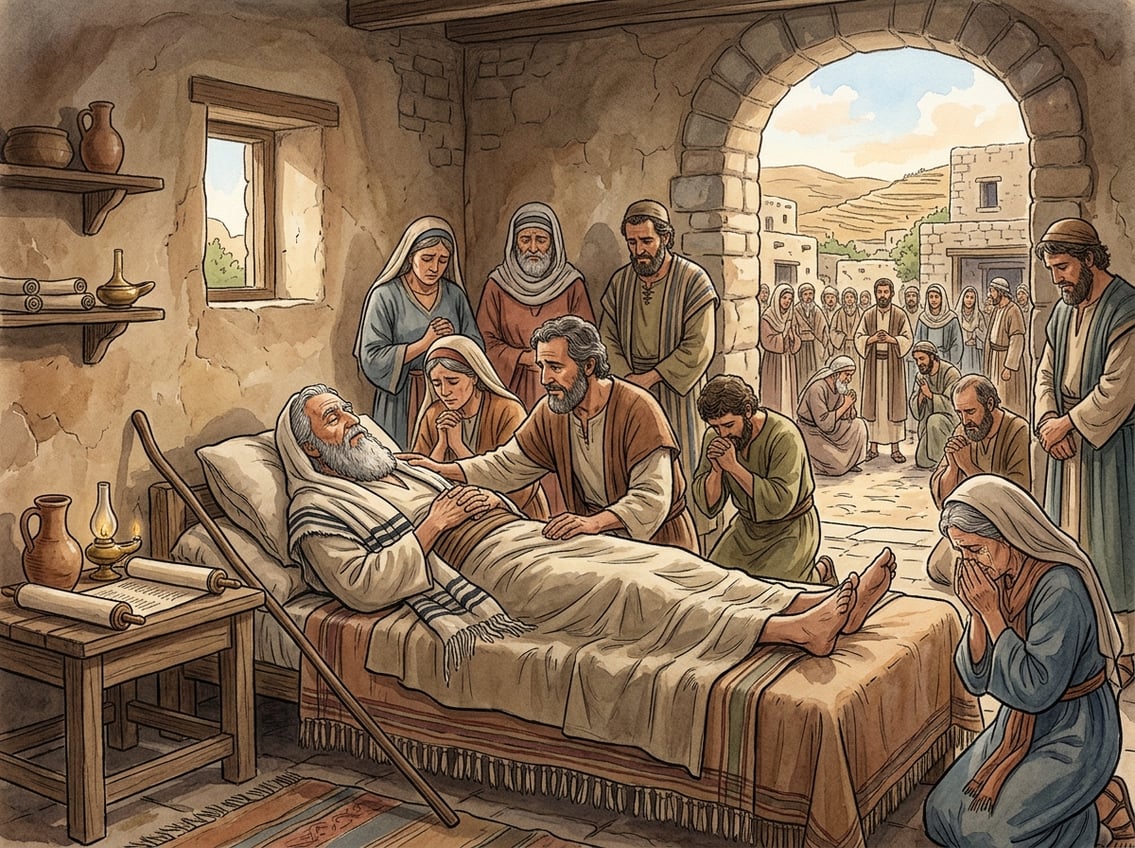
What Scripture Actually Says About Samuel’s Death
The Bible records Samuel's death in a single verse, offering few details about the cause or circumstances. Understanding what the text states—and what it leaves out—helps clarify why natural death is the most reasonable conclusion rather than a confirmed fact.
The Brief Record in 1 Samuel 25:1
The account of Samuel's death appears in 1 Samuel 25:1, which states:
| Translation | Text |
|---|---|
| ESV | "Now Samuel died. And all Israel assembled and mourned for him, and they buried him in his house at Ramah." |
| KJV | "And Samuel died; and all the Israelites were gathered together, and lamented him, and buried him in his house at Ramah." |
Key facts from the verse:
- Samuel died at some point after anointing David.
- All of Israel gathered to mourn him.
- He was buried in his own house at Ramah, his hometown.
This is the entire biblical record of the event itself.
What the Text Does and Does Not Reveal
The verse confirms a few basic facts, but it stays silent on many others.
What the text confirms:
- Samuel's death happened.
- The nation mourned collectively.
- His burial location was Ramah.
What the text does not confirm:
- His exact age at death.
- Any illness, injury, or specific medical cause.
- The day, season, or year of his death.
- Whether his death was sudden or expected.
Compared to other biblical death accounts, such as Moses in Deuteronomy 34 or Aaron in Numbers 20, Samuel's death in the Bible receives far less narrative detail.
Why Natural Death Is an Inference Rather Than a Stated Cause
The cause of Samuel's death is never named in scripture. Because the text gives no mention of violence, disease, or divine judgment, most readers and scholars treat natural causes as the likely explanation.
This conclusion rests on absence of evidence, not direct statement:
- No weapon, enemy, or attacker is mentioned.
- No illness or symptom is described.
- No divine punishment is referenced, unlike judgments recorded elsewhere in 1 Samuel.
- Samuel had lived a long life as judge and prophet before his death.
Given these points, the idea that Samuel died peacefully of old age is a reasonable inference. It is not, however, a fact stated directly in the biblical text.
National Mourning and Burial at Ramah
Samuel's death marked a major turning point for Israel, and the text shows the nation's grief through a short but clear response. The verse also identifies his burial site, which connects to his lifelong role as leader and prophet.
All Israel Assembled to Mourn
1 Samuel 25:1 states that when Samuel died, all Israel gathered and mourned for him.
Key facts about this national response:
| Detail | Description |
|---|---|
| Who mourned | All Israel, not just his family or local community |
| Scale of response | Described as a national event |
| Meaning | Reflects Samuel's standing as a leader across all the Israelites |
This kind of widespread mourning was rare in the Old Testament. It signals that Samuel held a unique place in Israel's history as the last judge before the monarchy.
The Meaning of Burial at His Home
Samuel was buried at his own house in Ramah, not in a separate tomb or public site. Multiple translations confirm this detail, including both the KJV and GNT versions.
Why this detail matters:
- Burial at home suggests deep personal connection to Ramah
- It shows Ramah as the center of his life, not just his work
- The location reflects Israelite customs of burying loved ones near their household
This detail is brief in the text, but it points to Ramah as more than a location. It was where Samuel lived, worked, and was laid to rest.
Ramah in Samuel's Life and Ministry
Ramah was not a random location. It was tied to nearly every stage of Samuel's leadership.
Ramah's role in Samuel's life:
- Home base – Ramah was where Samuel lived throughout his adult life.
- Center of judgment – He returned to Ramah after judging Israel each year.
- Place of prayer – He built an altar there, connecting it to his role as a spiritual leader.
- Final resting place – His burial there closed the loop between his life and his death.
Samuel's legacy is closely tied to this one location. Ramah represented both his personal home and his public role as prophet and judge over Israel.
Samuel’s Final Place in Israel’s Story
Samuel’s life connects Israel’s early years under judges to its new era under kings. His roles as prophet, priest, and judge shaped the nation long before his death and burial in Ramah.
From Hannah and Shiloh to Prophetic Leadership
Samuel’s story starts with his mother Hannah, whose prayer for a child is recorded in 1 Samuel 1. She gave her son to serve at Shiloh under the priest Eli.
Key early events:
- 1 Samuel 3:1 – God's word was rare in Israel before He called young Samuel.
- 1 Samuel 3:19 – Samuel grew up, and God made sure none of his words failed.
- Eli's failing leadership created a need for a new voice in Israel.
These events mark the start of Samuel’s prophetic ministry. He grew from a boy serving in the temple into a trusted voice for God. This shift set the stage for his lifelong role in spiritual leadership, a role that later writers like the Topical Bible entry on Samuel's death describe as central to Israel’s transition from judges to kings.
Judge, Prophet, Priest, and Intercessor
Samuel held more than one role at once. Few leaders in the Bible carried this many titles at the same time.
| Role | What It Meant |
|---|---|
| Judge | Settled disputes and led Israel before kings existed |
| Last judge of Israel | Marked the end of the judges' era |
| Prophet | Spoke God's messages to the people |
| Priest | Offered sacrifices and led worship |
| Intercessor | Prayed on behalf of Israel, even during battles with the Philistines |
This mix of roles gave Samuel unique authority. Few figures in Scripture combine judge, prophet, and priest in one life, as noted in [BibleAnalysis's overview of Sam
The Events That Preceded His Passing
Samuel's death came after decades of guiding Israel through a critical transition. Three key events set the stage for this moment: Saul's failure as king, David's rise as God's chosen successor, and David's time hiding in the wilderness.
Saul's Disobedience and Rejection
King Saul was Israel's first king. His reign fell apart because he refused to follow God's clear instructions.
Key event: 1 Samuel 15
| What God Commanded | What Saul Did |
|---|---|
| Destroy the Amalekites completely | Kept King Agag alive |
| Destroy all their livestock | Kept the best sheep and cattle |
| Full obedience to God's word | Partial obedience, then excuses |
Saul claimed he obeyed. Samuel told him plainly that partial obedience is disobedience.
This moment marked the end of Saul's future as king. Samuel delivered the verdict: God rejected Saul as king because Saul rejected God's word. Saul showed no real repentance, only concern about how the people would view him.
David's Anointing as Future King
After Saul's rejection, God sent Samuel to find the next king. Samuel visited Jesse's family in Bethlehem.
The selection process:
- Jesse presented his sons one by one
- Samuel rejected each based on outward appearance
- God told Samuel to look at the heart, not the height or looks
- David, the youngest son, was tending sheep
- Jesse called David in from the field
- Samuel anointed him on the spot
The result: 1 Samuel 16:13 records that the Spirit of the Lord came powerfully on David from that day forward.
This act placed David on a direct path toward the throne. It also set up years of tension between Saul and David.
David in the Wilderness of Paran
After Samuel's death, David moved into the wilderness of Paran. This dry, remote region became his base during a dangerous period.
Why David was there:
- He was avoiding Saul, who still saw him as a threat
- He needed distance and safety for his men
- The area gave him room to build strength before becoming king
What happened during this time:
- David led a group of loyal fighters
- He protected local flocks and property from raiders
- He faced conflict with a wealthy man named Nabal, whose wife Abigail later became David's wife
David's actions in Paran showed faithfulness to God even while living as an outcast. He trusted God's timing instead of forcing his way to power, a contrast to Saul's earlier impatience and disobedience.
Why His Death Is Mentioned Again in 1 Samuel 28
Samuel’s death appears twice in Scripture because the second mention sets up a key moment in Saul’s downfall. The repeat notice in 1 Samuel 28:3 reminds readers that Saul had lost his main source of godly guidance right before a major crisis.
Saul’s Desperation Before the Philistine Battle
Saul faced a serious problem. The Philistines had gathered their army for battle, and Saul had no way to get advice from God.
Saul's situation before the battle:
| Problem | Detail |
|---|---|
| Enemy threat | Philistines camped for war |
| Lost advisor | Samuel had already died |
| No divine answer | God did not respond through dreams, priests, or prophets |
| Past action | Saul had banned mediums from the land |
This is why 1 Samuel 28 restates Samuel's death. It shows Saul was cut off from normal channels of guidance right when he needed help most.
The Medium at Endor and Forbidden Consultation
Blocked from normal answers, Saul turned to a banned practice.
Key facts about this event:
- Saul disguised himself and traveled at night to find a medium.
- The woman lived in Endor, a village Saul had to sneak into.
- Israelite law forbade contacting the dead or using mediums.
- Saul himself had earlier removed mediums from Israel, as noted in 1 Samuel 28:3.
- The medium recognized Saul once something unexpected happened during the session.
This consultation broke God's law. It also showed how far Saul had drifted from following God's direct instructions, a point explored further in commentary on this chapter.
Major Interpretations of Samuel’s Appearance
Bible scholars do not agree on what happened when the medium claimed to summon Samuel. Three main views exist.
Comparison of interpretations:
| View | Explanation | Supporting Detail |
|---|---|---|
| Demonic impersonation | A spirit posed as Samuel | God would not permit real necromancy |
| Psychological effect | The vision was based on fear and deception | Saul already expected bad news |
| Genuine divine act | God allowed real contact for this one case | The medium was shocked, suggesting something unusual occurred |
Each interpretation agrees on one point: the message matched what God had already said about Saul
What Samuel's Life and Death Reveal About Faithful Leadership
Samuel's story shows a clear pattern for leaders. He stayed honest, kept working into old age, and left behind results that lasted after he was gone.
Integrity in Speaking God's Word
Samuel never softened a message to protect himself or please others.
| Situation | Samuel's Action | Result |
|---|---|---|
| Eli's sons sinned | Delivered God's judgment as a boy | Message came true |
| Saul disobeyed on the Amalekites | Confronted him directly | Saul lost the kingdom |
| Israel demanded a king | Warned them of the cost | People chose anyway |
| End of his public service | Asked Israel to name any wrong he did | No one could accuse him |
Samuel's faithfulness meant he spoke what God gave him, not what was easy. This built trust that lasted his entire life. His integrity became the standard other leaders in Israel were measured against.
Faithfulness Through Old Age
Samuel did not slow down or step back as he aged.
Key facts about his later years:
- He continued to judge Israel and travel his circuit into old age
- He confronted Saul's disobedience even as an elderly man
- His words still carried full authority near the end of his life
- Scripture never records him stepping away from his calling
Faithfulness to God, in Samuel's case, meant staying active in spiritual leadership without a break. He treated his final years as a continuation of his duty, not a retirement from it.
A Legacy That Outlasted One Leader
Samuel's impact did not end with his death.
What carried forward:
- Two kings anointed – Saul and later David, securing Israel's transition to monarchy
- Schools of prophets – structures that trained future spiritual leaders
- A record of integrity – a public standard no one could challenge
- National mourning – all Israel gathered, showing the reach of his service
Samuel's legacy shows that faithful leadership builds something that continues past one person's lifetime. The prophet Samuel prepared Israel for its next chapter before he was gone, which is the clearest sign his leadership succeeded.
Frequently Asked Questions
Samuel's death raises common questions about his age, the timing of his passing, and what happened after he died. These questions cover the key facts recorded in 1 Samuel and clear up some confusion about events people often mix up.
What does the Bible say about Samuel's death?
The Bible gives a short, direct account of Samuel's death in 1 Samuel 25:1.
| Detail | Biblical Record |
|---|---|
| Verse | 1 Samuel 25:1 |
| Cause | Not stated directly |
| Likely cause | Natural causes tied to his old age |
| Public response | All Israel gathered to mourn him |
| Burial location | His home in Ramah |
The text focuses more on Samuel's legacy than on how he physically died.
How old was Samuel when he died?
The Bible does not list Samuel's exact age at death.
- He served as a judge and prophet for many decades before he died.
- Scripture describes him as old by the time of his death, based on his long record of service to Israel.
- His age is inferred from his life story, not stated as a number.
Did Samuel die before David became king?
Yes. Samuel died while Saul was still king and before David took the throne.
| Event | Order |
|---|---|
| Samuel's death | 1 Samuel 25:1 |
| Saul remains king | Continues after Samuel's death |
| David becomes king | Happens later, after Saul's death |
David was living in the wilderness area near En Gedi at the time Samuel died, based on the surrounding chapters of 1 Samuel 24.
Did Samuel die after confronting Saul?
Yes. Samuel's final direct confrontation with Saul happened earlier in 1 Samuel, when he told Saul that God had rejected him as king.
- This confrontation is recorded in 1 Samuel 15.
- Samuel's death is recorded later, in 1 Samuel 25:1.
- The two events are separated by other chapters covering David's rise, so time passed between them.