How Did Saul Die in the Bible? Scripture Memory Method
The death of King Saul marks the end of Israel's first monarchy in the Old Testament.
Posted by
 Eden
EdenRelated reading
Are Dinosaurs Mentioned in the Bible? A Retention Guide
The Bible does not explain how these creatures came to an end.
How Did Samuel Die in the Bible? Memory Science Guide
Samuel was buried at his own house in Ramah, the town connected to most of his life and work, according to the account of his death and burial in 1 Samuel 25.
How Do You Read the Bible in Order? Memory That Sticks
No single order is required by faith traditions; the right choice depends on personal goals, prior knowledge, and how much time someone can commit to bible reading each day.
TL;DR
- The Bible gives two accounts of Saul's death: he fell on his own sword after being wounded in battle, and a separate account has an Amalekite claiming he killed Saul.
- The main record of Saul's death appears in 1 Samuel 31, where Saul is badly wounded by Philistine archers on Mount Gilboa.
- A second version shows up in 2 Samuel 1, where an Amalekite man tells David he killed Saul, though many scholars believe he lied for a reward.
- Saul's three sons, including Jonathan, died in the same battle before Saul took his own life.
- The death of King Saul marks the end of Israel's first monarchy in the Old Testament.
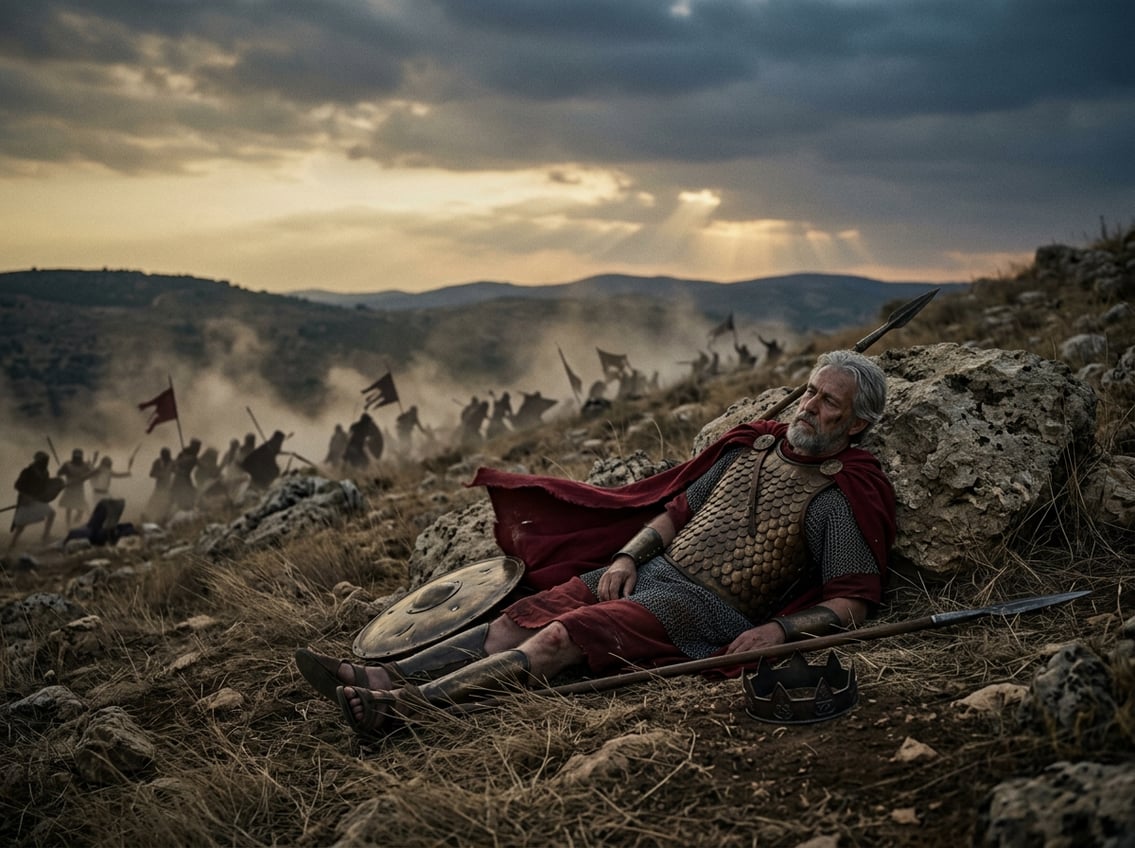
The Battle at Mount Gilboa
Israel's army collapsed under a Philistine assault at Mount Gilboa, leaving Saul's sons dead and the king himself gravely wounded. This defeat set the stage for Saul's final moments, choices shaped by fear, injury, and the threat of capture.
Israel's Defeat by the Philistines
The Philistines had gathered their forces at Shunem, positioning themselves for a direct strike against Israel. Saul moved his army to Mount Gilboa to meet the threat.
The clash did not go Israel's way. According to 1 Samuel 31, the Israelite army broke and fled once the fighting began.
Key outcomes of the battle:
- Israel's soldiers retreated from the battlefield
- Many Israelite men were killed on the mountain slopes
- The Philistines pushed forward and occupied abandoned Israelite towns
- Saul's forces failed to hold their ground against the advancing enemy
This collapse left Saul and his remaining men exposed and vulnerable to direct attack.
The Deaths of Jonathan, Abinadab, and Malki-Shua
As Israel's lines broke, Philistine soldiers pressed hard against Saul and his sons. Three of Saul's sons died in the fighting.
| Son | Outcome |
|---|---|
| Jonathan | Killed in battle |
| Abinadab | Killed in battle |
| Malki-Shua | Killed in battle |
The Battle of Mount Gilboa marked the end of Saul's family line as heirs to the throne, since all three sons died alongside him. Their deaths cleared the way for a new king to eventually take Saul's place as ruler over Israel.
Saul's Wounds and Fear of Capture
Philistine archers located Saul during the battle and struck him with arrows, leaving him severely wounded.
Saul's response, according to 1 Samuel 31:4:
- Saul told his armor-bearer to kill him with a sword
- Saul feared capture and mistreatment by the Philistines, whom he called uncircumcised
- The armor-bearer refused, too afraid to strike his king
- Saul took the sword himself and fell on it, ending his own life
The armor-bearer then took his own life as well once he saw that Saul had died. This left Saul, his sons, his armor-bearer, and his soldiers all dead on the mountain that same day, according to the account of Saul's death.
Saul's Final Act and the Armor-Bearer
Saul's death came at the hands of his own sword after Israel's army lost to the Philistines on Mount Gilboa. The events leading to his death, recorded in 1 Samuel 31:4, show a king facing capture and choosing to end his own life instead.
Why Saul Asked to Be Killed
Saul was badly wounded by Philistine archers before he spoke to his armor-bearer.
Key facts:
| Detail | Description |
|---|---|
| Saul's condition | Critically wounded by archers |
| Saul's fear | Capture and abuse by the Philistines |
| His request | Told his armor-bearer to kill him with a sword |
| Armor-bearer's response | Refused out of fear |
Saul feared torture or mockery at the hands of his enemies more than death itself. As king, he did not want to be captured alive and humiliated by the Philistines, who he called "uncircumcised fellows" in 1 Samuel 31:4. His armor-bearer's refusal to strike him down likely stemmed from the belief that killing the Lord's anointed was forbidden, a idea reinforced earlier in scripture when David refused to harm Saul for the same reason.
Falling on His Own Sword
Saul took matters into his own hands after his armor-bearer refused to kill him.
What happened:
- Saul drew his own sword
- He fell on it
- This act ended his life on the battlefield
This act of suicide marked the end of Saul's reign as Israel's first king. The NIV account describes it plainly: Saul took his own sword and fell on it. 1 Chronicles 10 repeats this same account, confirming the details across two separate biblical books.
The Armor-Bearer's Death
The armor-bearer made his own choice after witnessing Saul's death.
Sequence of events:
- The armor-bearer saw that Saul was dead
- He fell on his own sword
- He died beside King Saul
This act is often read as a sign of loyalty. Some commentators view the armor-bearer's death as devotion to his king, while others see it as a result of despair with no hope left after the battle was lost. The text notes that Saul died together with his three sons, his armor-bearer, and his men that same day, marking the complete collapse of Saul's household in a single battle.
The Amalekite's Report to David
After Saul's death on Mount Gilboa, a man claiming to be an Amalekite arrived at David's camp in Ziklag with a very different version of events. His story, recorded in 2 Samuel 1, sets up one of the more debated contradictions in the Old Testament.
What the Amalekite Claimed
The Amalekite told David he had killed Saul himself, not that Saul died by his own sword.
His account, found in 2 Samuel 1:6-10, included these details:
- He said he was on Mount Gilboa by chance during the battle.
- He claimed Saul was leaning on his spear, badly wounded but still alive.
- Saul allegedly begged him to finish the job because "the throes of death" had already gripped him.
- He said he obeyed Saul's request and killed him.
- He brought Saul's crown and an arm band as proof, placing them before David.
The items were meant to confirm his story and likely to earn a reward.
Why the Two Accounts Differ
The Amalekite's version does not match the earlier account in 1 Samuel 31, which states Saul fell on his own sword after his armor-bearer refused to kill him.
Several explanations exist for this gap:
| Explanation | Summary |
|---|---|
| False testimony | The Amalekite lied to gain favor with David, possibly hoping for a reward for killing Saul, David's enemy |
| Battlefield looting | He may have found Saul's body already dead and took the crown and armband, then invented the killing story |
| Two separate reports | Scripture records his claim as a report, not as a confirmed fact |
Many biblical scholars treat the Amalekite's words as an unreliable account rather than a second true version of Saul's death. The text of scripture faithfully records what he said, but it does not claim his words are accurate.
David's Judgment on the Messenger
David's response was immediate and severe.
Instead of rewarding the Amalekite, he had him executed. His reasoning appears in 2 Samuel 1:14, where King David asks why the man was not afraid to harm the Lord's anointed.
Key points about the judgment:
- David and his men mourned Saul and Jonathan rather than celebrating.
- David treated the killing of Saul, even by request, as a serious offense.
- He used the Amalekite's own words as the basis for the death sentence.
- The account reflects the larger pattern in Saul and David's relationship, where David repeatedly refused to harm Saul himself, even when given the chance.
This response shows that David viewed Saul's position as king, not his personal conduct, as the reason his life was protected.
The Treatment and Burial of Saul's Body
The Philistines publicly displayed Saul's body after his death, but the people of Jabesh-Gilead risked their lives to give him a proper burial. These events also set the stage for a power struggle over who would rule Israel next.
Philistine Victory Displays at Beth Shan
The Philistines treated Saul's body as a war trophy. This showed their total victory over Israel's first king.
Key details of the display:
- The Philistines cut off Saul's head and stripped his armor from his body.
- They fastened his body to the wall of Beth Shan, a Canaanite city under their control.
- Saul's armor was placed in the temple of the Ashtoreths, a pagan fertility goddess worshipped by the Philistines.
- News of Saul's death was announced in Philistine temples and towns as a victory message.
This public humiliation was meant to demoralize Israel and honor the Philistine gods.
The Courage of Jabesh-Gilead
The people of Jabesh-Gilead remembered that Saul had rescued their city early in his reign. They repaid that debt after his death.
Their actions, step by step:
- Warriors from Jabesh Gilead traveled through the night to Beth Shan.
- They removed the bodies of Saul and his sons from the city wall.
- They carried the bodies back to Jabesh for proper treatment.
- The bodies were burned, then the bones were buried under a tamarisk tree.
- The town fasted for seven days to mourn Saul.
This act restored some dignity to Saul's memory despite the Philistines' earlier treatment of his body.
Saul's Family and the Transition of Power
Saul's death created an immediate leadership gap in Israel. Two separate paths for the throne emerged at once.
| Event | Outcome |
|---|---|
| David anointed king over Judah | Recorded in 2 Samuel 2:4–7 |
| Abner installs Ish-bosheth as king over Israel | Sets up rival rule against David |
| Ish-bosheth assassinated | Described in 2 Samuel 4 |
| Mephibosheth, Saul's grandson, survives | Later shown mercy by David |
Saul's crown and armband were taken from his body on the battlefield and brought to David as proof of his death. Abner's support of Ish-bosheth delayed David's full control of Israel for several years, but Saul's line effectively lost the throne once Ish-bosheth was killed.
The Long Road to Saul's Downfall
Saul's decline did not happen overnight. It followed a steady pattern of small compromises that grew into open defiance of the Lord's direct commands.
Saul's Calling and Early Leadership
Saul, the son of Kish from the tribe of Benjamin, began as an unlikely choice for king. Samuel anointed him at the Lord's direction, and the Spirit of the Lord came upon him with power.
His early leadership showed real promise. He led Israel to a decisive victory over the Ammonites, earning respect from the people and confirming his position as king.
At this stage, Saul acted with humility and courage. Nothing in his early actions hinted at the failures that would follow later in his reign.
Disobedience at Gilgal and Against Amalek
Saul's obedience started to crack at Gilgal. Instead of waiting for Samuel to arrive and offer the sacrifice as instructed, Saul offered it himself out of impatience and fear of losing his army.
The larger break came in 1 Samuel 15, when the Lord commanded Saul to completely destroy the Amalekites and everything they owned. Saul only followed part of the order.
| Command from the Lord | Saul's Actual Action |
|---|---|
| Destroy all Amalekites | Spared King Agag |
| Destroy all livestock | Kept the best sheep and cattle |
| Complete obedience required | Delivered partial obedience |
Samuel confronted Saul directly. He told him that rebellion is as serious as witchcraft, a warning recorded in 1 Samuel 15:23. This moment marked the start of Saul's persistent rebellion against God's word.
Endor and the Search for Forbidden Guidance
After Samuel's death, Saul faced a crisis. The Spirit of the Lord had already left him, and an evil spirit troubled him instead.
Facing a Philistine army with no answer from the Lord through dreams, prophets, or priests, Saul turned to forbidden means. As noted in [1 Samu
Lessons and Scripture Memory Anchors
Saul's death teaches the difference between fear-driven regret and true repentance, and it shows how David modeled respect for God's authority even under pressure. These lessons can be turned into short verses and daily reviews that stick in memory.
Distinguishing Regret From Genuine Repentance
| Regret (Saul) | Genuine Repentance (David) |
|---|---|
| Fears man's opinion | Fears God's judgment |
| Seeks a medium for answers (1 Samuel 28) | Seeks God directly |
| Ends in despair and death | Ends in restoration |
| Hides from consequences | Confesses openly |
- Psalm 51:17 (New Living Translation): "The sacrifice you desire is a broken spirit. You will
Frequently Asked Questions
Saul's death raises specific questions about the biblical text, the sequence of events, and how the two accounts fit together. The answers below use direct verse references and structured comparisons to clarify the details.