How Do You Read the Bible in Order? Memory That Sticks
No single order is required by faith traditions; the right choice depends on personal goals, prior knowledge, and how much time someone can commit to bible reading each day.
Posted by
 Eden
EdenRelated reading
Are Dinosaurs Mentioned in the Bible? A Retention Guide
The Bible does not explain how these creatures came to an end.
How Did Samuel Die in the Bible? Memory Science Guide
Samuel was buried at his own house in Ramah, the town connected to most of his life and work, according to the account of his death and burial in 1 Samuel 25.
How Did Saul Die in the Bible? Scripture Memory Method
The death of King Saul marks the end of Israel's first monarchy in the Old Testament.
TL;DR
- There are three main ways to read the Bible in order: canonical (the order books appear in print), chronological (the order events happened), and thematic (grouped by topic or reading goal).
- Beginners often find the most success starting with the New Testament, then moving to the Old Testament, since this builds context around the life of Jesus before tackling earlier history.
- Chronological reading plans rearrange scripture to follow a timeline of events, which can help connect the story of the Old and New Testaments.
- A study Bible or reading plan can guide the order and pace, making the process less overwhelming for new readers.
- No single order is required by faith traditions; the right choice depends on personal goals, prior knowledge, and how much time someone can commit to bible reading each day.
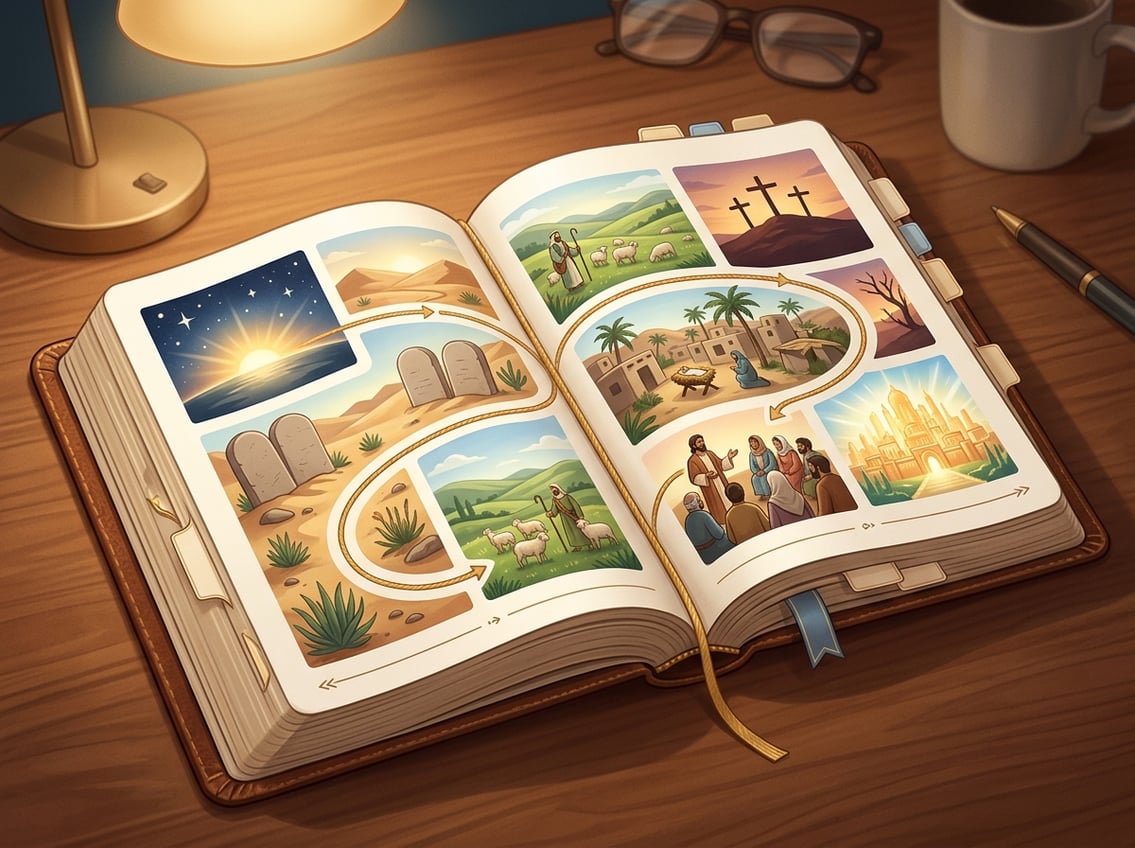
Choose the Reading Sequence That Fits Your Goal
Some readers want to meet Jesus Christ first. Others want the full historical and cultural context of every book, or a bible reading plan for beginners that fits into one year.
Jesus-First Order for New Readers
This order starts with the gospel-first approach that is easier for beginners than starting at Genesis.
Suggested reading order:
- Gospel of John (introduces Jesus Christ and his purpose)
- Gospel of Mark (short, fast-paced account of the life of Jesus)
- Gospel of Matthew (adds Jewish context and teaching)
- Gospel of Luke (adds detail and leads into Acts)
- Acts (the early church after Jesus)
This method skips ahead to the New Testament before circling back to the Old Testament. It works well because a clear, beginner-friendly plan can start with Jesus and build context from there.
New readers often find this less confusing than jumping into ancient law codes or genealogies on day one.
Canonical Order for Reading Every Book
Canonical order is the traditional layout found in printed Bibles. It groups books by type, not by when they happened.
| Section | Contains | Focus |
|---|---|---|
| Old Testament | Law, history, poetry, prophets | Creation through the prophets |
| New Testament | Gospels, Acts, letters, Revelation | Life of Jesus through the early church |
Some guides suggest reversing the printed order and reading the New Testament first, then going back to the Old Testament, while still keeping each book's internal order intact.
Others recommend following the step-by-step canonical guide built for first-time readers, moving straight through from Genesis to Revelation.
This order suits readers who want to read every book once, in the order most Bibles print them.
Chronological Order for Following the Biblical Timeline
Chronological order arranges books by when the events happened, not by where they sit in the printed Bible.
Key challenges with this order:
- Ancient dating systems were based on kings, not calendars
- Some books overlap in time (Kings and Chronicles, for example)
- Prophets rarely state exact dates
A full chronological breakdown is available through a detailed guide to reading the Bible in the order events took place
Start With Jesus and the Early Church
The New Testament tells the story of Jesus and what happened after he left earth. Reading it in a clear order helps beginners understand who Jesus is, how his followers spread his message, and how the early church grew through the work of the Holy Spirit.
Read the Gospel of John Before the Other Gospels
John is a good place to start because it explains who Jesus is in plain terms. It focuses on faith, salvation, and a personal relationship with God.
Many guides point to John as the best starting point for beginners because it answers basic questions about Jesus early on.
Why start with John:
- Opens with a clear statement about who Jesus is
- Uses simple stories to explain big ideas like salvation
- Includes Jesus praying for his followers (a model for prayer)
- Written later than the other Gospels, so it explains meaning rather than just events
| Feature | Detail |
|---|---|
| Focus | Belief and identity of Jesus |
| Style | Explains meaning, not just events |
| Good for | First-time readers |
Compare Matthew, Mark, and Luke Without Losing the Main Story
Matthew, Mark, and Luke are called the Synoptic Gospels because they cover many of the same events. Reading them side by side shows different angles on the same story of Jesus.
| Gospel | Audience
Read the New Testament Letters and Revelation With Context
The New Testament letters make more sense when paired with the events in Acts, and Revelation reads clearer once its symbols are traced back through the rest of the New Testament.
Follow Paul's Letters Alongside the Events of Acts
Paul wrote most of his letters during or right after events recorded in Acts. Reading them together shows why he wrote what he wrote.
| Paul's Letter | Acts Connection | Main Topic |
|---|---|---|
| Galatians | Acts 13-14 (first missionary journey) | False teaching about the law |
| 1 & 2 Corinthians | Acts 18 (time in Corinth) | Church problems and division |
| Romans | Acts 20 (before trip to Jerusalem) | Salvation and faith |
| Ephesians, Philippians, Colossians, Philemon | Acts 28 (Roman imprisonment) | Christian identity and unity |
| 1 & 2 Thessalonians | Acts 17 (visit to Thessalonica) | Christ's return |
| 1 Timothy, Titus, 2 Timothy | After Acts ends | Church leadership |
Reading a letter right after its matching Acts chapters gives the reader the full backstory. It also shows how Paul's teaching changed based on each church's specific problems.
Read the General Epistles for Faith and Daily Practice
The general epistles were not written by Paul, but they cover similar ground: how to live out faith in daily life.
- Hebrews explains how Jesus fulfills Old Testament promises.
- James focuses on practical faith, like controlling speech and helping the poor.
- 1 Peter and 2 Peter address suffering and false teachers.
- 1 John, 2 John, 3 John cover love, truth, and false teaching.
- Jude warns against false teachers, much like 2 Peter.
These letters work well as a short daily reading block. Each one is short enough to read in a single sitting, which makes it easier to catch the main point without losing track of the argument.
Save Revelation Until You Know the New Testament Story
Revelation uses images and phrases that appear earlier in the Bible. Reading it last, after the Gospels and the letters, makes those images easier to recognize.
Three things to know before starting Revelation:
- The letters to the seven churches in Revelation 2-3 connect to real cities Paul and others wrote to or visited.
- The imagery draws heavily from Old Testament books like Daniel and Ezekiel.
- The ending in Revelation 21-22 answers the story that starts in Genesis, showing the return to a restored creation.
Reading Revelation without this background can make it confusing. Reading it after finishing the rest of the New Testament turns it into a conclusion rather than a puzzle.
Follow the Old Testament Story in Manageable Stages
The Old Testament covers thousands of years and 39 books. Breaking it into stages makes the story easier to follow and remember.
Begin With Creation, Abraham, and Israel's Deliverance
The story starts with Genesis, which covers creation, Adam and Eve, Noah, and the call of Abraham.
| Book | Main Focus |
|---|---|
| Genesis | Creation, patriarchs, Joseph in Egypt |
| Exodus | Israel's escape from Egypt, the Ten Commandments |
| Leviticus | Priestly laws and worship rules |
| Numbers | The 40 years in the wilderness |
| Deuteronomy | Moses restates the law before Israel enters Canaan |
These five books, often called the Torah or Pentateuch, set up every later part of the Old Testament. They explain who God is, who Israel is, and why the law matters.
Trace Israel's History From Joshua Through the Kings
After the Pentateuch, the story moves into Israel's national history. This section is part of what scholars call the historical books, which run from Joshua through 2 Chronicles.
Key stages to follow:
- Joshua – Israel enters and conquers Canaan
- Judges – A cycle of sin, oppression, and rescue by local leaders
- Ruth – A short story of loyalty during the time of the judges
- 1 & 2 Samuel – Israel gets its first kings, Saul and David
- 1 & 2 Kings – The kingdom splits and both halves eventually fall
- 1 & 2 Chronicles – A second look at the same kings, with focus on David and Solomon
This stretch shows how Israel went from a loose group of tribes to a kingdom, then to a divided and defeated nation.
Add Psalms and Wisdom Books to Your Daily Reading
The wisdom books are best read alongside the history, not after it. They give personal reflection on the same events happening in the historical books.
| Book | What It Offers |
|---|---|
| Psalms | Prayers and songs, many written by David |
| Proverbs | Short, practical sayings about daily life |
| Job | A story about suffering and trust in God |
| Ecclesiastes | Reflections on the meaning of life |
Reading a psalm after a related event in Samuel or Kings adds emotional depth to the history. For example, several psalms connect directly to specific moments in David's life, such as his sin with Bathsheba.
Read the Prophets Within Their Historical Setting
The prophets speak directly into the events covered in Kings and Chronicles. Reading them separately from that history can make their messages confusing.
Prophets and their general time period:
- Isaiah – Warned Judah before Assyrian and Babylonian threats
- Jeremiah – Preached right before Jerusalem's fall to Babylon
- Ezekiel – Wrote during the Babylonian exile
- Daniel – Lived through the exile in Babylon's royal court
- Hosea – Spoke to the northern kingdom before its collapse
- Jonah – Sent to Nineveh, outside Israel's own history
- Malachi – Addressed the people after their return from exile
Placing a prophet's book next to the king or event it addresses gives the message a clear anchor in real history.
Complete the Exile and Return Narratives
The final stage covers Israel's fall, exile, and return to the land.
- 2 Kings and 2 Chronicles describe Jerusalem's destruction and the start of exile.
- Ezekiel and Daniel show life during the exile in Babylon.
- Ezra covers the return of exiles and the rebuilding of the temple.
- Nehemiah describes the rebuilding of Jerusalem's walls.
- Esther shows Jewish life for those who stayed in Persia.
- Malachi closes the Old Testament with a call to renewed faithfulness.
This stage brings the long story full circle, from a united kingdom to defeat,
Include Deuterocanonical Books When They Belong in Your Bible
Different Bible editions include different books, so readers following a reading plan need to know if their edition includes the deuterocanonical books and where they fit in the reading order. These extra books add historical and cultural context to the time between the Old and New Testaments.
Understand Why Bible Tables of Contents Differ
Not all Bibles have the same table of contents. Catholic and Orthodox Bibles include books that most Protestant Bibles leave out.
| Bible Tradition | Deuterocanonical Books Included |
|---|---|
| Catholic | Tobit, Judith, Wisdom, Sirach, Baruch, 1 & 2 Maccabees, additions to Esther and Daniel |
| Eastern Orthodox | All Catholic books, plus 1 Esdras, 3 & 4 Maccabees, Psalm 151, Prayer of Manasseh |
| Protestant | None (these books are called the Apocrypha and often left out entirely) |
These books were part of the Septuagint, the Greek Old Testament used by early Christians. Protestant reformers removed them in the 1500s and 1600s because Jewish scholars had not accepted them as scripture.
Place Deuterocanonical Books in a Historical Reading Plan
Readers who want a historical reading order can slot these books into the timeline where they belong.
- Tobit and Judith – Read alongside Old Testament histories like Ezra and Nehemiah. They cover Jewish life during exile and foreign rule.
- Sirach – Read with wisdom books like Proverbs and Ecclesiastes. It offers practical advice on daily living.
- Baruch – Read near Jeremiah and Lamentations. It reflects on the Babylonian exile.
- 1 & 2 Maccabees – Read after Nehemiah. These books cover the Jewish revolt against Greek rule, a period not covered elsewhere in the Old Testament.
This placement matches how most modern Bible editions already organize them by theme and historical period.
Use Your Church Tradition and Edition as a Guide
The simplest way to decide whether to include these books is to check what a reader's Bible edition and church tradition already recommend.
- Open the table of contents and check if deuterocanonical books are listed.
- If using a Protestant Bible, decide whether to add these books from a separate edition or skip them.
- If attending a Catholic or Orthodox church, follow the lectionary readings tied to that tradition, since these already include the deuterocanonical texts on scheduled days.
- Cross-check any reading plan against the printed edition being used to avoid skipping or duplicating books.
This approach keeps the reading plan lined up with the specific Bible edition on hand.
Make the Plan Stick Through Active Reading
A bible reading plan works best when reading turns into an active habit, not a passive task. Short daily sessions, a mix of Bible sections, a journal for notes, the right translation, and a flexible pace all help God's Word stick in memory.
Use Short Daily Sessions and Simple Recall Prompts
Long reading blocks are hard to remember. Short, daily sessions work better for most people.
Simple session structure:
| Step | Action | Time |
|---|---|---|
| 1 | Read one chapter | 5-10 min |
| 2 | State the main point out loud | 1 min |
| 3 | Write one takeaway | 1 min |
Recall prompts help lock in what was read. Try these three questions after each session:
- What happened in this passage?
- What does it show about God?
- What is one thing to remember today?
This method fits well into a bible reading plan for beginners because it keeps each day's task small and clear.
Pair Narrative, Psalms, and Proverbs for Variety
Reading only one type of Bible writing each day can get repetitive. Mixing genres keeps the mind engaged.
Sample daily pairing:
| Type | Example Book | Purpose |
|---|---|---|
| Narrative | Genesis, Exodus | Shows events and history |
| Poetry | Psalms | Expresses prayer and emotion |
| Wisdom | Proverbs | Gives short, practical advice |
Reading a psalm and a proverb alongside a story chapter breaks up the pace. Psalms often connect to prayer, while proverbs offer short lessons that are easy to recall later in the day.
This pairing method also works inside a full bible in a year plan, since many year-long schedules already group these sections together.
Record Questions and Key Connections in a Reading Journal
A reading journal turns Bible study into an active process instead of a passive one.
What to record each day:
- One question about the passage
- One connection to another Bible passage
- One personal application
Example entry:
| Field | Entry |
|---|---|
| Passage | Exodus 14 |
| Question | Why did God harden Pharaoh's heart? |
| Connection | Romans 9 discusses this same event |
| Application | Trust God's plan even when it's unclear |
Writing this down takes less than five minutes but builds a written record of growth over time. It also makes it easier to review past lessons instead of forgetting them.
Choose a Readable Translation and Helpful Study Tools
The right translation makes daily reading easier to understand and stick with.
Common translation comparison:
| Translation | Style | Best For |
|---|---|---|
| NIV |
Frequently Asked Questions
Reading the Bible in order raises common questions about which sequence works best, how to handle both testaments, and where to find structured plans. The answers below cover the most direct paths for building a reading order that fits different goals.
What is the best order to read the Bible for the first time?
For a first read, three approaches work well:
| Approach | Starting Point | Best For |
|---|---|---|
| Traditional order | Genesis, page one | Readers who want the full canon as arranged |
| Jesus-first order | One Gospel, then Old Testament context | Readers who want to meet Jesus before the backstory |
| Chronological order | Genesis 1-11, then Job | Readers who want events in the order they happened |
Each path covers the same 66 books. The difference is sequence, not content. A step-by-step beginner guide lays out all three options with a suggested schedule.