Where Is the Star of David Talked About in the Bible?
The symbol's meaning today comes from centuries of Jewish tradition and use, not from scripture itself.
Posted by
 Eden
EdenRelated reading
Are Dinosaurs Mentioned in the Bible? A Retention Guide
The Bible does not explain how these creatures came to an end.
How Did Samuel Die in the Bible? Memory Science Guide
Samuel was buried at his own house in Ramah, the town connected to most of his life and work, according to the account of his death and burial in 1 Samuel 25.
How Did Saul Die in the Bible? Scripture Memory Method
The death of King Saul marks the end of Israel's first monarchy in the Old Testament.
TL;DR
- The exact phrase "Star of David" does not appear anywhere in the Bible or Hebrew scriptures.
- The related term "Shield of David" (Magen David) shows up in the Babylonian Talmud, not in the biblical text itself.
- The six-pointed star symbol formed later in Jewish tradition and became linked to Jewish identity over time, not through a direct biblical reference.
- Early versions of similar star shapes appear on ancient artifacts, but these predate its formal connection to King David.
- The symbol's meaning today comes from centuries of Jewish tradition and use, not from scripture itself.
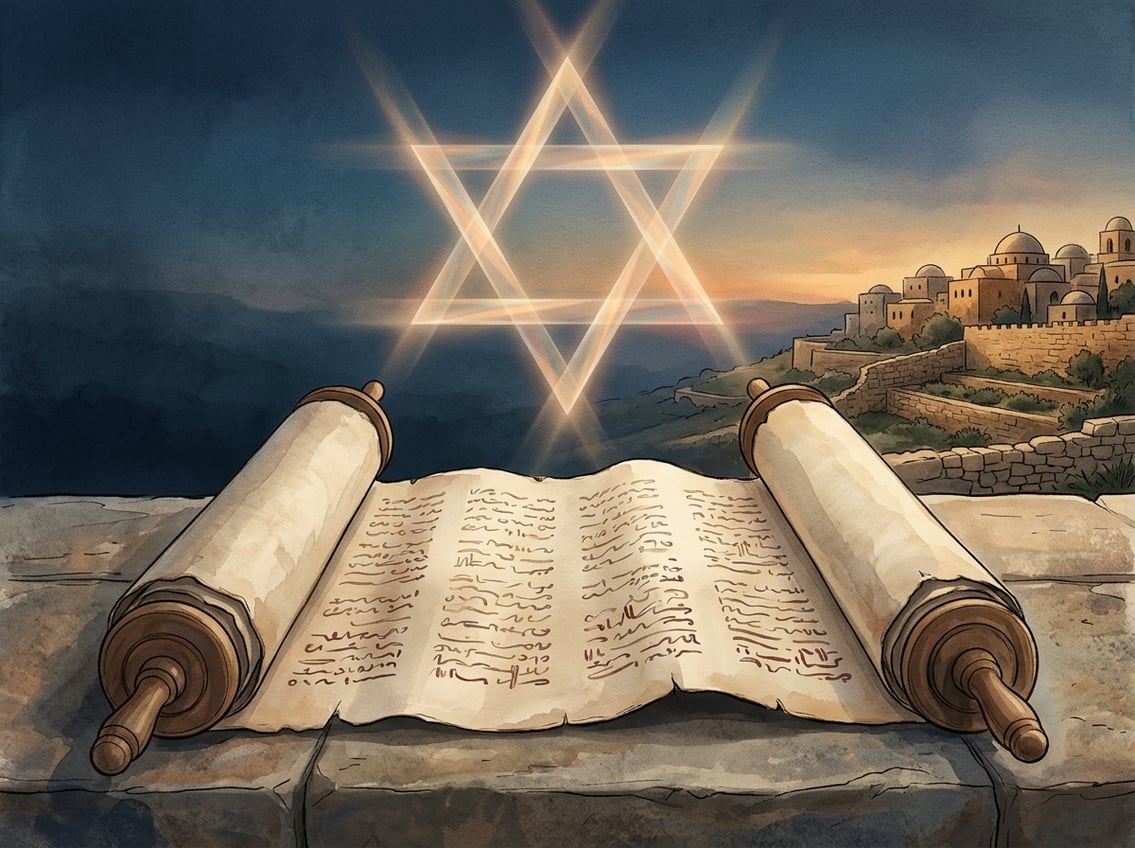
The Direct Biblical Answer
Scripture contains no six-pointed star and no hexagram. The symbol now called the Star of David developed after the biblical period and has no textual basis in either the Old Testament or the New Testament.
No Six-Pointed Emblem Appears in the Hebrew Bible or New Testament
A word search of the Hebrew Bible turns up no mention of a hexagram or overlapping triangles.
| Search Area | Result |
|---|---|
| Genesis through Malachi | No hexagram, no six-pointed star |
| Books of Samuel (David's life) | No shape or emblem described |
| New Testament | No mention of the symbol |
The star imagery in scripture refers to actual stars in the sky, not a geometric shape. Examples include the star that guided visitors to Jesus and the promise made to Abraham that his descendants would outnumber the stars.
The six-pointed design is absent from Genesis, Exodus, and every other biblical book, based on a direct check of the text.
King David Is Never Linked to a Hexagram in Scripture
David's story fills large sections of 1 and 2 Samuel. None of these chapters mention a six-pointed star as his emblem or symbol.
What scripture does record about David:
- His anointing by Samuel over Saul
- His victory over the Philistines, including Goliath
- His battles against the Amalekites
- His rule from the City of David in Zion
- His bringing the Ark of the Lord into Jerusalem
None of these events include a description of a shield, star, or geometric emblem tied to his name.
The phrase "Shield of David" does appear later in the Talmud, a Jewish text written after the Bible. That phrase refers to God's protection of David, not a physical object or drawing. Britannica confirms that the Bible never associates a hexagram with King David in any passage.
Why Biblical Stars Should Not Be Equated With the Magen David
Scripture mentions stars in several places. None of these references describe a six-pointed geometric shape.
| Biblical Star Reference | What It Describes |
|---|---|
| Genesis 15 | Stars as a symbol of Abraham's future descendants |
| Numbers 24 | A prophecy about "a star out of Jacob" |
| Matthew 2 | The star that led visitors to Jesus |
These passages use stars as poetic or prophetic images. They do not describe a physical symbol, and they never connect to the six-pointed hexagram design.
The confusion happens because both ideas use the word "star." But a biblical reference to a star in the sky is not the same as a modern jewish symbol used on flags, jewelry, and buildings today. The Magen David draws its meaning from post-biblical Jewish history, not from a direct scriptural source.
Bible Passages About Stars Often Connected to the Symbol
Several Bible passages use star imagery to point toward a coming king, a divine sign, or Christ himself. These verses are the ones most often linked back to the Star of David symbol, even though the six-pointed shape itself is not named in scripture.
Numbers 24:17 and the Star Out of Jacob
Numbers 24:17 records a prophecy spoken by Balaam about a future ruler.
| Element | Detail |
|---|---|
| Verse | "There shall come a Star out of Jacob, and a Sceptre shall rise out of Israel" |
| Speaker | Balaam |
| Subject | A ruler tied to Jacob, ancestor of the twelve tribes |
| Setting | Spoken near Moab, before Israel entered the Promised Land |
Bible scholars often read this prophecy as pointing to Christ, the future king from Israel's line. The "star" here is a symbol of leadership and rising power, not a literal object in the sky.
This is one reason some writers connect Numbers 24:17 to later ideas about a star representing hope for Israel, even though the verse does not describe a six-pointed shape.
Matthew 2:2 and the Star Seen by the Magi
Matthew 2:2 shifts from prophecy to a specific event: the birth of Jesus.
- The Magi ask, "Where is he that is born King of the Jews? for we have seen his star in the east, and are come to worship him."
- The star guides them to Jesus, described here as Son of David and King of the Jews.
- Their goal is worship, not just observation.
This star acts as a sign confirming Jesus Christ's identity as the promised king. It ties back to Numbers 24:17 by fulfilling the earlier prophecy of a
Amos and Acts: The Star Associated With Idolatry
The Bible links a "star" to false worship in two connected passages: Amos 5:26 and Acts 7:43. Both passages describe Israel carrying idols and star symbols instead of worshiping God correctly.
The Context of Amos 5:22 and Amos 5:26
Amos 5:22 records God rejecting Israel's burnt offerings and sacrifices because their worship had become empty.
| Verse | Content | Meaning |
|---|---|---|
| Amos 5:22 | God refuses burnt offerings and grain offerings | Ritual worship without true devotion is rejected |
| Amos 5:26 | Israel carried Sikkuth and Chiun, "the star of your god" | Israel secretly worshiped foreign star gods alongside the Lord |
These two verses work together. Amos 5:22 shows God's rejection of hollow ritual, while Amos 5:26 names the specific idols Israel carried through the wilderness. The message is clear: outward religious symbols meant nothing without loyalty to God.
Sikkuth, Chiun, and the Star of Your God
Sikkuth and Chiun are names for pagan deities tied to astral worship.
- Sikkuth: linked to a Mesopotamian god, sometimes read as "tabernacle" in older translations
- Chiun: connected to Saturn worship in ancient Near Eastern religion, also called Kaiwan
- Star of your god: refers to the astral symbol used to represent these gods
Bible commentators note this worship followed the golden calf incident and reflected a shift toward worship of the host of heaven
How the Magen David Became a Jewish Symbol
The hexagram moved through several distinct phases before becoming linked to Jewish identity, starting as a decorative shape and later gaining religious and political meaning.
Ancient Decorative Uses of the Hexagram
The six-pointed star was not originally a Jewish symbol. It appeared as a general decorative design across many ancient cultures.
Early examples show up in unexpected places:
- A 7th century BCE seal from Sidon bears the name Joshua ben Asayahu alongside a hexagram, one of the earliest known examples of the symbol linked to a person who worshipped the God of Israel.
- A 4th–5th century CE synagogue frieze in Capernaum shows the hexagram next to floral patterns and a five-pointed star, suggesting decoration rather than religious meaning.
- A 6th century CE tombstone in Taranto, Italy, pairs a hexagram with the name David, though scholars are not sure what it meant there.
During this period, the menorah was the main symbol tied to Jewish worship and community life, not the hexagram.
The symbol also appears outside Jewish contexts. In India, the same shape is called the shatkona in Hindu tradition, used in tantric diagrams and floor art.
Medieval Jewish Communities, Kabbalists, and Prague
During the Middle Ages, the hexagram started to gain religious weight within Jewish tradition, though it remained rare at first.
Key developments include:
| Period | Development |
|---|---|
| c. 1008 | Hexagrams decorate the Leningrad Codex, an early Hebrew Bible manuscript |
| c. 1300 | First named "Shield of David" in a Kabbalistic text by David ben Judah |
| 1490s–1530s | Adopted as the official emblem of Prague's Jewish community |
| 1656 | Placed next to a Christian cross on a Vienna border marker |
Kabbalists, practitioners of Jewish mysticism, used the Shield of David as a protective symbol against evil spirits. This use paralleled the Seal of Solomon, a related symbol tied to magical protection in both Jewish and Islamic tradition.
The Talmud mentions God's protection of David using the phrase "Shield of David," but this refers to a concept, not a physical or visual symbol.
Prague marks a turning point. The city's Jewish community adopted the Magen David as an official communal symbol in the late 1400s, the first documented case of the star representing an entire Jewish community rather than an individual or mystical idea.
From the Zionist Movement to the State of Israel
By the 19th century, the Star of David had spread across Europe as a general symbol of Judaism, partly in response to the widespread use of the cross as a Christian symbol.
The Zionist movement adopted the star as its central emblem in the late 1800s:
- 1885 – A flag with the star reportedly flown at Rishon LeZion, an early Jewish settlement in Palestine.
- 1891 – A precursor flag design created in Boston by Jakob and Charles Askowith.
- 1897 – David Wolffsohn presents a version at the First Zionist Congress in Basel.
These early flags placed a blue Star of David between two blue stripes, resembling a traditional prayer shawl.
The symbol took on painful meaning during the Nazi era, when Jews were forced to wear Star of David badges as a mark of persecution.
In 1948, the Zionist flag became the official flag of the newly declared State of Israel. The Star of David has since remained the central emblem of Israel and a widely recognized marker of Jewish identity around the world, appearing on synagogues, religious items, and personal jewelry as a sign of belonging within the Jewish faith.
Modern Meaning, Memory, and Responsible Interpretation
The Star of David carries weight far beyond its geometric shape. Its history includes forced identification, prayer language about God's protection, and a modern symbol that developed after the biblical period closed.
The Holocaust and the Yellow Badge
During the Holocaust, Nazi Germany forced Jewish people to wear a yellow badge shaped like the Star of David. This badge marked people for public identification and targeted them for persecution.
The symbol was not chosen by Jewish communities for this purpose. It was imposed as a tool of control and humiliation.
After World War II, the meaning shifted again. When Israel became a state in 1948, the Star of David appeared on the national flag, turning a symbol of forced marking into one of national identity and survival.
Key facts:
- Used by: Nazi Germany, as documented in what the Star of David is and its biblical origins
- Purpose: public identification of Jewish people
- Later shift: adopted on Israel's flag in 1948
Protection Language in Scripture and Jewish Prayer
The Hebrew name for the Star of David, Magen David, means "Shield of David." This phrase connects to a biblical theme found throughout the Psalms.
Psalm 18:2 states that God is "my rock, my fortress and my deliverer; my God is my rock, in whom I take refuge, my shield." This verse uses shield language to describe divine protection, not a physical object or symbol.
| Concept | Scripture Reference | Meaning |
|---|---|---|
| God as shield | Psalm 18:2 | God protects and defends |
| God as strength and shield | Psalm 28:7 | Trust leads to help from God |
Jewish prayer often repeats this shield language to describe God's protection over the Jewish people. The connection between this phrase and the star's name likely grew over time, not from a direct biblical command.
Separating Later Symbolism From Biblical Teaching
The Bible does not describe a six-pointed star or connect it directly to creation, unity, or the relationship between heaven and earth. These ideas came later, mostly through Jewish mysticism and tradition.
Scripture does teach that God is present in creation and involved in the lives of his people. It does not use geometric shapes to express this idea.
For Christian readers, the difference matters. Faith and biblical theme should rest on scripture itself, not on later religious symbols.
Christians can respect the Star of David within Jewish tradition without treating it as biblical teaching. The distinction protects clear interpretation and avoids adding meaning that the text does not support, a point addressed in questions about biblical references to the Star of David.
Frequently Asked Questions
These questions cover direct scripture references, related biblical symbols, and the historical background of the six-pointed star linked to King David.
Is the Star of David ever mentioned in the Bible?
No. The Bible does not name or describe the six-pointed star known today as the Star of David. This point is confirmed across multiple biblical resources, including a direct answer on the topic.
The symbol does not appear in any book, verse, or prophecy. It developed later in Jewish history.
Is the Star of David found in the Torah or the Old Testament?
No. The Torah and the rest of the Old Testament contain no reference to this specific geometric symbol. Detailed background on this gap is available in this explanation of the star's origins.
| Old Testament Section | Star of David Mentioned? |
|---|---|
| Torah (Genesis–Deuteronomy) | No |
| Historical Books (Joshua–Esther) | No |
| Wisdom Books (Job–Song of Solomon) | No |
| Prophets (Isaiah–Malachi) | No |
Is the Star of David the same as the star of Remphan?
No. These are two separate concepts from different periods and traditions.
| Feature | Star of David | Star of Remphan |
|---|---|---|
| Biblical mention | Not mentioned | Mentioned in Acts 7:43 |
| Nature | Jewish cultural/religious symbol | Pagan idol reference |
| Origin | Post-biblical Jewish history | Ancient Near Eastern worship |
| Context | Not tied to idolatry | Tied to idol worship condemned by Stephen |
What Bible verses mention the star of Remphan?
Acts 7:43 is the key verse. It appears in Stephen's speech before his execution.
- Acts 7:43: References the "star of your god Remphan," images the Israelites made to worship.
- This verse quotes and reflects Amos 5:26, which mentions a similar idol from Israel's history.
Both verses describe idol worship, not a symbol linked to King David.