Who Is Jacob in the Bible? A Memory-Friendly Guide
His story shows a shift from deception to transformation, making him a key figure for understanding covenant and identity in the Old Testament.
Posted by
 Eden
EdenRelated reading
Are Dinosaurs Mentioned in the Bible? A Retention Guide
The Bible does not explain how these creatures came to an end.
How Did Samuel Die in the Bible? Memory Science Guide
Samuel was buried at his own house in Ramah, the town connected to most of his life and work, according to the account of his death and burial in 1 Samuel 25.
How Did Saul Die in the Bible? Scripture Memory Method
The death of King Saul marks the end of Israel's first monarchy in the Old Testament.
TL;DR
- Jacob is a patriarch in the Book of Genesis, son of Isaac and Rebekah, and twin brother of Esau.
- He is best known for tricking Esau out of his birthright and blessing, then later wrestling with God and receiving the new name Israel.
- Jacob's twelve sons became the foundation of the twelve tribes of Israel, a core reference point in both Judaism and Christianity.
- His story shows a shift from deception to transformation, making him a key figure for understanding covenant and identity in the Old Testament.
Jacob's Identity, Family, and Covenant Role
Jacob's story begins with his birth to Isaac and Rebekah and continues through his rivalry with his twin brother Esau. His life ends with a new name, Israel, and a role as father of a nation tied to God's covenant promises.
Son of Isaac and Rebekah, Grandson of Abraham and Sarah
Jacob was born to Isaac and Rebekah, making him the grandson of Abraham and Sarah. This family line matters because God's covenant with Abraham passed down through specific descendants.
Family Line:
| Generation | Person(s) |
|---|---|
| Grandparents | Abraham and Sarah |
| Parents | Isaac and Rebekah |
| Jacob | Son, twin to Esau |
Rebekah struggled with a difficult pregnancy. In Genesis 25, she carried twins who fought inside her.
She asked God why this was happening. Genesis 25:22 records her question, and Genesis 25:23 gives God's answer: two nations were in her womb, and the older would serve the younger.
This set up Jacob's future role before he was even born.
Jacob and Esau: Twin Brothers With Diverging Futures
Jacob and Esau were twins, but their lives took very different paths. Genesis 25:26 describes Jacob being born holding onto Esau's heel, a detail that hints at the struggle between them.
Key Differences:
- Esau: Firstborn, skilled hunter, favored by Isaac
- Jacob: Second-born, quieter nature, favored by Rebekah
- Birthright conflict: Esau sold his birthright to Jacob for a bowl of stew
- Blessing conflict: Jacob later deceived Isaac to receive the blessing meant for Esau
These events created lasting tension between the brothers. Esau planned to kill Jacob after losing the blessing, which forced Jacob to flee his home. This conflict shaped much of Jacob's early life and pushed him toward the events that would define his identity.
Why Jacob Became Israel and Forefather of a Nation
Jacob's name changed to Israel after he wrestled with God, as described in several Bible passages referenced in topical studies on Jacob's transformation. This name change marked a turning point in his identity and mission.
What the Name Change Meant:
- Israel means "one who struggles with God"
- The new name confirmed God's covenant promises first given to Abraham
- Jacob became the direct link between the covenant with Abraham and the nation of Israel
Jacob had twelve sons. These sons became the twelve tribes of Israel, forming the foundation of the Israelites as a people.
This connects directly to the land of Israel and the promises found throughout the Torah. Jacob's role as forefather placed him at the center of God's ongoing plan, linking Abraham's original covenant to the future nation of Israel.
The Birthright, Blessing, and Cost of Deception
The rivalry between Jacob and Esau moved through three key stages: a traded birthright, a stolen blessing, and a family fractured by favoritism. Each stage carried consequences that shaped Jacob's path away from Canaan.
Esau's Birthright Exchange
Genesis 25:29-34 describes the moment Esau traded his birthright for a bowl of stew.
| Detail | Description |
|---|---|
| Esau's state | Returned from the field, described as famished |
| Jacob's offer | Red stew, in exchange for the birthright |
| Esau's response | "What good is a birthright to me?" |
| Outcome | Esau ate, drank, and left; the text notes he "despised his birthright" |
The birthright carried real legal weight. It typically gave the firstborn a larger inheritance share and a leadership role in the family.
Esau's choice is presented as impulsive, not forced. Jacob did not need to trick him here; Esau simply valued immediate hunger over long-term status.
Rebekah's Plan to Obtain Isaac's Blessing
Genesis 27 shifts from a private trade to a formal, spoken blessing meant for Esau, Isaac's firstborn.
Rebekah's plan, step by step:
- She overheard Isaac tell Esau to hunt game before receiving the blessing.
- She instructed Jacob to bring two young goats instead.
- She prepared the meal to taste like wild game.
- She dressed Jacob in Esau's clothing and covered his arms and neck with goat skin to mimic Esau's hairier build.
- Jacob entered Isaac's tent claiming to be Esau.
Isaac, blind and relying on touch, smell, and voice, questioned Jacob but ultimately gave the blessing. Once spoken, the blessing was treated as final and could not be reversed, even after Isaac learned the truth.
This act is the clearest example of Jacob's deception and explains why his name relates to the word supplanter, meaning one who takes another's place.
Family Favoritism and Jacob's Flight From Canaan
Favoritism split the household well before the blessing was stolen.
- Isaac favored Esau, tied to Esau's skill as a hunter.
- Rebekah favored Jacob, tied to his quieter, tent-based life.
This divide fed direct family strife once the deception came to light:
- Esau reacted with grief and anger after learning what happened.
- Esau expressed intent to kill Jacob once Isaac died.
- Rebekah learned of the threat and urged Jacob to leave.
- Jacob fled Canaan for Paddan-aram, his mother's homeland, to escape Esau and to find a wife among his relatives.
Jacob's flight marks the end of the birthright-and-blessing conflict and the start of his years away from home. Despite the deception, the narrative treats Jacob's future as secured, an example scholars often point to as an early sign of God's grace extended to a flawed figure rather than a reward for good behavior.
Bethel and the Renewal of God's Promises
Bethel marks the place where Jacob first encountered God in a dream and later returned to renew his commitment to the covenant. The events at Bethel connect Jacob’s faith to the larger promises God made to Abraham and Isaac, and they point forward to the coming of the Messiah.
Jacob’s Ladder and the Angels of God
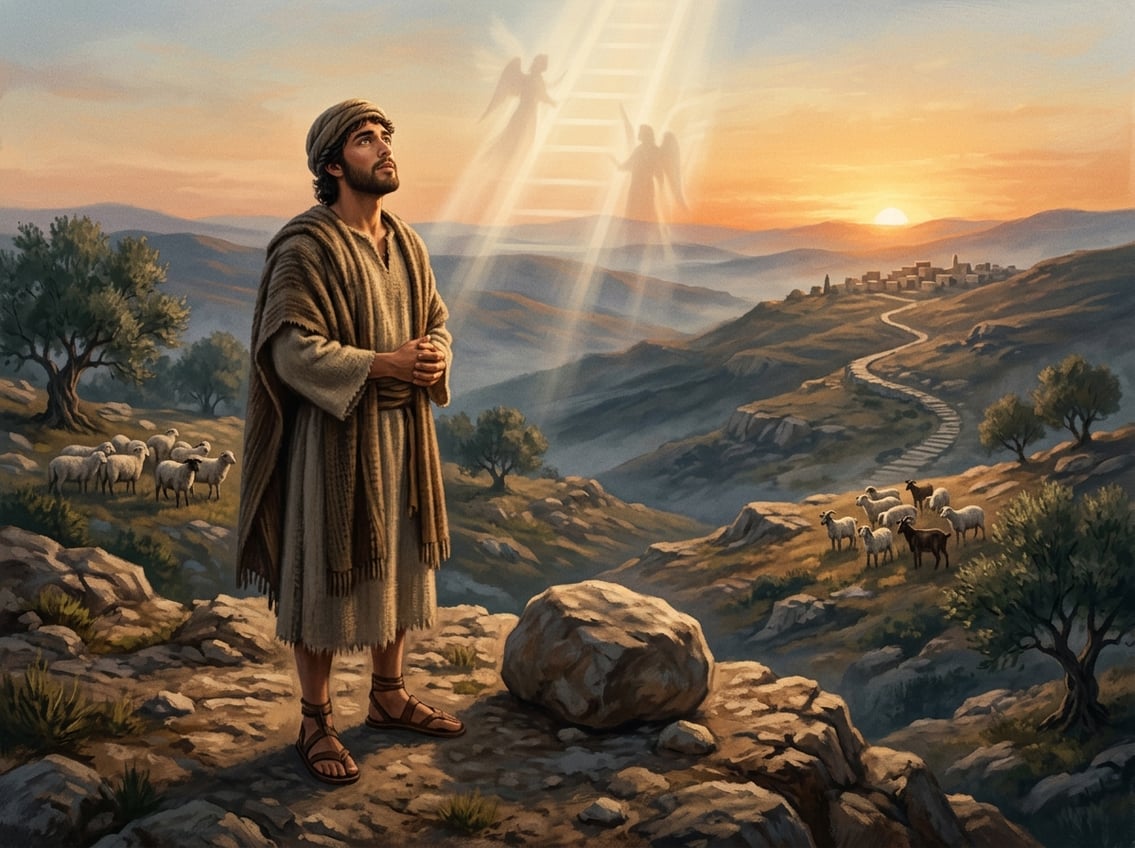
In Genesis 28, Jacob has a dream while fleeing from his brother Esau. He sees a ladder, or stairway, reaching from earth to heaven.
Angels move up and down the ladder. This shows a connection between heaven and earth.
Key details of the dream:
- Location: A place Jacob later names Bethel
- Vision: A ladder connecting earth and heaven
- Angels: Moving up and down the ladder
- God’s position: Standing above the ladder, speaking directly to Jacob
This dream is often called Jacob’s ladder. It shows Jacob that God is present even when he feels alone.
Bethel as the House of God
After the dream, Jacob names the place Bethel, which means "house of God." He sets up the stone he used as a pillow and pours oil on it as an act of worship.
Years later, God tells Jacob to return to Bethel and build an altar there. This return trip is described in Genesis 35.
Before going back, Jacob tells his household to get rid of foreign gods. This step shows a return to full faith in God alone.
| Event | Location | Purpose |
|---|---|---|
| First visit | Bethel | Dream of the ladder, God's promise |
| Return visit | Bethel | Renewal of covenant, removal of foreign gods |
The Promise of Land, Descendants, and Blessing
At Bethel, God repeats the same promises he made to Abraham and Isaac. These promises form the core of the covenant with Abraham.
God's promises to Jacob include:
- Land: The ground Jacob is lying on will belong to his descendants. This land later becomes the land of Israel.
- Descendants: His offspring will be as many as the dust of the earth.
- Blessing: All families on earth will be blessed through his family line.
- Presence: God says he will stay with Jacob and bring him back to this land.
These promises connect directly to earlier covenant promises given to Abraham and Isaac. Christians see these promises as part of a larger plan that leads to Jesus Christ, the Messiah, who comes from this same family line.
Haran, Laban, and a Divided Household
Jacob spent twenty years in Haran working for his uncle Laban. During this time, he gained two wives, two additional partners, twelve children, and great wealth, but he also faced deception and family conflict that shaped the rest of his life.
Leah and Rachel: Marriage Through Laban's Deception
Jacob met Rachel at a well shortly after arriving in Haran. He fell in love with her right away and agreed to work seven years for Laban in exchange for her hand in marriage.
On the wedding night, Laban secretly gave Jacob his older daughter Leah instead of Rachel. Jacob did not realize the switch until morning.
Laban explained that local custom required the older daughter to marry first. He offered Jacob a solution:
- Finish the wedding week with Leah
- Marry Rachel one week later
- Work seven more years to pay for her
Jacob agreed. He now had two wives, Leah and Rachel, but he loved Rachel more. This imbalance created lasting tension between the sisters, since Leah felt unloved while Rachel struggled with jealousy over Leah's ability to have children.
Bilhah, Zilpah, and the Birth of Jacob's Children
Leah and Rachel each gave Jacob a personal servant to bear children on their behalf. This practice was common at the time and added to the competition between the two sisters. Leah gave Jacob her servant Zilpah, and Rachel gave him her servant Bilhah.
| Mother | Children |
|---|---|
| Leah | Reuben, Simeon, Levi, Judah, Issachar, Zebulun, Dinah |
| Bilhah | Dan, Naphtali |
| Zilpah |
The Jabbok River, Peniel, and Reconciliation
Genesis 32 records one of the most important nights in Jacob's life. At the Jabbok River, he wrestles with a divine being, receives a new name, and prepares to face his estranged brother Esau.
Jacob Wrestles With God Before Meeting Esau
Jacob sends his family and belongings across the Jabbok River and stays behind alone. That night, a man wrestles with him until daybreak.
Key details from the encounter:
| Event | Description |
|---|---|
| Location | The Jabbok River crossing point |
| Duration | All night, until daybreak |
| Physical result | Jacob's hip is wrenched |
| Jacob's demand | "I will not let you go unless you bless me" |
Many Bible scholars identify the man as a theophany, meaning a physical form of God himself. This matches Jacob's own words after the fight ends.
The Name Israel and Spiritual Transformation
After the struggle, the man changes Jacob's name. Genesis 32:28 states that Jacob will now be called Israel, "because you have struggled with God and with humans and have overcome."
What the name change signals:
- A shift in identity, not just a title change
- Recognition of Jacob's faith and persistence
- A blessing tied directly to the struggle itself
Jacob then names the place Peniel, meaning "face of God." He explains the name by saying he saw God face to face and survived.
This moment marks a clear turning point. Jacob leaves as a changed man, carrying both a new name and a physical reminder of the encounter.
Reconciliation With Esau After Years of Fear
Jacob had feared this meeting with Esau for years. He had taken Esau's birthright and blessing through deception, and now Esau approached with 400 men.
Steps Jacob took before the meeting:
- Divided his family and animals into two groups for safety
- Sent multiple waves of gifts ahead to Esau
- Prayed for protection and mercy
- Bowed low seven times when he finally saw Esau
The fear turns out to be unfounded. Esau runs to meet Jacob, embraces him, and weeps. He accepts the gifts and welcomes his brother back without anger.
This reunion shows forgiveness in action. Esau, who later becomes associated with the nation of Edom, chooses peace over revenge. The scene reflects God's grace working through both brothers to end decades of separation.
Jacob's Legacy in Israel's Story and Scripture
Jacob's life shaped the future of an entire nation. His sons became the foundation of the twelve tribes of Israel, and his story continues to appear throughout Scripture as a picture of God's covenant faithfulness.
The Twelve Tribes and Jacob's Final Blessings
Jacob had twelve sons. Each one became the head of a tribe that carried his name.
Before he died, Jacob gathered his sons and gave each one a final blessing. These blessings are recorded in Genesis 49, and they describe both the character and future of each tribe.
| Son | Tribe Outcome |
|---|---|
| Reuben | Lost leadership rights due to past actions |
| Simeon & Levi | Warned for violence |
| Judah | Given the promise of kingship and leadership |
| Zebulun | Blessed with coastal territory |
| Issachar | Described as strong but subject to labor |
| Dan | Judged his own people |
| Gad | Blessed with strength in battle |
| Asher | Blessed with rich food |
| Naphtali | Described as free and eloquent |
| Joseph | Given a double portion through Ephraim and Manasseh |
| Benjamin | Described as fierce, like a wolf |
Jacob's favoritism toward Joseph earlier in life caused family conflict. Still, Joseph's descendants received a lasting blessing through his two sons, Ephraim and Manasseh.
Joseph, Egypt, and the Preservation of Jacob's Family
Joseph's rise to power in Egypt saved Jacob's family from famine. Genesis 46 describes Jacob moving his entire household to Egypt after Joseph revealed his identity.
Key events include:
- Pharaoh welcomed Jacob's family and gave them land in Goshen
- Jacob's household grew from seventy people into a large nation
- This growth set the stage for the events described in Exodus
- Centuries later, Moses led Jacob's descendants out of slavery in Egypt
This move to Egypt protected Jacob's family during a time of famine, but it also began a period of hardship that lasted
Frequently Asked Questions
Jacob's story spans his birth as Isaac's second son, his family conflicts, his name change to Israel, and his role as the father of the twelve tribes. Below are direct answers to the most common questions about his life, family, and where his story appears in the Bible.
What is the story of Jacob in the Bible?
Jacob's life moved through several key stages, each marked by conflict, growth, or a turning point:
- Birth and early life: Jacob was born grasping his twin brother Esau's heel, and his name means "he deceives."
- The stolen blessing: With his mother Rebekah's help, Jacob tricked his father Isaac into giving him the blessing meant for Esau.
- Flight to Haran: Jacob fled Esau's anger and worked for his uncle Laban, marrying Leah and Rachel.
- Return home: Jacob wrestled with God at night and received a new name, Israel.
- Reunion with Esau: The brothers reconciled after years apart.
- Family and final years: Jacob raised twelve sons, moved to Egypt during a famine, and died at 147 after blessing his sons.
A full breakdown of these events, including scripture references, is available in this detailed account of Jacob's life.
Why is Jacob important in the Bible?
Jacob matters to the biblical story for a few clear reasons:
| Reason | Why It Matters |
|---|---|
| Father of the twelve tribes | His twelve sons became the twelve tribes of Israel |
| Name change to Israel | Marked a shift from deception to a new identity tied to God's promise |
| Link in the covenant line | Continued the promise God made to Abraham and Isaac |
| Example of God's faithfulness | Showed that God keeps promises despite human flaws |
This overview explains how Jacob's transformation from deceiver to patriarch shaped the rest of the Old Testament.