Where Are the Ten Commandments in the Bible? Memory Map
Understanding both locations helps clarify how the same set of rules was delivered twice for two different purposes and audiences.
Posted by
 Eden
EdenRelated reading
Are Dinosaurs Mentioned in the Bible? A Retention Guide
The Bible does not explain how these creatures came to an end.
How Did Samuel Die in the Bible? Memory Science Guide
Samuel was buried at his own house in Ramah, the town connected to most of his life and work, according to the account of his death and burial in 1 Samuel 25.
How Did Saul Die in the Bible? Scripture Memory Method
The death of King Saul marks the end of Israel's first monarchy in the Old Testament.
TL;DR
- The Ten Commandments appear in two places in the Bible: Exodus 20:1-17 and Deuteronomy 5:6-21.
- Both passages, known together as the Decalogue, contain the same core commandments but differ slightly in wording and detail.
- Exodus 20 records God speaking the commandments directly to the Israelites at Mount Sinai.
- Deuteronomy 5 shows Moses repeating the commandments to a new generation before they entered the Promised Land.
- Understanding both locations helps clarify how the same set of rules was delivered twice for two different purposes and audiences.
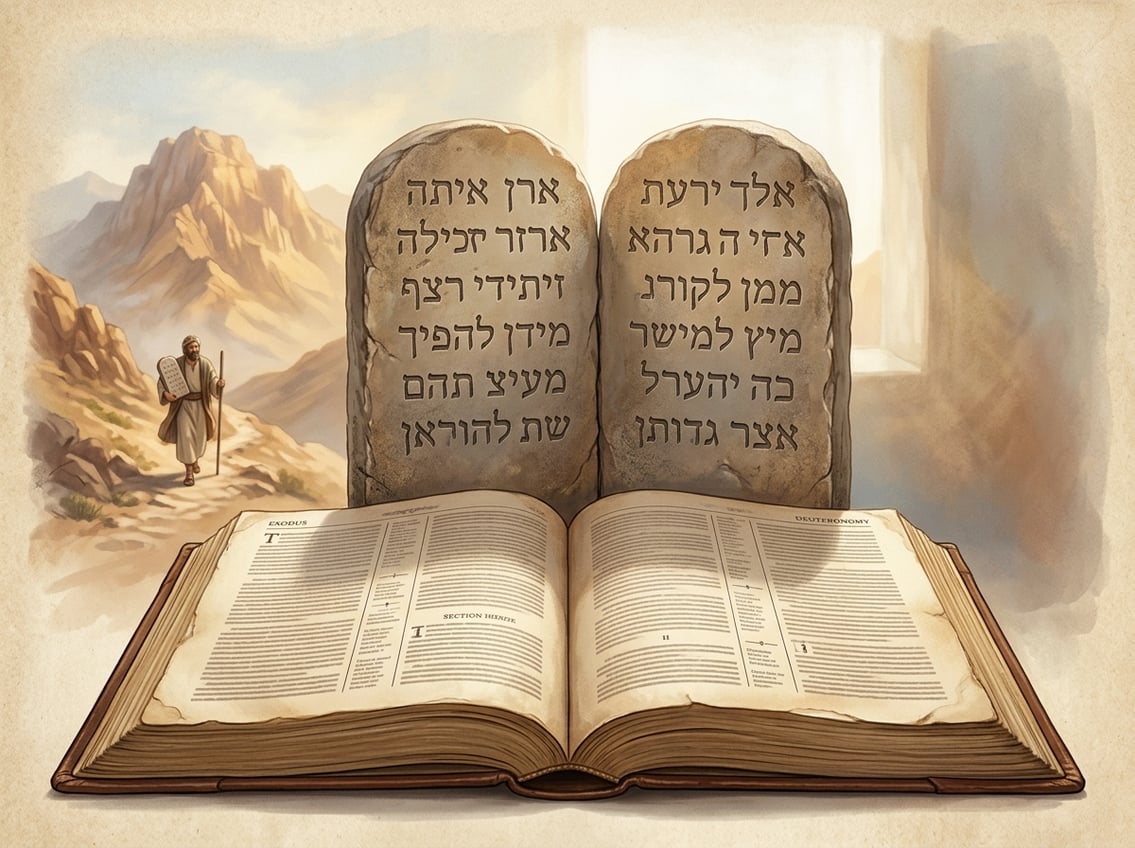
The Two Primary Bible Passages
The Ten Commandments appear twice in the Old Testament: once when Moses first received them from God, and again when he repeated them to the Israelites before they entered the Promised Land. Both passages sit within the Torah, also called the Pentateuch, and carry nearly identical content with a few notable wording differences.
Exodus 20:2–17: The First Written Account
Exodus 20 records the first delivery of the commandments, given directly to Moses on Mount Sinai.
Quick reference — Exodus 20:2–17:
| Verse | Commandment |
|---|---|
| 2–3 | No other gods before the Lord |
| 4–6 | No graven images |
| 7 | No misuse of God's name |
| 8–11 | Keep the Sabbath holy |
| 12 | Honor father and mother |
| 13 | Do not murder |
| 14 | Do not commit adultery |
| 15 | Do not steal |
| 16 | Do not bear false witness |
| 17 | Do not covet |
This version ties the Sabbath command to God resting after creating the world in six days.
Deuteronomy 5:6–21: Moses' Restatement
Deuteronomy 5:6-21 contains Moses' retelling of the commandments, spoken just before the Israelites crossed into the Promised Land.
Quick reference — Deuteronomy 5:6–21:
| Verse | Commandment |
|---|---|
| 6–7 | No other gods |
| 8–10 | No graven images |
| 11 | No misuse of God's name |
| 12–15 | Observe the Sabbath |
| 16 | Honor father and mother |
| 17 | Do not murder |
| 18 | Do not commit adultery |
| 19 | Do not steal |
| 20 | Do not bear false witness |
| 21 | Do not covet |
Here, the Sabbath command is linked to Israel's slavery in Egypt rather than creation.
How the Two Accounts Differ
The two passages match in substance but differ in a few specific details, as shown below.
| Element | Exodus 20 | Deuteronomy 5 |
|---|---|---|
| Reason for Sabbath | God rested after creation | Israel was freed from slavery in Egypt |
| Coveting order | Neighbor's house listed before wife | Neighbor's wife listed before house |
| Extra phrasing | Fewer added clauses | Includes "as the Lord your |
The Ten Commandments in Order
The Ten Commandments follow a clear sequence in Exodus 20:1-17, moving from a person's duty to God toward how people should treat their neighbors. Each command carries a short, direct instruction, and most translations keep the same numbering and order.
Commands About Worship and Loyalty to God
The first commandments focus on loyalty to God alone and reject the worship of idols.
| # | Commandment | Key Terms | Plain-English Meaning |
|---|---|---|---|
| 1 | "You shall have no other gods before me" | no other gods, other gods | God demands sole worship, with no rivals |
| 2 | "You shall not make for yourself a carved image" | idols, graven images, carved image, jealous god | God rejects physical images or objects used in worship |
God identifies himself as a jealous God in these verses, meaning he does not share worship with idols or other gods. These two commands set the foundation for the rest of the list, since loyalty to God comes before every other rule.
Commands About the Name of the Lord and the Sabbath
The third and fourth commandments shift from image and idol worship to how people speak about God and structure their week.
| # | Commandment | Key Terms | Plain-English Meaning |
|---|
Sinai, Exodus, and the Covenant Setting
The Ten Commandments were not given in isolation. They arrived at a specific place, at a specific time, following a specific event: Israel's escape from slavery in Egypt.
Israel's Deliverance From Egypt
Israel spent generations as slaves in Egypt before God freed them through Moses.
Key facts:
- Egypt is described as a land of slavery for the Israelites.
- The exodus event happened before the law was given, not after.
- Israel reached the Sinai Desert three months after leaving Egypt, according to Exodus 19.
- This timing matters: the commandments came to a people already rescued, not a people trying to earn rescue.
Why order matters:
| Event | Purpose |
|---|---|
| Deliverance from Egypt | Establishes relationship with God |
| Arrival at Sinai | Sets stage for covenant |
| Giving of the law | Defines terms of the relationship |
The law follows grace. God acted first; the commandments came after.
Mount Sinai, Thunder, and the Trumpet
Mount Sinai is the exact location where God gave the law to Moses, as confirmed by Sinai covenant accounts.
What happened at the mountain:
- Thunder and lightning surrounded the peak.
- A trumpet blast grew louder as the moment approached.
- The mountain was covered in smoke, described as rising like smoke from a furnace.
- The ground trembled.
- Boundaries were set so the people could not touch the mountain.
Sensory summary:
| Element | Description |
|---|---|
| Sound | Thunder, trumpet blasts |
| Sight | Smoke, fire, dense cloud |
| Physical effect | Mountain shook |
| Access | Restricted; only Moses and Aaron could approach |
This event is sometimes called Mount Horeb in other parts of the Bible, though Mount Sinai and Horeb refer to the same general location.
Stone Tablets and the Covenant
God wrote the Ten Commandments on two stone tablets and gave them to Moses.
Core details:
- The commandments appear in Exodus 20:1-17.
- They were written on two stone tablets, not one.
- The tablets formed the center of a covenant, a binding agreement between God and Israel.
- Additional laws, called the Book of the Covenant, follow in Exodus 20:22-23:33.
What the covenant addressed:
| Topic | Example | |---
Why Numbering and Translation Can Vary
The Ten Commandments appear in two Bible passages, but the way they are counted and worded shifts depending on religious tradition and Bible version. These differences come from ancient manuscript formatting, translation choices, and centuries of theological interpretation.
Jewish, Catholic, and Protestant Numbering
The Bible text does not label the commandments 1 through 10. Each tradition splits the passage differently.
| Tradition | First Commandment | Idolatry Commandment | Coveting Commandment(s) |
|---|---|---|---|
| Jewish tradition | "I am the LORD your God" | Combined with no other gods | One commandment |
| Catholic tradition | No other gods | Merged with first commandment | Split into two commandments |
| Protestant | No other gods | Separate commandment | One commandment |
In Jewish tradition, this passage connects to a larger structure of 613 commandments, with the Ten Commandments serving as a summary of core moral law.
The Catechism of the Catholic Church follows a numbering system credited to Saint Augustine, which merges the prohibition on idolatry with the first commandment and splits coveting into two parts.
The Meaning of Decalogue and the Ten Words
The term "Ten Commandments" comes from a Greek word.
- Decalogue comes from dekalogos, meaning "ten words" or "ten sayings."
- The original Hebrew phrase, Aseret ha-Dibrot, also translates to "the ten words."
- This term appears in the Septuagint, the Greek translation of the Hebrew Bible used by early Christian communities.
- Neither the Hebrew nor Greek text splits the commandments into ten labeled statements. The numbering was added later by scholars and religious leaders.
This is why the phrase "Ten Words" appears in some study Bibles instead of "Ten Commandments." Both terms refer to the same set of instructions.
Comparing KJV, NIV, and Other Bible Translations
Wording differs slightly between English Bible translations, though the core meaning stays the same.
| Commandment | KJV | NIV |
|---|
How Jesus and the New Testament Frame the Law
Jesus and the New Testament writers do not remove the Ten Commandments. Instead, they connect the commandments to two central ideas: love and righteousness through faith.
The Greatest Commandment in Matthew 22
In Matthew 22, a religious leader asks Jesus which commandment matters most. His answer sets the frame for how the rest of the New Testament treats the law.
| Question | Jesus's Answer | Reference |
|---|---|---|
| What is the greatest commandment? | "Love the Lord your God with all your heart and with all your soul and with all your mind." | Matthew 22:37 |
| What is the second greatest? | "Love your neighbor as yourself." | Matthew 22:39 |
| What do these two commands support? | "On these two commandments depend all the Law and the Prophets." | Matthew 22:40 |
Jesus Christ places both commands above the rest without canceling the Ten Commandments. He states that the entire law rests on these two ideas.
Love for God and Neighbor as a Memory Framework
The two-part structure Jesus gives works as a simple sorting tool for the Ten Commandments. Adults can group each commandment under one of two labels.
Commandments tied to love God:
- No other gods
- No carved images
- No misuse of God's name
- Keep the Sabbath
Commandments tied to love your neighbor:
- Honor father and mother
- Do not murder
- Do not commit adultery
- Do not steal
- Do not lie
- Do not covet
This split gives a two-step recall path instead of ten separate items.
- Ask: is this about God or about people?
- Match the specific command to that category.
Paul uses the same grouping method in Romans 13:9, listing several commandments as summed up in "love your neighbor as yourself."
Law, Righteousness, and the New Covenant
The New Testament separates the moral standard of the commandments from the method of righteousness before God.
| Old Covenant Emphasis | New Covenant Emphasis |
|---|---|
| Righteousness through law-keeping | Righteousness through faith in Jesus Christ |
| External rule compliance | Internal transformation |
| Mosaic covenant structure | New covenant established through the gospel |
Paul writes that no one is made right with God by obeying the law alone; salvation comes through faith (Romans 3:20–22). The commandments still describe right and wrong conduct, but they do not serve as the payment for sin under the new covenant.
Hebrews 8:6–13 describes this new covenant as a replacement for the old one, not an addition to it. The moral content of the Ten Commandments carries forward, but the covenant structure around them changes under the gospel.
Frequently Asked Questions
The Ten Commandments appear in two Old Testament books with slight wording differences, and different faith traditions divide and number them in distinct ways.
What are the Ten Commandments in order?
| Number | Commandment |
|---|---|
| 1 | Have no other gods |
| 2 | Make no graven images |
| 3 | Do not misuse God's name |
| 4 | Keep the Sabbath holy |
| 5 | Honor father and mother |
| 6 | Do not murder |
| 7 | Do not commit adultery |
| 8 | Do not steal |
| 9 | Do not give false testimony |
| 10 | Do not covet |
This order matches the Exodus 20 listing. Catholic and Lutheran traditions split and combine a few of these differently, as shown later in this section.
Which Bible passages contain the Ten Commandments?
The Ten Commandments are found in two places:
- Exodus 20:1-17 — given after the exodus from Egypt
- Deuteronomy 5:6-21 — repeated by Moses to a new generation before entering Canaan
Both passages come from the same core moral law, though the wording is not identical.
Can I read the Ten Commandments in Exodus 20?
Yes. Exodus 20:1-17 is the first and most quoted version of the Ten Commandments in the Bible.
Key verses include:
- Exodus 20:3 — "You shall have no other gods before me."
- Exodus 20:13 — "You shall not murder."
- Exodus 20:15 — "You shall not steal."
This chapter sets up God's law for the nation of Israel right after the escape from slavery in Egypt.
Are the Ten Commandments repeated in Deuteronomy?
Yes. Deuteronomy 5:6-21 restates the same ten laws, but with a few changes in wording.
| Topic | Exodus 20 | Deuteronomy 5 |
|---|---|---|
| Sabbath reason | Rest, since God rested on day seven | Rest, and remember slavery in Egypt |
| Honor parents | Live long in the land | Live long and go well in the land |
| Coveting order | House listed before wife | Wife listed before house |
These changes are small but noted by scholars studying both versions of the commandments.
What are the Ten Commandments in simple terms?
- Worship only God
- Don't make idols
- Don't misuse God's name
- Rest one day a week
- Respect parents
- Don't kill
- Stay faithful in marriage
- Don't take what isn't yours
- Tell the truth
- Don't want what belongs to others
This plain-language version follows the basic meaning of each command without changing its intent.