What Is a Gentile in the Bible? Memory Cues That Stick
Key figures like Ruth, Rahab, and Cornelius show Gentiles becoming part of God's plan across both Old and New Testament accounts.
Posted by
 Eden
EdenRelated reading
Are Dinosaurs Mentioned in the Bible? A Retention Guide
The Bible does not explain how these creatures came to an end.
How Did Samuel Die in the Bible? Memory Science Guide
Samuel was buried at his own house in Ramah, the town connected to most of his life and work, according to the account of his death and burial in 1 Samuel 25.
How Did Saul Die in the Bible? Scripture Memory Method
The death of King Saul marks the end of Israel's first monarchy in the Old Testament.
TL;DR
- A Gentile is any person who is not of Jewish descent, based on the Hebrew word "goy" and the Greek word "ethnos," both meaning nations or peoples.
- In the Old Testament, Gentiles are non-Jewish nations outside God's covenant with Israel and the Jewish people.
- In the New Testament, Gentiles are included in salvation through Jesus Christ, breaking down the separation between Jews and non-Jewish people.
- The term does not refer to one specific group or ethnicity; it applies broadly to anyone outside the nation of Israel.
- Key figures like Ruth, Rahab, and Cornelius show Gentiles becoming part of God's plan across both Old and New Testament accounts.
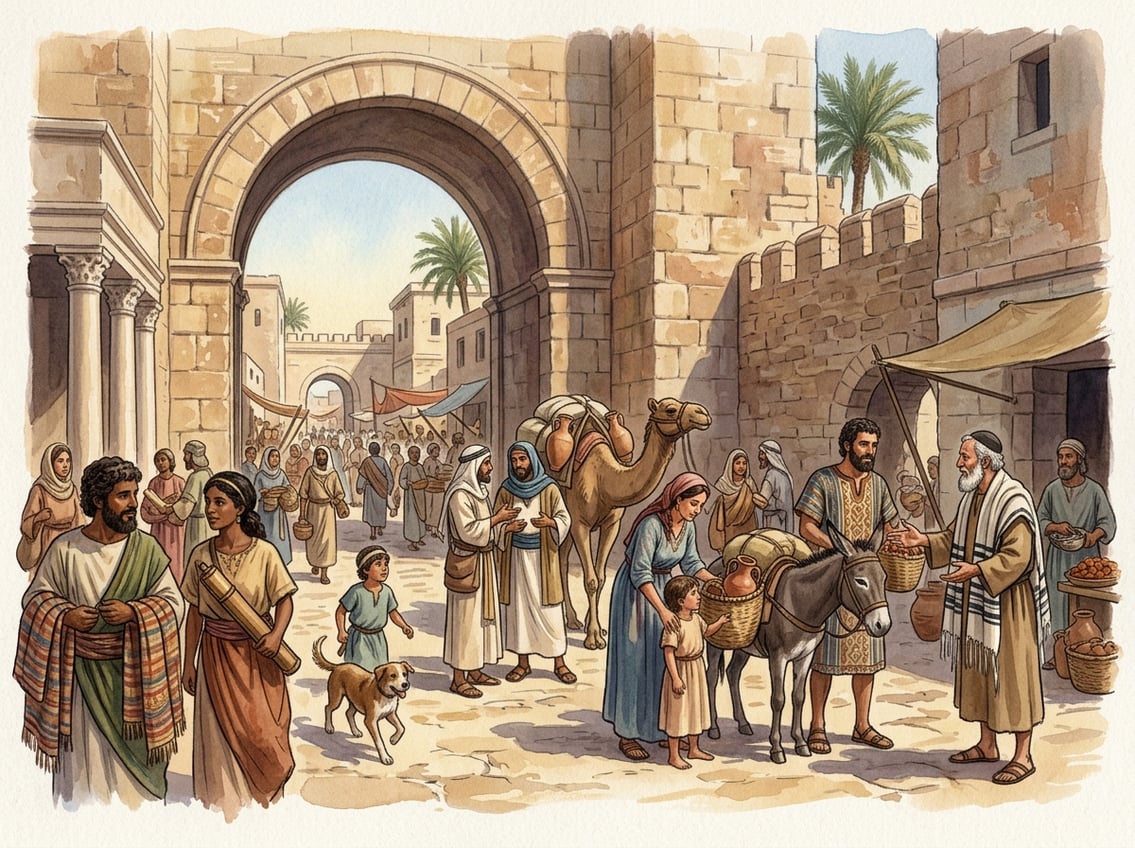
The Biblical Meaning and Language of the Term
The word "Gentile" carries a specific meaning rooted in ancient Hebrew and Greek. Its usage shifts slightly between the Old and New Testaments, but the core idea stays consistent: anyone outside the nation of Israel.
Gentile as a Non-Jewish Person or Nation
A Gentile is any person who is not Jewish by birth or descent.
Key facts:
- The term applies to individuals and entire nations.
- It is not tied to a single ethnicity or culture.
- It includes all non-Jewish people from every background.
The word does not describe one specific group. Instead, it works as a broad category. Anyone who is not part of the Israelite bloodline falls under this label.
This distinction mattered greatly in biblical times. Israel was set apart as God's chosen nation, so the term "Gentile" marked a clear line between insiders and outsiders to that covenant.
Hebrew Goy and Goyim in the Old Testament
The Old Testament uses the Hebrew word goy (singular) and goyim (plural) to describe nations outside Israel.
| Term | Meaning | Usage |
|---|---|---|
| Goy | Nation or people | Can refer to any nation, including Israel itself |
| Goyim | Nations or peoples | Usually refers to non-Israelite nations |
Goy literally means "nation" or "people." It did not always carry a negative meaning.
Over time, goyim became the standard way to describe nations outside of Israel. The Israelites used this word to separate themselves from surrounding cultures and peoples who did not follow their God.
Greek Ethnos in the New Testament
The New Testament uses the Greek word ethnos to translate what English Bibles call "Gentile."
Quick facts about ethnos:
- It means "nations" or "people groups."
- It appears throughout the Gospels, Acts, and the Pauline letters.
- Paul used this word often when writing about non-Jewish believers joining the early church.
Ethnos does not point to one nation. It describes all people groups that are not Jewish.
This word shows up in key passages about salvation reaching beyond Israel. Writers used it to show that the Gospel message was meant for every nation, not just one group.
Why Gentile Does Not Always Mean Pagan or Unbeliever
Being a Gentile is about ancestry, not belief. A Gentile can be a believer or an unbeliever.
Important distinctions:
- Gentile = non-Jewish by birth
- Pagan = someone who worships false gods
- Uncircumcised = a Jewish term for Gentiles, since circumcision marked Jewish identity
Many Gentiles became faithful followers of God. Rahab, Ruth, and Cornelius all serve as examples of Gentiles who trusted in God despite not being born Israelites.
The New Testament makes clear that Gentiles can receive salvation through faith. Ethnicity does not determine belief. A person's nation of origin says nothing about their standing with God once they place their faith in Jesus Christ.
Israel's Calling and God's Purpose for All Nations
God chose Israel not to exclude other nations but to bless them. Through Abraham's descendants, God planned to bring salvation and truth to all people on earth.
Abraham's Covenant and the Promise of Blessing
God's covenant with Abraham set the foundation for including all nations in His plan.
Key Passage: Genesis 12:3
| Element | Meaning |
|---|---|
| Promise to Abraham | "I will bless you...and all peoples on earth will be blessed through you" |
| Scope | Not limited to Israel alone |
| Fulfillment | Through Abraham's descendants, including Isaac |
| Purpose | To extend God's blessing to every nation |
This covenant shows that God's plan always included Gentiles. Israel would carry the blessing, but the blessing itself belonged to the whole world.
Israel as a Kingdom of Priests
God gave Israel a specific role: to represent Him to the nations.
Key Passage: Exodus 19:5
- Israel would be God's "treasured possession" if they obeyed His covenant
- They were called a "kingdom of priests and a holy nation"
- Priests serve as mediators between God and people
- Israel's job was to show other nations who God is
This role placed Israel at the center, not the edge, of God's plan for the world. Their worship and obedience were meant to reflect God's character to everyone watching.
The Law of Moses and Israel's Distinct Identity
The Law of Moses gave Israel clear boundaries that separated them from other nations.
| Practice | Purpose |
|---|---|
| Circumcision | Physical sign of the covenant |
| Dietary laws | Set Israel apart in daily life |
| Sabbath observance | Marked sacred time |
| Sacrificial system | Provided a way to approach God |
These laws created a distinct identity. Gentiles who wanted to join Israel's worship often had to adopt these practices, which is why the topic mattered so much to early Christians debating Gentile inclusion in the faith.
Prophets Who Foretold Light for the Gentiles
Old Testament prophets predicted that God's plan would reach beyond Israel.
Key Verse: Isaiah 42:6 — God calls His servant "a light for the Gentiles."
| Prophet | Prophecy | Reference |
|---|---|---|
| Isaiah | Servant as light to Gentiles | Isaiah 42:6 |
| Isaiah | Nations streaming to Jerusalem | Isaiah 2:2-4 |
| Zechariah | All nations worshiping the King | Zechariah 14:16 |
| Jonah | God's mercy shown to Nineveh | Jonah 3-4 |
These prophecies show that Gentile inclusion was not a new idea introduced in the New Testament. It was planned and announced centuries earlier, waiting for its full revelation in Christ.
Gentiles in the Old Testament Story
The Old Testament shows many moments where non-Israelites played a role in God's plan. These stories reveal how gentiles in the Bible were sometimes welcomed, judged, or used to teach lessons about faith and salvation.
Jethro the Midianite and Moses
Jethro was a Midianite priest and the father-in-law of Moses. He was not part of Israel, but he played a key role in guiding Moses.
In Exodus 18, Jethro gave Moses practical advice on how to lead the people of Israel. He suggested that Moses appoint other leaders to help judge smaller disputes. This advice helped Moses avoid burnout and improved how Israel was governed.
Jethro also recognized the power of the God of Israel after hearing what happened to Egypt. His story shows that gentiles in the Bible could still respect and support God's plans, even without being part of the covenant people.
Rahab of Jericho and Ruth the Moabite
Rahab lived in Jericho and was not an Israelite. She hid two spies sent by Joshua and helped them escape.
Because of her actions, Rahab and her family were spared when Jericho fell. She later became part of the lineage of Jesus, according to the New Testament.
Ruth was a Moabite woman who chose to stay with her mother-in-law, Naomi, after both of their husbands died. She left her own people and followed the God of Israel.
Ruth's loyalty led her to marry Boaz, and she became an ancestor of King David. Both women show how faith, not birth, could bring someone into God's family.
Egypt, Edom, and Other Neighboring Nations
Israel's history included complex relationships with nearby nations. Some of these nations were allies at times, while others were enemies.
| Nation | Relationship with Israel |
|---|---|
| Egypt | Enslaved Israel, later a place of refuge |
| Edom | Descended from Esau, often in conflict with Israel |
| Moab | Sometimes hostile, sometimes connected by marriage |
| Midian | Included allies like Jethro |
Egypt held Israel in slavery for hundreds of years before the exodus. Edom, descended from Esau, often clashed with Israel over land and history.
These relationships were not simple. They show that gentile nations could be both a threat and, at times, a source of unexpected connection to Israel.
God's Justice and Mercy Beyond Israel
The Old Testament shows that God's judgment was not limited to Israel. Nations like Egypt and Edom faced consequences for cruelty or pride.
At the same time, mercy was also extended beyond Israel's borders. The book of Jonah shows God sending a prophet to warn Nineveh, a gentile city, so its people could turn from their sins.
When Nineveh repented, God spared the city. This story shows that salvation and mercy were never meant to stay within one nation. Old Testament accounts point toward a wider plan that later unfolds fully in the New Testament.
Jesus and the Opening of the Gospel to the Nations
Jesus Christ began his ministry focused on the Jewish people, yet specific encounters and teachings revealed a wider plan for Gentiles. These moments, along with his final instructions to his followers, mark the shift from a message centered on Israel to one meant for all nations.
Jesus’ Ministry Among Jewish People and Gentiles
Jesus directed most of his teaching and healing toward Jewish communities. He told his disciples early on to avoid Gentile towns and focus only on "the lost sheep of the house of Israel."
Key facts about this early focus:
- Jesus rarely spoke directly with Gentiles during his ministry.
- He sent his twelve disciples only to Jewish towns at first (Matthew 10:5-6).
- His public teaching addressed Jewish audiences and used Jewish religious concepts.
- Despite this focus, Jesus did not reject Gentiles who came to him in faith, as detailed in this breakdown of what Jesus said about Gentiles.
This pattern shows a clear order in
The Early Church and Gentile Inclusion
The early church began as a Jewish movement, but within a few decades it opened its doors to non-Jews. This shift happened through specific events described in Acts, each one building the case that Gentiles could receive salvation through faith in Christ without first becoming Jewish.
Pentecost and the Gospel's Multilingual Witness
Pentecost marked the first major sign that the gospel would reach beyond Israel. When the Holy Spirit came upon the apostles, they spoke in different languages, and people from many nations understood the message in their own tongue.
This event pointed to a future where the gospel would not stay limited to one ethnic group. The crowd included Jews and God-fearing Gentiles from across the Roman world.
Pentecost did not open the church to Gentiles right away. It set the stage by showing that God's message was meant to cross language and cultural lines from the very beginning.
Peter, Cornelius, and the Holy Spirit in Acts 10
Acts 10 describes Peter's encounter with Cornelius, a Roman centurion. Cornelius was not Jewish, but he feared God and gave generously to those in need.
Peter received a vision telling him not to call anything unclean that God had made clean. This vision prepared him to enter Cornelius's home, something a Jewish man would not normally do.
While Peter spoke, the Holy Spirit fell on Cornelius and his household. Peter and the Jewish believers with him saw this as clear proof that God accepted Gentiles.
Acts 11 records Peter defending this decision to the Jerusalem church, explaining that God had given Gentiles "the same gift" received at Pentecost.
Paul's Mission as Apostle to the Gentiles
Paul, also called the apostle Paul, became the central figure in bringing the gospel to non-Jewish people. Acts 9:15 records God's statement that Paul would carry His name "before the Gentiles, kings, and the children of Israel."
Paul's mission took shape in specific ways:
- He traveled through Gentile cities across the Roman Empire.
- He preached that salvation came through faith in Christ, not through following Jewish law.
- Acts 13 marks a turning point, where Paul and Barnabas turned their focus toward Gentile audiences after facing rejection from some Jewish communities.
- He is commonly referred to as the apostle to the Gentiles because of this focused work.
Paul's letters later explained the theological reasoning behind Gentile inclusion in more detail.
The Jerusalem Council and Gentile Converts
By Acts 15, the growing number of Gentile converts created a dispute. Some Jewish believers argued that Gentiles needed to follow Jewish law, including circumcision, to be saved.
Church leaders gathered in Jerusalem to settle the question. This meeting is known as the Jerusalem Council.
| Person | Position |
|---|---|
| Peter | Argued that God gave the Holy Spirit to Gentiles without requiring the law |
| Paul and Barnabas | Reported the signs and wonders God did among Gentiles |
| James | Proposed a resolution requiring only a few practical guidelines |
The council concluded that Gentiles did not need to follow the full Mosaic law to be saved. They asked Gentile believers to avoid a small list of practices tied to idol worship and improper conduct, mainly to preserve unity with Jewish believers.
This decision confirmed that faith in Christ, not adherence to Jewish law, was the basis for salvation. It set the direction for Christianity as a faith open to all people, regardless of background.
Paul's Teaching on Unity, Faith, and Israel
Paul's letters explain how Jews and Gentiles become one people through faith in Christ. His teaching covers salvation, the removal of old barriers, shared inheritance, and Israel's continuing role in God's plan.
Salvation Through Faith for Jew and Gentile
Key verse: Romans 1:16 — "For I am not ashamed of the gospel of Christ: for it is the power of God unto salvation to every one that believeth; to the Jew first, and also to the Greek."
Paul's core teaching on salvation:
| Point | Meaning |
|---|---|
| Salvation source | Faith in Christ, not ethnic background |
| Order given | Jewish people first, then Gentiles |
| Scope | Available to all who believe |
| Basis | God's power, not human effort |
Galatians 3:28 reinforces this: "There is neither Jew nor Greek... for ye are all one in Christ Jesus." Paul removed ethnic identity as a barrier to salvation, according to Paul's teaching on unity.
The Dividing Wall Removed in Christ
Ephesians 2:14 states: "For he is our peace, who hath made both one, and hath broken down the middle wall of partition between us."
What the wall represented:
- A physical barrier in the Jerusalem temple separating Gentiles from Jewish worshippers
- A symbol of religious and social separation
- Inscriptions warned Gentiles of death for crossing it, based on historical evidence from Ephesians 2:14
How Paul says it was removed:
| Element | Role |
|---|---|
| Blood of Christ | Ended the legal separation (Ephesians 2:13) |
| Cross | Reconciled both groups to God |
| New identity | One body in Christ, not two separate groups |
Ephesians 2:11-22 describes this shift from division to a "new man" made from both groups.
Gentiles as Fellow Heirs of God's Promise
Ephesians 3:6 defines the mystery Paul revealed: "That the Gentiles should be fellow heirs, and of the same body, and partakers of his promise in Christ by the gospel."
Three terms Paul uses for Gentiles in Christ:
- Fellow heirs – equal share in God's promises
- Same body – full membership in the church
- Partakers – direct access to the promise, not secondhand
This meant Gentiles gained full standing in God's kingdom, not a lesser status. Paul presented this as a plan God held since before creation, later revealed through Christ, according to Paul's teachings on Gentile inclusion.
The Olive Tree and Israel's Continuing Place
Romans 11 uses an olive tree to explain Israel's ongoing role.
| Symbol | Meaning |
|---|---|
| Root | Israel's covenant history |
| Natural branches | Jewish people |
| Grafted-in branches | Gentile believers |
| Warning | Gentiles should not boast over Jewish branches |
Paul makes clear that Gentile inclusion does not replace Israel. He states that God has not rejected His people and points to a future restoration for Jewish people. The image shows both groups drawing life from the same root, supporting Paul's broader argument that unity in Christ does not erase Israel's place in God's ongoing plan.
Frequently Asked Questions
These answers cover key facts about Gentiles in the Bible, including specific people, verses, and modern meanings.
Who are considered Gentiles in the Bible?
A Gentile is anyone who is not a descendant of Jacob, also called Israel. The Bible names several Gentiles by their nation or background:
- Jethro – a Midianite priest and father-in-law of Moses
- Rahab – an Amorite woman from Jericho
- Ruth – a Moabite woman who married into an Israelite family
- Cornelius – a Roman centurion
- Luke – a Greek physician who wrote two New Testament books
Some important Gentiles in the Bible later became believers and are named in scripture as examples of faith outside the nation of Israel.
What is the difference between Jews and Gentiles in the Bible?
| Group | Ancestry | Covenant Status |
|---|---|---|
| Jews | Descendants of Jacob (Israel) | Given the Law through Moses |
| Gentiles | All other nations and peoples | Not under the original covenant with Israel |
The Greek word for Gentile, ethnos, simply means "nations" or "peoples." It does not point to one specific group. The difference between Jews and Gentiles centers on ancestry and covenant history, not on personal belief alone.
Are Gentiles considered nonbelievers in the Bible?
Not always. The term "Gentile" refers to ancestry, not faith.
- A Gentile can be a believer, such as Cornelius or Ruth.
- A Gentile can also reject God, as Paul described in Ephesians 4:17-19.
- The label changes meaning depending on the verse and time period.
In later New Testament writing, some authors used Gentile to describe those who reject the Gospel, but this is a specific use, not the only meaning.