How Many Pages Are in the Bible? Memory-Friendly Reading
The Bible's 66 books, split between the Old and New Testaments, make up the core text that page counts are based on.
Posted by
 Eden
EdenRelated reading
Are Dinosaurs Mentioned in the Bible? A Retention Guide
The Bible does not explain how these creatures came to an end.
How Did Samuel Die in the Bible? Memory Science Guide
Samuel was buried at his own house in Ramah, the town connected to most of his life and work, according to the account of his death and burial in 1 Samuel 25.
How Did Saul Die in the Bible? Scripture Memory Method
The death of King Saul marks the end of Israel's first monarchy in the Old Testament.
TL;DR
- The average Bible contains about 1,200 pages, though this number changes based on font size, translation, and page layout.
- Bible page count ranges from roughly 900 pages in compact editions to over 1,500 pages in large-print versions.
- Standard translations like the KJV, NIV, and ESV typically fall between 1,200 and 1,300 pages.
- Bible length depends on formatting choices such as column layout, paper thickness, and included study notes or maps.
- The Bible's 66 books, split between the Old and New Testaments, make up the core text that page counts are based on.
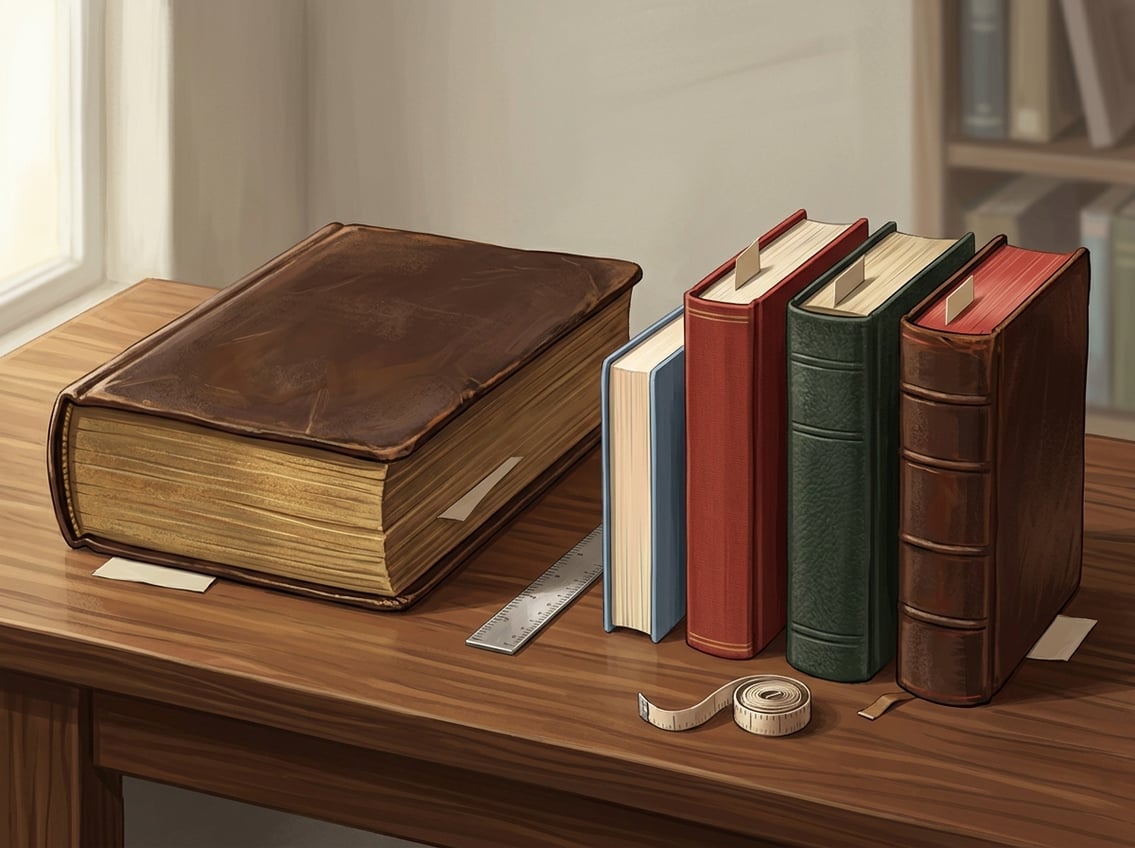
Typical Page Counts by Bible Format
Page count depends heavily on the physical format of a Bible, not just the translation. Font size, paper thickness, column layout, and added content like notes or maps all shift the total page number, sometimes by more than 1,000 pages.
Standard and Pew Editions
A standard hardcover Bible runs about 1,200 pages in most major translations. This format uses 9 to 10 point font, standard bible paper, and no study notes.
Pew Bibles fall into this same range. They are built for durability and easy reading in a church setting, not portability.
| Edition Type | Typical Page Count |
|---|---|
| Standard hardcover (NIV, ESV, NLT, CSB) | 1,000–1,300 pages |
| ESV Pew Bible | 1,056 pages |
| KJV standard hardcover | 1,200–1,400 pages |
Standard editions use a plain layout with cross-references but skip footnotes and commentary. This keeps the page count predictable across translations.
Compact and Pocket Editions
Compact and pocket Bibles use smaller font sizes, often 6 to 8 point, and thinner paper to shrink the overall size. The text is identical to a standard Bible; only the formatting changes.
- Compact NIV: around 750 to 950 pages
- Two-column KJV at 8-point font: about 900 pages with no study notes
- Thinline editions: slightly fewer pages than standard hardcovers due to tighter margins
These editions trade readability for size. Smaller font and thinner paper make the Bible easier to carry, but harder to read for long stretches.
Large-Print and Giant-Print Editions
Large-print and giant-print Bibles increase page count because bigger font takes up more space per verse. A large-print edition typically uses 12 to 14 point type, while giant-print editions go even larger.
This format does not add content. It only spreads the same text across more pages, often pushing a standard 1,200-page Bible past 1,800 or 2,000 pages.
Large-print Bibles are common choices for readers who find compact or standard font sizes hard to read. The tradeoff is a heavier, bulkier book.
Study and Reference Editions
Study Bibles nearly double the page count of a standard edition because they add footnotes, cross-references, book introductions, maps, and sometimes a concordance. These additions explain historical context and word meaning but are not part of the biblical text itself.
| Study Bible | Page Count |
|---|---|
| ESV Study Bible | 2,752 pages |
| NIV Study Bible, Fully Revised | 2,512 pages |
| CSB Study Bible | ~2,100 pages |
| Catholic Study Bible (Oxford) | ~2,000 pages |
Reference editions without full study notes, but with a concordance and cross-references, land somewhere between standard and full study Bibles. The added material is meant to support deeper reading and structured reading plans, not to shorten or simplify the text.
Why Page Counts Differ Between Editions
Bible page count changes based on translation wording, font size, page layout, and extra content like notes or maps. These factors combine to create huge differences in total pages, even when the biblical text stays the same.
Translation Wording and Text Density
Each Bible translation uses different word choices. Some translations use more words to say the same thing.
Word-for-word translations often use more words than thought-for-thought translations. This affects total page count.
- Formal translations (like the KJV or ESV) tend to have longer sentences
- Dynamic translations (like the NIV or NLT) often use shorter, simpler phrasing
- Paraphrase versions (like The Message) can use even fewer or more words depending on style
Word count differences between bible translations can add up to thousands of extra words across the whole book. This changes the final page count even before layout is considered.
Type Size, Columns, Margins, and Paper
Font size has a major impact on total pages. Smaller text fits more words per page.
Bible paper is often thin. This is called "Bible paper" or "India paper," and it lets publishers fit more pages into a smaller book without making it too thick.
| Layout Feature | Effect on Page Count |
|---|---|
| Small font (8pt or less) | Fewer total pages |
| Large print (12pt or more) | More total pages |
| Single column layout | More pages needed |
| Double column layout | Fewer pages needed |
| Wide margins | More pages needed |
| Thin paper | Allows more pages in a smaller book |
A standard hardcover Bible usually falls between 900 and 1,500 pages, but compact or large-print versions can fall well outside that range.
Notes, Maps, Introductions, and Reference Tools
Extra content adds pages without changing the biblical text itself. A study Bible almost always has more pages than a text-only Bible.
Common additions include:
- Footnotes that explain word meanings or translation choices
- Cross-references that point to related verses
- Study notes that explain historical or cultural background
- A concordance for looking up where words appear in scripture
- Maps showing biblical locations
- Introductions to each book of the Bible
A full study bible can add hundreds of extra pages compared to a plain text edition. Some study editions go past 2,700 pages once all reference tools are included.
Print Pages Versus Digital Bible Displays
Digital Bibles do not have fixed page counts. The number of "pages" on a screen depends on screen size, font size, and app settings.
A phone screen shows far less text per page than a tablet or e-reader. This means the same digital Bible can show a different number of "pages" depending on the device.
Digital formats often list total word count or chapter count instead of page count. This gives a more consistent way to measure the length of God's Word across different devices and apps.
Page Ranges for Major English Translations
Page counts differ across English Bible translations based on wording style, font size, and paper type. The tables below show typical ranges for standard hardcover editions without study notes.
King James Tradition
The King James Version (KJV) uses older English phrasing that tends to run longer than modern translations.
| Edition | Typical Page Count |
|---|---|
| KJV Bible (standard hardcover) | 1,200–1,400 pages |
| KJV original 1611 (with Apocrypha) | 1,500+ pages |
| New King James Version (NKJV) | 1,200–1,400 pages |
The 1611 KJV included 14 Apocryphal books placed between the Old and New Testaments. Most modern printings leave these books out.
The NKJV updates the language of the KJV but keeps a similar sentence structure. This keeps its page count close to the original KJV.
Modern Formal-Equivalence Translations
Formal-equivalence translations aim for word-for-word accuracy. This style keeps page counts in a narrow range across publishers.
| Translation | Typical Page Count |
|---|---|
| New International Version (NIV) | 1,000–1,200 pages |
| English Standard Version (ESV) | 1,100–1,300 pages |
| New American Standard Bible (NASB) | 1,000–1,300 pages |
| Revised Standard Version (RSV) / NRSV | 1,100–1,300 pages |
The ESV Pew Bible runs 1,056 pages, while the ESV Thinline edition runs 1,136 pages. The NIV is the bestselling modern English translation, and its standard hardcover editions fall near the middle of this range.
Readable and Meaning-Based Translations
Meaning-based translations focus on clear, everyday language over strict word-for-word phrasing.
| Translation | Typical Page Count |
|---|---|
| New Living Translation (NLT) | 1,000–1,300 pages |
| Christian Standard Bible (CSB) | 1,000–1,300 pages |
| Good News Bible (GNT) | 900–1,100 pages |
| The Message | 1,300–1,600 pages |
| The Passion Translation | 1,500–1,800 pages |
The NLT and CSB match the page range of formal-equivalence translations like the NIV and ESV. The Message and The Passion Translation run longer because their expanded phrasing adds more words per verse.
Study Bible Page-Count Examples
Study Bibles add notes, articles, and cross-references, which roughly doubles the standard page count.
| Study Bible | Page Count |
|---|---|
| ESV Study Bible | 2,752 pages |
| NIV Study Bible (Fully Revised) | 2,512 pages |
| CSB Study Bible | ~2,100 pages |
| KJV Study Bible | ~1,700–2,000 pages |
| NKJV Study Bible | ~1,700–2,000 pages |
| NLT Study Bible | ~2,200 pages |
The ESV Study Bible contains 20,000 study notes and 80,000 cross-references, making it one of the longest single-volume Bibles in print. The NIV Study Bible adds over 21,000 notes and 125 articles, which explains its higher page count compared to the standard NIV.
Canon and Testament Differences
Different Christian traditions include different numbers of books in their Bibles, which directly affects total page count. These differences trace back to language, translation choices, and decisions made centuries ago about which texts count as scripture.
Protestant, Catholic, and Orthodox Collections
Bible length varies by tradition because each group recognizes a different set of books.
| Tradition | Total Books | Old Testament | New Testament |
|---|---|---|---|
| Protestant Bible | 66 | 39 | 27 |
| Catholic Bible | 73 | 46 | 27 |
| Eastern Orthodox Bible | 78+ | 51+ | 27 |
The Protestant canon reflects the Reformation-era decision to exclude certain Old Testament texts. The Catholic canon adds seven more books than the Protestant version. Eastern Orthodox Bibles include additional texts beyond the Catholic list, making them the longest of the three.
The Old Testament and New Testament Share
All three traditions agree on the New Testament's 27 books. This includes the four Gospels, Acts, 21 letters, and Revelation.
The Old Testament is where traditions diverge:
- Protestant Old Testament: 39 books, matching the Hebrew Bible's content but with different book divisions
- Catholic Old Testament: 46 books, adding seven texts plus extra material in Esther and Daniel
- Orthodox Old Testament: 51 or more books, including additional texts like 3 Maccabees and Psalm 151
The core content overlaps across all versions. The disagreement centers on which extra books count as scripture.
Deuterocanonical Books and the Apocrypha
Catholic and Orthodox Bibles include books that Protestant Bibles leave out. Catholics call these texts deuterocanonical. Protestants call them the Apocrypha.
Common deuterocanonical books include:
- Tobit – a story about faith and family loyalty
- Judith – an account of courage during a military threat
- 1 and 2 Maccabees – historical books about Jewish resistance
- Wisdom of Solomon and Sirach – wisdom literature
Martin Luther placed these books in a separate section during the Reformation and labeled them as useful but not equal to scripture. The Council of Trent later confirmed these books as fully canonical for Catholics in 1546.
Original Languages and Translation History
The Old Testament was written mostly in Hebrew, with some sections in Aramaic. The New Testament was written in Greek.
Modern translations reflect different canon choices:
| Translation | Tradition | Includes Deuterocanonical Books |
|---|---|---|
| Jerusalem Bible | Catholic | Yes |
| Douay-Rheims | Catholic | Yes |
| New American Bible | Catholic | Yes |
| NABRE | Catholic | Yes |
| NIV, ESV | Protestant | No |
Translation choices affect both content and page count. A Catholic edition using the New American Bible or NABRE will run longer than a Protestant edition using the NIV or ESV, since the additional books add pages beyond the shared 66-book core.
Bible Length in Books, Chapters, Verses, and Words
The Bible's structure breaks down into clear units: 66 books, 1,189 chapters, and 31,102 verses. These divisions were not part of the original texts—they were added centuries later to help readers navigate the Old and New Testaments.
Books and Chapters in the Protestant Canon
The Protestant Bible contains 66 books split into two testaments.
| Testament | Books | Categories |
|---|---|---|
| Old Testament | 39 | Historical books (Genesis, Exodus, Numbers, and others), poetic books (Psalms), prophetic books (Isaiah, Jeremiah) |
| New Testament | 27 | Gospels (Matthew, Luke, John), Acts, Paul's epistles, general epistles, Revelation |
The Old Testament holds [929 chapters and
Choosing an Edition That Supports Consistent Reading
The right edition removes barriers to daily reading, while the wrong one adds friction through cramped text, missing notes, or an awkward format. Font size, page layout, and the presence of study tools all affect whether someone finishes a reading plan or abandons it.
Match Type Size and Format to Reading Comfort
Font size and page layout affect how long a person can read before eye strain sets in.
| Edition Type | Typical Font Size | Best For |
|---|---|---|
| Pocket Bible | 6-7 pt | Travel, carrying to church |
| Compact Bible | 7-8 pt | Daily carry, short reading sessions |
| Standard Print Bible | 9-10 pt | Regular home reading |
| Large Print Bible | 11-14 pt | Extended reading, low light, eye strain |
Many standard editions use a two-column format with smaller fonts to keep the book portable. This layout works for short sessions but can slow down longer reading blocks.
A large print Bible can run 30-40% more pages than the same text in standard print. The trade-off is a heavier book in exchange for less eye fatigue.
Use Study Tools Without Overloading Each Session
Study tools add depth but also add pages and reading time per session.
- Footnotes: short clarifications on word meaning or translation choices
- Cross-references: links between related verses across the Old and New Testament
- Concordance: alphabetical index for locating a word or phrase in scripture
- Study notes: longer explanations of historical or theological context
A study Bible can run past 2,700 pages once these tools are added, compared to roughly 1,200 for a standard edition. That extra material works best for planned study sessions, not quick daily reading.
For consistent reading, a plain text edition without heavy study notes keeps each session focused on the word of God itself rather than commentary.
Build a Page-Based Reading Plan That Sticks
A page-based plan sets a fixed number of pages per day instead of a fixed number of chapters.
- Confirm the total page count for the specific edition being used
- Divide by the number of days in the plan (365 for a one-year plan)
- Set a daily page target based on that division
- Track pages read, not just days completed
- Adjust the target if the edition changes (switching from compact to large print shifts the math)
This approach accounts for the fact that page counts vary by translation and edition
Frequently Asked Questions
Bible page counts change based on translation, font size, and edition type. Here are quick answers to the most common questions people ask.
How many pages are in a full Bible?
A full Bible has between 1,200 and 1,500 pages in most standard print editions.
| Edition Type | Approx. Pages |
|---|---|
| Compact/pocket | 800–1,000 |
| Standard print | 1,100–1,300 |
| Large print | 1,500–2,000 |
| Study Bible | 2,200–2,800 |
This range covers most popular Bible editions sold today.
How many pages are in the Old Testament and New Testament?
The Old Testament takes up most of the book. It has 39 books and usually runs 750 to 950 pages.
The New Testament has 27 books. It is shorter, usually 250 to 350 pages.
| Section | Books | Approx. Pages | Share of Bible |
|---|---|---|---|
| Old Testament | 39 | 750–950 | 75–78% |
| New Testament | 27 | 250–350 | 22–25% |
How many pages are in the King James Version Bible?
The KJV page count depends on the edition.
| KJV Edition | Approx. Pages |
|---|---|
| Compact/pocket | 800–1,000 |
| Standard print | 1,200–1,300 |
| Large print | 1,600–2,000 |
| Giant print | 2,200–3,000 |
| Study Bible | 2,200–2,400 |
A basic two-column KJV with small font and no notes can run as low as 900 pages.
How many pages are in the NIV Bible?
The NIV runs slightly shorter than the KJV in most formats.
| NIV Edition | Approx. Pages |
|---|---|
| Compact/pocket | 800–950 |
| Standard print | 1,100–1,200 |
| Large print | 1,500–1,800 |
| Giant print | 2,000–2,800 |
| Study Bible | 2,200–2,400 |
How many pages are in the ESV Bible?
The ESV page count is close to the NIV in standard print.
| ESV Edition | Approx. Pages |
|---|---|
| Compact | 800–1,000 |
| Standard print | 1,100–1,200 |
| Large print | 1,600–1,900 |
| Study Bible | 2,700–2,800 |
The ESV Study Bible is one of the longest single-volume Bibles available, due to its added commentary and notes.