What Does Yoke Mean in the Bible? Memory That Sticks
Faith in God, according to this image, means trading a heavy load for one that is lighter because it is shared.
Posted by
 Eden
EdenRelated reading
Are Dinosaurs Mentioned in the Bible? A Retention Guide
The Bible does not explain how these creatures came to an end.
How Did Samuel Die in the Bible? Memory Science Guide
Samuel was buried at his own house in Ramah, the town connected to most of his life and work, according to the account of his death and burial in 1 Samuel 25.
How Did Saul Die in the Bible? Scripture Memory Method
The death of King Saul marks the end of Israel's first monarchy in the Old Testament.
TL;DR
- A yoke is a wooden frame that joins two animals, usually oxen, so they can pull a plow or cart together.
- In the Bible, the yoke often stands for submission, service, or shared burden, and it can point to either oppression or partnership depending on the context.
- The Old Testament uses "yoke" to describe slavery and hardship, like Israel's bondage in Egypt.
- Jesus uses the yoke as a symbol of discipleship, inviting people to follow him and share his burden instead of carrying life alone.
- Faith in God, according to this image, means trading a heavy load for one that is lighter because it is shared.
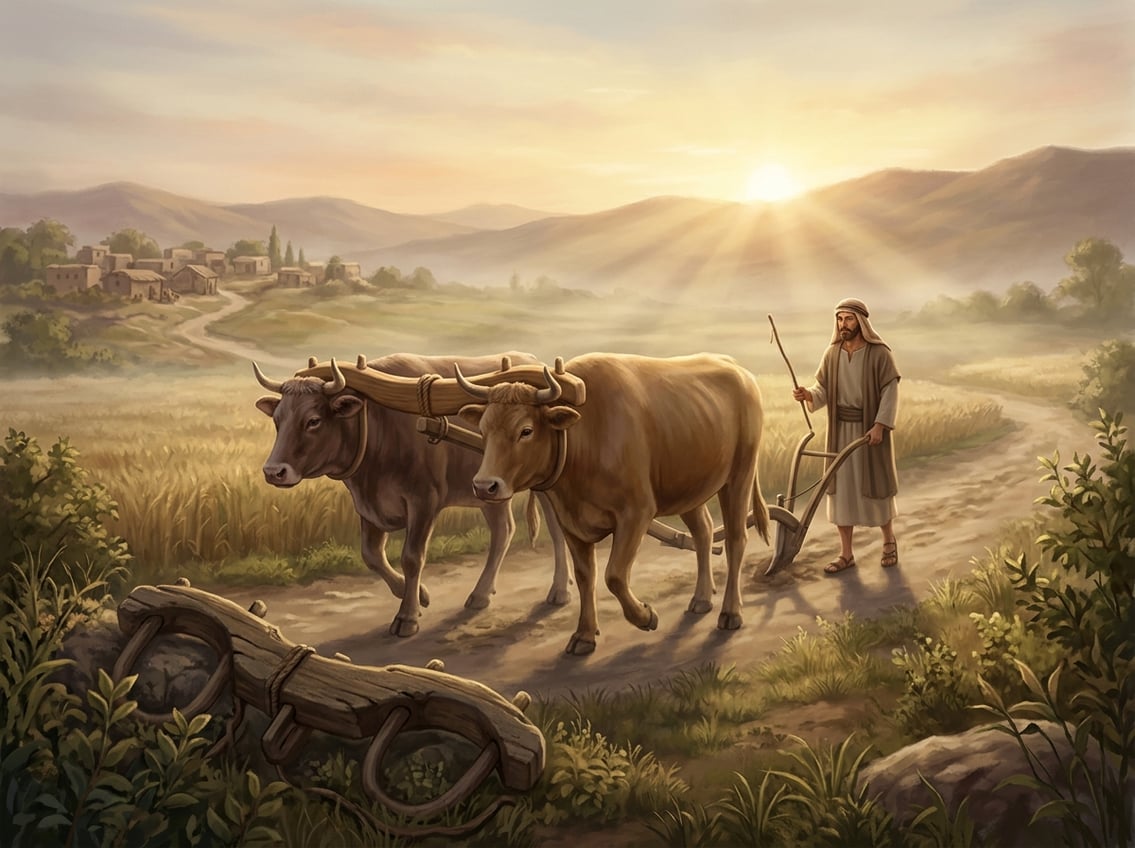
The Farming Image Behind the Metaphor
The yoke came from daily farm work in ancient Israel. Farmers used this tool to join animals together so they could do hard jobs that one animal could not do alone.
How Oxen Pulled a Plow or Cart
Oxen worked in pairs to pull plows and carts. A yoke fit over their necks and joined them together so they moved as one unit.
Key facts about this setup:
- Oxen pulled plows to break up soil for planting crops.
- Oxen pulled carts to move heavy loads like grain or wood.
- Two animals worked better than one because the load was split between them.
- The yoke kept both oxen moving at the same pace and in the same direction.
This method was common in biblical times. Farmers depended on oxen because they were strong and could work for long hours.
Why a Wooden Beam Represented Shared Labor
The yoke itself was a wooden beam with curved pieces that fit around each animal's neck. This design forced both oxen to move together.
What the wooden beam did:
| Function | Result |
|---|---|
| Joined two animals | Created one working unit |
| Spread the weight | Reduced strain on each ox |
| Controlled direction | Kept both animals in step |
Deuteronomy 21:3 mentions a heifer that had not worn a yoke, showing that this tool marked an animal's first time doing real work. The wooden harness became a natural picture for shared burden and shared labor. When Bible writers used the word yoke in the Bible, they built on this everyday image that most readers would have seen or used themselves.
Burden, Rule, and Oppression in the Old Testament
The Old Testament often uses the word "yoke" to describe hard rule, unfair taxes, and slavery. Kings placed heavy yokes on their people, and God's judgment sometimes came in the form of an iron yoke placed on a nation.
Heavy Yokes Under Kings and Empires
A yoke in the Bible can mean control by a harsh ruler.
Key example: Rehoboam and Israel
- The people asked King Rehoboam to lighten the "heavy yoke" his father Solomon had placed on them (1 Kings 12:4)
- Rehoboam refused and made the yoke heavier instead
- This decision led to Israel's kingdom splitting in two
Other examples of national yokes:
| Nation | Yoke Type | Result |
|---|---|---|
| Israel/Judah | Political oppression | Split kingdom |
| Judah | Assyrian rule | Forced tribute |
| Judah | Babylonian rule | Exile |
A yoke, in this sense, means forced submission to a ruler's demands.
Iron Yokes, Judgment, and Servitude
Sometimes God used the image of an iron yoke as a warning of judgment.
Verses that use "iron yoke" language:
- Deuteronomy 28:48 – God warns that disobedience will bring "a yoke of iron" through enemy rule
- Jeremiah 28:13 – Jeremiah tells a false prophet that breaking a wooden yoke will only bring an iron one in its place
The Jeremiah yoke sign:
- God told Jeremiah to wear a wooden yoke as a symbol
- He sent yoke symbols to nearby kings, telling them to submit to Babylon (Jeremiah 27:2)
- This act showed that resisting Babylon's rule would only make things worse
Assyria and Babylon as yoke-bearers:
- Assyria placed a yoke on the northern kingdom of Israel
- Babylon later placed a yoke on Judah, leading to exile
An iron yoke in scripture means a punishment that is harder to escape than an ordinary one.
God's Promise to Break Oppressive Bonds
The Old Testament also promises that God can break yokes of oppression.
Verses about breaking the yoke:
| Verse | Promise |
|---|---|
| Leviticus 26:13 | God says He broke the bars of Israel's yoke so they could walk with heads held high |
| Isaiah 9:4 | God will break the yoke that burdens His people |
| Isaiah 10:27 | God's judgment will destroy the yoke placed on Israel |
| Isaiah 58:6 | True fasting includes freeing the oppressed and breaking every yoke |
What "breaking the yoke" means:
- Freedom from slavery or forced service
- An end to unfair rule by another nation
- A turning point away from wickedness and toward justice
These verses show that a yoke is not permanent. God's judgment on wickedness often includes lifting the burden He once allowed.
Obedience, Discipline, and the Yoke of Torah
In Jewish thought, accepting the yoke of Torah meant choosing obedience and discipline over disorder. This shaped how a person grew in humility and how religious rules could either guide or burden the faithful.
Formation Through Humble Submission
Taking on the yoke of Torah was an act of humility. It meant putting God's instruction above personal comfort or pride.
| Concept | Meaning |
|---|---|
| Torah | God's law and teaching |
| Obedience | Following divine commands |
| Discipline | Steady practice of God's ways |
| Humility | Submitting one's will to God |
Lamentations 3:27 says, "It is good for a man that he bear the yoke in his youth." This verse points to early discipline as a path to spiritual growth.
Rabbinic teaching also framed the yoke of Torah as freedom from lesser burdens. A person who accepted God's law was said to be released from the "yoke of government and worldly concerns," according to the Jewish Virtual Library's overview of yoke symbolism.
When Religious Requirements Become Unbearable
Not all yokes were seen as good. Some religious rules became heavy burdens rather than helpful guidance.
Key contrast:
- Yoke of Torah – meant to guide and discipline
- Yoke of bondage – excessive rules that trap people
- Yoke of slavery – loss of freedom through legalism
Acts 15:10 shows early church leaders questioning whether new believers should carry a "yoke" of strict legal requirements for salvation. Galatians 5:1 warns believers not to be "entangled again with the yoke of bondage," rejecting legalism as a path to righteousness.
This contrast highlights a key tension explored in discussions of the yoke as a symbol of slavery or freedom: obedience should lead to spiritual growth, not oppression.
Jesus' Easy Yoke and the Rest He Offers
Jesus makes a direct offer to tired and burdened people in Matthew 11:28-30. His words describe a new kind of relationship with God built on trust and guidance, not on heavy rules.
The Invitation in Matthew 11:28–30
Jesus speaks to people who feel worn out by daily struggles and religious rules.
| Verse | Plain-English Meaning |
|---|---|
| Matthew 11:28 – "Come to me, all who labor and are heavy laden, and I will give you rest." | Jesus asks tired people to come to him instead of carrying their load alone. |
| Matthew 11:29 – "Take my yoke upon you and learn from me, for I am gentle and lowly in heart, and you will find r |
Unequally Yoked Relationships and Shared Direction
Paul's command in 2 Corinthians 6:14 addresses close partnerships between believers and unbelievers, using the image of two oxen pulling one load. The verse contrasts righteousness with wickedness and describes why shared faith matters for any relationship built on a common burden.
Paul's Warning About Binding Partnerships
| Translation | Text of 2 Corinthians 6:14 |
|---|---|
| KJV | "Be ye not unequally yoked together with unbelievers: for what fellowship hath righteousness with unrighteousness? and what communion hath light with darkness?" |
| NASB | "Do not be bound together with unbelievers; for what partnership have righteousness and lawlessness, or what fellowship has light with darkness?" |
A yoke joins two oxen so they can pull one load together. When one ox is stronger or faster, the mismatch causes the load to go around in circles instead of moving forward.
Paul applied this picture to three types of partnerships:
- Marriage – a union meant to make two people "one flesh"
- Business – daily decisions that reflect one partner's values or the other's
- Ministry alliances – shared spiritual work requiring common conviction
Righteousness, Fellowship, and Differing Allegiances
Paul's argument rests on four paired opposites in 2 Corinthians 6:14-15:
| Believer's Side | Unbeliever's Side |
|---|---|
| Righteousness | Wickedness |
| Light | Darkness |
| Christ | Belial (Satan) |
| Faith | Unbelief |
Christians and unbelievers hold opposite worldviews, so fellowship between the two groups creates ongoing tension rather than unity.
The Greek term Paul uses, heterozugeó, means “unequally yoked.”
Reading Yoke Passages With Context and Recall
Understanding yoke passages requires separating verses about forced bondage from verses about chosen service to God, then linking related passages without losing each one's specific meaning.
Distinguishing Liberation From Willing Service
Yoke passages fall into two distinct categories based on whether the yoke is imposed or chosen.
| Type | Example Verse | Key Idea |
|---|---|---|
| Imposed Bondage | Leviticus 26:13 | God breaks the yoke of slavery from Egypt |
| Imposed Bondage | Jeremiah 27:8 | Nations forced under Babylon's yoke |
| Chosen Service | Matthew 11:29-30 | Jesus invites people to take His yoke willingly |
| Chosen Service | Galatians 5:1 | Paul warns against returning to a yoke of slavery |
The difference matters for reading comprehension:
- Liberation verses describe God freeing people from oppression they did not choose.
- Submission verses describe a person choosing obedience as an act of faith, not force.
Jeremiah uses the yoke to show political and spiritual bondage under a foreign power. Jesus uses the same word to describe a burden that brings rest instead of harm.
Connecting Key Verses Without Flattening Their Meaning
Cross-referencing yoke verses helps readers see the full pattern across scripture, but each verse still needs its own context.
Old Testament yoke references:
- 1 Kings 19:19 – Elisha plows with twelve yoke of oxen (literal farming tool)
- Isaiah 9:4 – the yoke represents a burden God will break
- Jeremiah 28:13 – an iron yoke symbolizes harsh political control
New Testament yoke references:
- Matthew 11:29-30 – Jesus offers a yoke that is "easy" and a burden that is "light"
- 2 Corinthians 6:14 – Paul warns against being unequally yoked with unbelievers
- Acts 15:10 – Peter calls the ceremonial law a yoke the early church could not bear
A simple rule for connecting these verses: match the subject before matching the word. A verse about Elijah or farming tools should not be merged with a verse about spiritual obedience just because both use "yoke."
Memory encoding tip:
- Group verses by theme (oppression vs. invitation) before attempting to memorize word-for-word.
- Recall improves when the theme is fixed first, then the exact wording is layered on through repetition.
Frequently Asked Questions
The word yoke appears in verses about rest, bondage, marriage, and prophecy, and each context gives it a slightly different meaning. The tables and lists below break down what yoke means in specific Bible passages and situations.