Who Wrote Romans in the Bible? Memory Science Guide
The letter explains core Christian teaching on faith, grace, and salvation, making it one of the most studied texts in the New Testament canon.
Posted by
 Eden
EdenRelated reading
Are Dinosaurs Mentioned in the Bible? A Retention Guide
The Bible does not explain how these creatures came to an end.
How Did Samuel Die in the Bible? Memory Science Guide
Samuel was buried at his own house in Ramah, the town connected to most of his life and work, according to the account of his death and burial in 1 Samuel 25.
How Did Saul Die in the Bible? Scripture Memory Method
The death of King Saul marks the end of Israel's first monarchy in the Old Testament.
TL;DR
- The Book of Romans, also called the Epistle to the Romans, was written by the apostle Paul, a former Pharisee who became a leading voice in the early Christian movement.
- Pauline authorship is the near-unanimous position among biblical scholars, supported by internal claims in the text and consistent early church testimony.
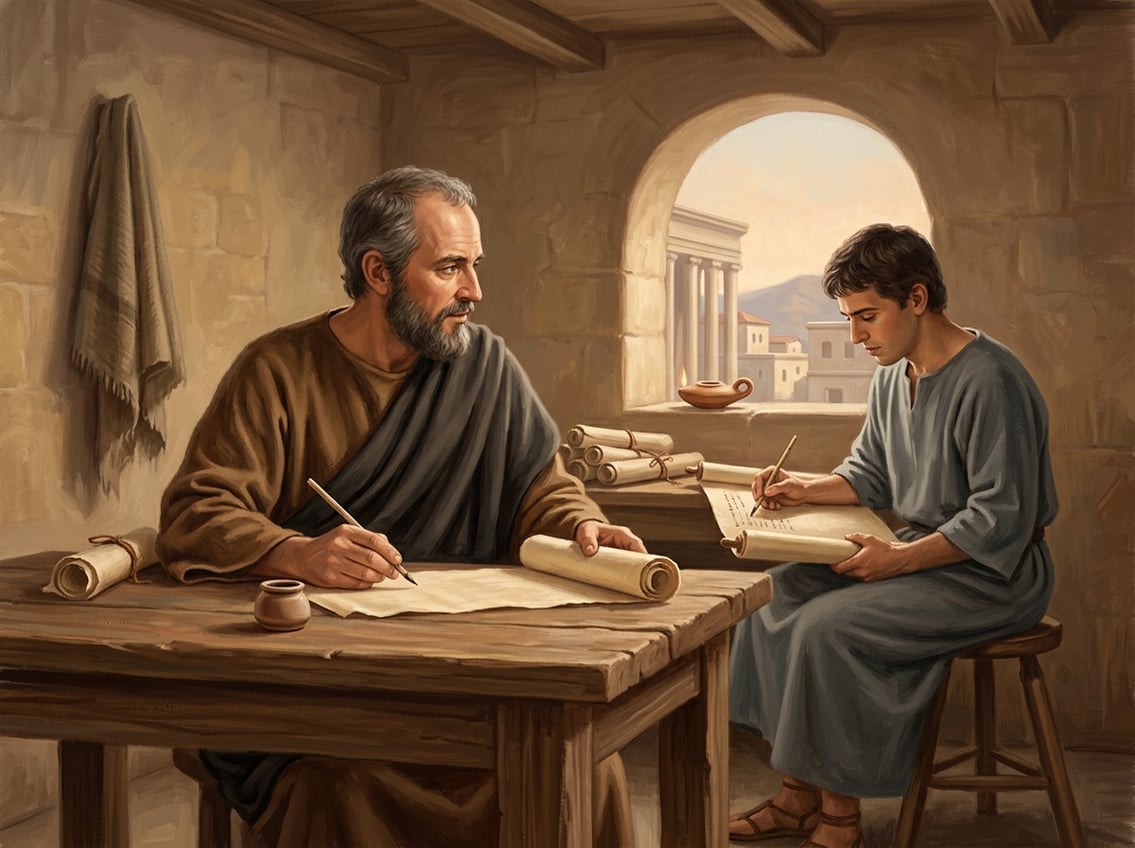
- Paul dictated the letter to a scribe named Tertius, a common practice for lengthy correspondence in the ancient world.
- Romans sits within the New Testament as the sixth book and the longest of Paul's epistles, addressing believers in Rome he had not yet personally met.
- The letter explains core Christian teaching on faith, grace, and salvation, making it one of the most studied texts in the New Testament canon.
Paul the Apostle and the Letter's Opening Claim
The opening line of Romans identifies its author in clear terms, and this claim has stood as the starting point for nearly all scholarly discussion of the letter. Paul's background, his sense of calling, and the letter's place among his other writings all support the traditional view of authorship.
Paul's Identification in Romans 1:1
Romans 1:1 opens with a direct statement: "Paul, a servant of Jesus Christ, called to be an apostle, separated unto the gospel of God." This is not a subtle reference. Paul the Apostle names himself in the very first word of the letter, a pattern common in ancient letter writing.
This self-identification matches how Romans opens with Paul's name as recorded in the earliest manuscripts. The claim has been accepted by the church since the earliest centuries after the letter was written. Unlike some New Testament writings whose authorship is debated, Romans 1:1 leaves little room for confusion about who wrote it.
Paul's Calling to Proclaim the Gospel
Paul describes himself as "separated unto the gospel of God" in Romans 1:1. This phrase points to a specific mission tied to spreading the gospel of Jesus Christ across the Roman world.
Paul's background as a Pharisee shaped how he approached this calling. He had trained under Jewish law before his conversion, and this training shows up in the way he argues points throughout Romans.
Key facts about Paul's calling include:
- He describes himself as set apart specifically for gospel work, not general ministry
- His conversion occurred in the early 30s AD, according to Paul's religious background as a Hellenistic Jew
- He had already evangelized regions around the Aegean Sea before writing Romans
- His stated goal was to reach Spain, using Rome as a stop along the way
Why Romans Is Counted Among the Undisputed Letters
Romans belongs to a group scholars call Paul's undisputed letters. These are letters that nearly all New Testament scholars agree Paul actually wrote, based on writing style, vocabulary, and theological consistency.
The undisputed letters include:
| Letter | Common Scholarly Agreement |
|---|---|
| Romans | Undisputed |
| 1 Corinthians | Undisputed |
| Galatians | Undisputed |
| Philippians | Undisputed |
Pauline authorship of Romans is supported by more than internal claims. Early church writers cited the letter as Paul's work well before the end of the second century, and external evidence for Pauline origin includes references from Apostolic Fathers and consistent placement in early New Testament lists. This combination of internal claims and external confirmation has made the authorship of Romans one of the least disputed questions in New Testament scholarship.
Evidence Supporting Pauline Authorship
Scholars point to several types of proof when identifying who wrote the Epistle to the Romans. This includes internal evidence found in the text itself, external evidence from early Christian writers, and physical manuscripts that trace the letter's history.
Internal Evidence From Language, Style, and Theology
The letter opens by naming Paul as its author, which is the most direct internal evidence available.
The writing style also matches Paul's other confirmed letters. Romans uses a method called diatribe, where the author raises objections and answers them, almost like a debate. This same technique appears in 1 Corinthians and Galatians.
The theology in Romans lines up with Pauline theology found elsewhere in the New Testament. Key ideas repeat across his letters:
- Justification by faith, not by following the law
- Salvation offered to both Jews and Gentiles
- The role of grace in Christian life
- Death and resurrection tied to spiritual renewal
New Testament scholar James D. G. Dunn has written extensively on how these theological patterns connect Romans to Paul's broader body of work.
External Evidence From Early Christian Writers
Early church leaders treated Romans as a genuine Pauline letter almost from the start.
Irenaeus, writing in the second century, quoted Romans directly and attributed it to Paul. Tertullian did the same in his own writings, treating the letter as settled scripture rather than a disputed text.
Origen, an early Christian scholar known for detailed commentary work, wrote one of the first full commentaries on Romans. His work treated the letter as an authentic theological treatise from Paul, not a later addition.
These references appear across a wide range of early Christian literature and early Christian writings, showing that acceptance of Paul's authorship was widespread and consistent, not limited to one region or writer.
Manuscripts and the Early Transmission of Romans
Physical manuscript evidence supports the same conclusion.
Papyrus 46, one of the oldest surviving manuscripts of Paul's letters, includes Romans and dates to around 200 AD. This manuscript groups Romans together with other undisputed Pauline letters, rather than placing it separately.
The table below summarizes how manuscript evidence supports Pauline authorship:
| Evidence Type | Detail |
|---|---|
| Manuscript | Papyrus 46 |
| Approximate Date | c. 200 AD |
| Content | Contains Romans alongside other Pauline letters |
| Significance | Shows early grouping with confirmed Paul letters |
Later manuscripts consistently preserved this same order and attribution. This steady transmission history is a major reason why the field of New Testament studies rarely questions who wrote Romans, even when other biblical books face more debate.
Tertius, Dictation, and the Making of the Letter
The name Tertius appears only once in the Bible, but that single verse explains how the letter to the Romans was actually put into writing. Understanding his role clarifies why Paul is called the author even though he did not hold the pen.
What Romans 16:22 Says About Tertius
The verse: "I, Tertius, who wrote down this letter, greet you in the Lord" (Romans 16:22).
Key facts from this verse:
- Tertius identifies himself by name, not Paul.
- He states plainly that he wrote the letter.
- His greeting comes near the end, right before Paul resumes speaking in his own voice.
- The phrase "in the Lord" shows Tertius was a fellow Christian, not just a hired hand.
This brief interruption gives a rare, direct look at how Tertius's greeting fits into the closing verses of Romans.
The Role of an Amanuensis in Ancient Letter Writing
An amanuensis was a scribe who wrote down words as someone else spoke them. This was common practice for long or formal letters in the Roman world.
| Task | Who Did It |
|---|---|
| Speaking the message | Paul |
| Writing the words down | Tertius |
| Final greeting/signature | Sometimes Paul, in his own hand |
Paul is believed to have used this method for several letters, not just Romans. This pattern is described as Paul dictating his letters to scribes such as Tertius, a practice similar to a modern executive dictating a memo to an assistant, as explained in how dictation worked in the ancient world.
Why a Scribe Does Not Change the Author
Using a scribe did not change who was seen as the true author of the letter.
- Paul supplied the message and ideas.
- Tertius supplied the handwriting.
- The early church credited the letter to Paul, not Tertius.
- The letter's authority rests on Paul's apostolic role and the belief that it was inspired.
This distinction matters because Tertius's writing role does not diminish the letter's authority. The message stayed Paul's, even though someone else physically wrote it down.
When and Where Romans Was Written
Paul wrote Romans near the end of his third missionary journey, most likely from the Greek city of Corinth. The letter fits into a specific window of time in the mid-first century, and clues inside the text point to both the date and the location.
Corinth and the Third Missionary Journey
Paul wrote Romans while he was staying in Corinth. This stop came near the close of his third missionary journey, a trip recorded in the book of Acts.
At this point, Paul had already spent years preaching in cities across Asia Minor and Greece. He was getting ready to head to Jerusalem to deliver a financial gift to the poor believers there.
Paul had not yet visited Rome, but he planned to go there next. He also hoped to use Rome as a base for a future trip to Spain.
Key facts about this stage of Paul's journey:
- He was staying in the house of a man named Gaius in Corinth.
- His next planned stop was Jerusalem, not Rome.
- He wanted the Roman church's support for a mission trip to Spain.
- This period is described in the closing chapters of the book of Acts.
Dating Romans to AD 56 or AD 57
Most scholars date Romans to AD 56 or AD 57. Some place it slightly later, around AD 57-58, but the general range stays within a few years.
This dating comes from lining up events in Acts with outside historical records. One key marker is Acts 18:2, which mentions Emperor Claudius ordering Jews to leave Rome. That event is dated to around AD 49.
The table below shows how the timeline fits together.
| Event | Approximate Date |
|---|---|
| Claudius expels Jews from Rome | AD 49 |
| Paul's third missionary journey | AD 53-57 |
| Paul writes Romans from Corinth | AD 56-57 |
| Paul travels to Jerusalem | Shortly after |
This places Romans firmly in the mid-first century, making it one of Paul's later major letters.
Phoebe, Gaius, and Erastus as Historical Clues
Three names in Romans help confirm where and when Paul wrote the letter. Each person connects to Corinth in a specific way.
- Phoebe – Paul calls her a servant of the church in Cenchreae, a port town next to Corinth. She likely carried the letter to Rome on Paul's behalf.
- Gaius – Paul mentions staying in Gaius's house. Paul had also baptized a man named Gaius in Corinth, based on his first letter to the Corinthians.
- Erastus – Paul identifies him as the city's director of public works. Archaeologists have found an inscription in Corinth naming an Erastus who held a similar civic role.
These three names do not prove the letter's origin on their own. But together, they line up with Corinth as the most likely place Paul wrote the letter.
The Roman Church and Paul’s Purpose
The church in Rome was made up of both Jewish and Gentile believers who came together under unique circumstances shaped by Roman Empire politics. Paul’s reasons for writing to this community connect directly to his mission plans, the makeup of the church, and events tied to the Edict of Claudius.
A Mixed Community of Jewish and Gentile Believers
The church in Rome included both Jews and Gentiles who worshiped together as one body. This mix created tension at times, since Jewish believers often followed Old Testament law while Gentile believers did not share the same background.
Paul addressed both groups directly in his letter. He wanted Jewish and Gentile believers to understand that salvation comes through faith in the gospel of Jesus Christ, not through following Jewish law alone.
This message mattered because it dealt with real conflict. Gentile believers needed to know they were fully included in God's plan, and Jewish believers needed reassurance that their heritage still had value.
Paul’s Planned Visit to Rome and Mission to Spain
Paul had not yet visited the church in Rome when he wrote this letter. He explained that he planned to travel through Rome on his way to a new mission field in Spain.
Before that trip, Paul had other plans to carry out. Here is a simple breakdown of his intended path:
| Destination | Purpose |
|---|---|
| Jerusalem | Deliver financial aid to believers there |
| Rome | Visit believers and gain support |
| Spain | Begin new missionary work |
Paul hoped the Roman church would help support his trip to Spain. This letter served as an introduction, since he had never met most of the believers there in person.
The Impact of Claudius’s Edict on the Church
Roman Emperor Claudius issued an edict that removed Jews from the city of Rome. The Roman historian Suetonius recorded this event, noting that it happened due to disputes among the Jewish community, some of which may have involved early Christian teaching.
This edict changed the makeup of the church in Rome. With Jews forced out, the church became mostly Gentile for a period of time.
When Claudius died and Nero took power, the edict ended. Jewish believers returned to Rome, and the church once again became a mix of Jewish and Gentile believers. This shift likely added to the tension Paul addressed in his letter, since both groups had to learn how to worship together again after living apart.
How Romans Expresses Paul's Central Theology
Romans lays out Paul's full argument for how humanity moves from sin to salvation through faith in Jesus Christ. The letter moves step by step from the problem of sin to the solution found in grace, then explains how believers live once they receive that grace.
Sin, Condemnation, and the Need for Salvation
Paul opens his argument by establishing that all people share the same problem.
| Verse | Plain-English Meaning |
|---|---|
| Romans 3:23 | Everyone has sinned and fallen short of God's standard. |
| Romans 6:23 | Sin leads to death, but God offers eternal life as a free gift. |
Sin brings condemnation, according to Paul's letter, which is the state of being guilty before God. No one earns their way out of this condition through good behavior.
Redemption is the answer Paul presents. It means being bought back from sin's penalty through Christ's sacrifice, a point Britannica confirms as central to Paul's argument.
Justification by Faith and the Righteousness of God
Justification
Frequently Asked Questions
The authorship, purpose, and audience of Romans are well documented in the text itself and in early Christian tradition. Below are direct answers to the most common questions about who wrote this letter and why.
Who is traditionally credited with writing the Epistle to the Romans?
The apostle Paul is credited as the author of Romans. The letter opens with his name, and biblical scholars agree that Paul the Apostle composed the letter to explain salvation through Jesus Christ.
Key facts about authorship:
- Romans names its author in the very first word: "Paul."
- It is grouped with Paul's undisputed letters, meaning scholars have little debate about who wrote it.
- The writing style and theological themes match Paul's other letters.
Did Paul write Romans himself or dictate it to Tertius?
Paul dictated the letter, and a scribe wrote down his words. This was a common practice for long or formal letters in the ancient world.
- Paul is the author in terms of authorship and ideas.
- The physical writing was done by someone else, following normal letter-writing customs of the time.
- This method does not change who is credited as the writer of Romans.
Who was Tertius, and what was his role in writing Romans?
Tertius was the scribe who physically wrote the words of Romans as Paul spoke them. He is mentioned by name in Romans 16:22, where he sends his own greeting to the readers.
- Tertius acted as a secretary, not as the author.
- Paul is still recognized as the author because he was inspired to write the words, even though Tertius held the pen.
- This kind of scribal help was standard for long letters like Romans.
Why did Paul write the letter to the Romans?
Paul wrote Romans to explain core Christian teachings to a church he had not yet visited. The letter lays out ideas about faith, sin, grace, and salvation in a clear, organized way.
Main purposes of the letter:
- To introduce Paul and his teaching to the believers in Rome before his planned visit.
- To explain the gospel message in detail for a mixed audience of Jewish and non-Jewish believers.
- To address questions about the law, faith, and how people are made right with God.
The letter is often described as the clearest and most systematic explanation of Christian teaching found in the New Testament.
When was the Book of Romans written?
Paul likely wrote Romans around A.D. 57. This places it near the end of his third missionary journey.
- Paul wrote the letter while staying in Corinth, in the house of a man named Gaius.
- The timing lines up with Paul's plans to travel to Jerusalem and then to Rome.
- Most scholars place Romans among Paul's later letters, written after he had already established several churches.