Who Was Melchizedek in the Bible? A Memory Method That Sticks
His identity has no listed parents or genealogy in scripture, which adds to his role as a symbol of an eternal priesthood in Hebrews.
Posted by
 Eden
EdenRelated reading
Are Dinosaurs Mentioned in the Bible? A Retention Guide
The Bible does not explain how these creatures came to an end.
How Did Samuel Die in the Bible? Memory Science Guide
Samuel was buried at his own house in Ramah, the town connected to most of his life and work, according to the account of his death and burial in 1 Samuel 25.
How Did Saul Die in the Bible? Scripture Memory Method
The death of King Saul marks the end of Israel's first monarchy in the Old Testament.
TL;DR
- Melchizedek was a king and priest of Salem (likely early Jerusalem) who appears briefly in Genesis 14, blessing Abraham and receiving a tithe from him.
- His only other Old Testament mention is Psalm 110:4, which calls him a type of priesthood tied to God's chosen king.
- The New Testament book of Hebrews uses Melchizedek's example to explain the priesthood of Jesus Christ, showing a priesthood that is not based on family line.
- Melchizedek combined the roles of king and priest, a rare pairing in the Bible used later to describe Christ's authority.
- His identity has no listed parents or genealogy in scripture, which adds to his role as a symbol of an eternal priesthood in Hebrews.
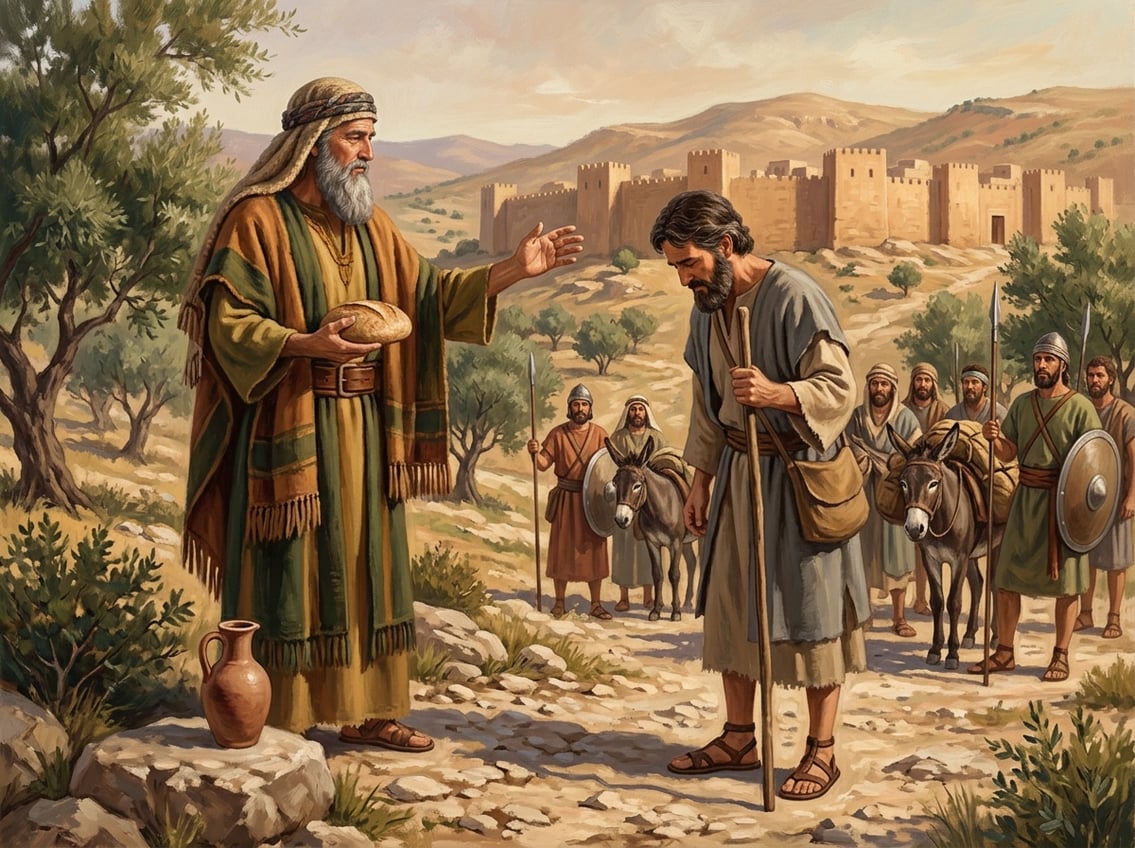
The Brief Biblical Portrait of Melchizedek
Melchizedek appears in only three verses in the Book of Genesis, yet those verses carry lasting meaning. His titles, actions, and the offerings he makes each point to a larger role in biblical history.
King of Salem and Priest of God Most High
Genesis 14:18-20 introduces Melchizedek with two titles at once.
| Title | Meaning |
|---|---|
| King of Salem | Ruler of Salem, widely identified as early Jerusalem |
| Priest of God Most High | Priest of El Elyon, a name for God used across ancient Near Eastern texts |
He holds both political and religious authority in one person. This dual role was rare in the ancient world, where kings and priests were usually separate people.
Melchizedek serves God Most High, not a local or tribal deity. His priesthood exists outside the Levitical system that Israel would later establish through Aaron.
The Meaning of King of Righteousness and King of Peace
Melchizedek's name and title carry direct meaning in Hebrew.
- Melchizedek translates to "king of righteousness"
- King of Salem translates to "king of peace," since Salem shares its root with the Hebrew word for peace
These two ideas, righteousness and peace, describe his character and rule. The Book of Hebrews later builds on this connection, using Melchizedek's name and city to describe qualities tied to Christ's kingship.
Righteousness comes first in the name order. Peace follows as a result of righteous rule, not as a separate or unrelated trait.
What Bread, Wine, Blessing, and Tithe Signify
Four actions define the encounter between Melchizedek and Abram.
- Melchizedek brings out bread and wine to Abram
- He blesses Abram in the name of God Most High
- Abram gives Melchizedek a tithe, a tenth of the goods recovered in battle
- Melchizedek credits God Most High as the source of Abram's victory
| Action | Common Interpretation |
|---|---|
| Bread and wine | Provision and hospitality; later linked to communion imagery |
| Blessing | Confirms Melchizedek's spiritual authority over Abram |
| Tithe | Abram recognizes Melchizedek's priestly status |
Abram's willingness to pay a tithe shows he accepted Melchizedek's priesthood as legitimate. This exchange appears again in Hebrews 7, where the tithe becomes evidence of Melchizedek's higher standing.
Why Melchizedek Met Abram After the Battle
Melchizedek's meeting with Abram was a direct result of a military conflict in Canaan. Understanding the war, the rescue of Lot, and Abram's response to the King of Sodom explains why this encounter took place.
Lot's Capture and Abram's Rescue Mission
Lot, Abram's nephew, lived in Sodom when a coalition of eastern kings attacked the region.
Key events:
- Four kings, led by Chedorlaomer, defeated the kings of Sodom and Gomorrah
- Lot was taken captive along with his possessions
- A survivor reported the news to Abram
- Abram gathered 318 trained men from his household
Abram pursued the invading kings north to Dan, then split his forces for a night attack.
He recovered Lot, the other captives, and all the stolen goods. This victory set up his return through the valley near Salem, where Melchizedek met him.
Chedorlaomer, the King of Sodom, and the War in Canaan
Genesis 14 describes a regional conflict between two groups of kings.
| Side | Kings Involved |
|---|---|
| Eastern coalition | Chedorlaomer (king of Elam) and three allied kings |
| Canaanite cities | The King of Sodom and four allied city-kings |
The eastern kings had ruled over Sodom and nearby cities for twelve years. In the thirteenth year, the Canaanite kings rebelled.
Chedorlaomer's coalition crushed the rebellion and plundered Sodom and Gomorrah. Abram's rescue of Lot reversed this defeat and freed the captured people and goods.
This victory placed Abram in a position of strength when he returned to Canaan, which is why both Melchizedek and the King of Sodom came out to meet him.
Why Abram Refused the King of Sodom's Offer
After the battle, the King of Sodom offered Abram a deal.
The offer:
- Abram could keep all the recovered goods
- The King of Sodom would only take back the people
Abram's response:
- He refused to take anything, "from a thread to a sandal strap"
- He had already sworn an oath to God Most High
- He wanted no one to say the King of Sodom had made him rich
This refusal came right after Melchizedek blessed Abram and Abram gave him a tenth of everything he had recovered. By tithing to Melchizedek first, Abram showed that his loyalty and gratitude belonged to God, not to the king of a corrupt city later destroyed alongside Gomorrah.
Psalm 110 and the Promise of a Priest Forever
Psalm 110 is a short poem written by David that points to a future king who also holds a priestly office. It connects directly to Melchizedek by naming him as the pattern for this coming priest-king.
David's Royal and Priestly Messiah
Psalm 110 opens with a striking line: "The LORD says to my Lord: 'Sit at my right hand, until I make your enemies your footstool'" (Psalm 110:1).
David wrote this psalm about a future ruler greater than himself. This ruler would hold two roles at once: king and priest.
The New Testament identifies this figure as the Messiah. Jesus applies this verse to himself in the Gospels (Matthew 22:41-45; Mark 12:35-37; Luke 20:41-44), and the most frequently quoted Old Testament passage in the New Testament is this opening verse of Psalm 110.
David saw a ruler who would sit at God's right hand and also serve as a priest. This combination was unusual. Old Testament kings and priests were normally separate offices, held by different tribes.
What the Order of Melchizedek Means
Psalm 110:4 states the promise directly:
"The LORD has sworn and will not change his mind: 'You are a priest forever, in the order of Melchizedek.'"
Key points about this verse:
- It is a sworn oath, not a conditional promise.
- The priesthood is called "forever," meaning it does not end.
- The pattern for this priesthood is Melchizedek, mentioned only once before, in Genesis 14:18-20.
This oath means the coming priest-king would not follow the temporary Levitical system. Instead, his priesthood would follow an older, permanent model tied to Melchizedek, the priest-king of Salem who blessed Abraham.
The connection between Psalm 110:4 and Melchizedek is central to how the New Testament book of Heb
How Hebrews Connects Melchizedek to Jesus
The Book of Hebrews uses Melchizedek's brief appearance in Genesis to build a detailed case for Jesus as the ultimate high priest. Hebrews 7 draws direct comparisons between the two figures to show why Christ's priesthood surpasses the old system.
Without Genealogy and Resembling the Son of God
Hebrews 7:3 describes Melchizedek as "without father, without mother, without genealogy, without beginning of days nor end of life." This description mirrors the eternal nature of the Son of God.
Key points from this comparison:
- Melchizedek has no recorded family line in Genesis
- His priesthood does not depend on ancestry
- This lack of genealogy makes him "resembling the Son of God"
- Jesus, unlike Levitical priests, does not need a tribal record to serve as priest
| Feature | Melchizedek | Jesus |
|---|---|---|
| Genealogy | None recorded | Eternal Son of God |
| Beginning/End | Not mentioned | Eternal existence |
| Priestly basis | Direct appointment | Divine appointment |
This gap in Melchizedek's record serves a purpose. It gives the author of Hebrews a way to point to someone in the Old Testament whose priesthood does not rely on human descent, just like Christ's.
A Superior Priesthood and Better Covenant
The order of Melchizedek stands apart from the Levitical priesthood in several ways.
Levitical priests:
- Came from the tribe of Levi
- Served for a limited time
- Offered repeated sacrifices
- Operated under the old covenant
Christ's priesthood:
- Comes from the order of Melchizedek
- Lasts forever
- Requires one sacrifice, not many
- Establishes a new and better covenant
Hebrews argues that if the Levitical system were sufficient, there would be no need for a different kind of priest. Since Jesus fulfills the role described in Psalm 110:4, his priesthood replaces the old covenant with one based on grace.
Christ's Once-for-All Sacrifice and Continuing Intercession
Jesus Christ's work as high priest differs from earlier priests in both scope and duration.
Comparison of sacrificial systems:
| Aspect | Old System | Christ's Priesthood |
|---|---|---|
| Sacrifice | Repeated animal offerings | One sacrifice on the cross |
| Priest's lifespan | Limited by death | Eternal |
| Access to God | Through temple rituals | Direct intercession |
| Result | Temporary atonement | Permanent atonement |
Because Jesus lives forever, he continues his intercession for believers. Hebrews 7:23-28 states that earlier priests died and were replaced, but Christ remains in his role without interruption.
This ongoing intercession connects directly to the gospel message. Believers can approach God with confidence, knowing Christ's sacrifice covered sin once, and his continued presence offers mercy for ongoing need.
Was Melchizedek a Historical King, Shem, or a Christophany?
Three main theories explain Melchizedek's identity: a real Canaanite king-priest, the patriarch Shem, or a theophany pointing to Christ. Each view rests on different readings of Genesis 14, Hebrews 7, and Jewish tradition.
The Historical King-Priest Interpretation
Most scholars read Melchizedek as a literal person. He was the king of Salem and priest of El Elyon, ruling a real city in early Canaan.
Key facts:
- Salem is widely linked to early Jerusalem.
- He worshipped "God Most High," a title also used by Abram.
- His actions were ordinary royal and priestly duties: bringing bread and wine, giving a blessing, receiving a tithe.
- Some extra-biblical and archaeological references support that a king-priest structure existed in that region and era.
This view treats Melchizedek as a real historical figure, not a symbol or divine being. It shows that worship of one supreme God existed outside Abram's family line at that time.
The Jewish Identification With Shem
A long-standing Jewish tradition identifies Melchizedek as Shem, the son of Noah.
Supporting points:
- The Targum Jonathan, Targum Yerushalmi, and the Babylonian Talmud present Melchizedek's name as a title for Shem.
- Shem was still alive during Abram's lifetime, based on biblical genealogies, making the timeline possible.
- This identification later influenced Christian theologians such as Jerome, Luther, and Melanchthon.
This theory solves the mystery of Melchizedek's background by connecting him to a known biblical family line. It does not treat him as divine, but as a righteous descendant of Noah who kept true worship alive after the flood.
The Case For and Against a Pre-Incarnate Appearance of Christ
Some readers view Melchizedek as a Christophany, meaning Christ appeared in human form before his birth.
| Argument For | Argument Against |
|---|---|
| Hebrews 7:3 says he had no recorded father, mother, or genealogy, and his life "abides a priest continually" | This may describe a lack of priestly records, not literal eternal existence |
| His priesthood is used as a pattern for Christ's eternal priesthood | Hebrews presents him as a "type of Christ," a foreshadowing image, not Christ himself |
| Abram later saw Yahweh in human form in Genesis 17–18, showing such appearances happened | Most theologians hold that Old Testament theophanies were temporary appearances of the Son of God, not evidence Melchizedek himself was divine |
Mainstream theology favors the historical king-priest or Shem view. Melchizedek's priesthood is treated as a symbol pointing forward to Jesus Christ, not proof that he was Christ in disguise.
Later Jewish and Christian Interpretations
Jewish and Christian thinkers expanded on the short Genesis account of Melchizedek in different ways. Jewish writings from the Second Temple period gave him a role in end-times events, while Christian writers used him to explain ideas about Jesus and communion.
Melchizedek in Second Temple Literature and Qumran
Second Temple Jewish texts show growing interest in Melchizedek beyond the plain Genesis story. Writers in this period often turned him into a symbol tied to the future and to divine judgment.
The Dead Sea Scrolls community at Qumran took this even further. They saw Melchizedek as more than a historical king or priest.
Key points from this era include:
- Some Jewish texts placed Melchizedek in a heavenly role, not just an earthly one.
- Qumran writings connected him to the final days and to God's plan for justice.
- Rabbinic sources later linked him to Shem, Noah's son, as a way to explain his background.
This shift set the stage for later, more detailed writings found among the Dead Sea Scrolls.
11Q13, Belial, Judgment, and Redemption
A Qumran scroll known as 11Q13 gives Melchizedek a central place in a final judgment scene. This text describes him as a heavenly figure who acts on God's behalf.
In this scroll, Melchizedek is shown leading a fight against evil forces, including a figure called Belial. He is described as bringing freedom and judgment to God's people.
The scroll's main ideas:
| Element | Role in 11Q13 |
|---|---|
| Melchizedek | Heavenly judge and deliverer |
| Belial | Evil figure opposed by Melchizedek |
| Judgment | Final ruling in favor of God's people |
| Redemption | Freedom announced through Melchizedek |
This text shows that some Jewish groups saw Melchizedek as tied closely to their hopes for a coming rescue, similar to ideas about a messiah.
Careful Christian Reflection on Communion Imagery
Christian writers connected Melchizedek's bread and wine to later church practices. This link appears mainly in discussions of the Lord's Supper, also called communion.
The Epistle to the Hebrews builds on this connection, presenting Melchizedek's priesthood as a pattern for Christ's role. Early theology used this comparison carefully, since Genesis does not describe a formal ritual.
Main points in this area:
- Melchizedek brought out bread and wine as a blessing, not as a fixed ceremony.
- Some Christian theology later drew parallels between this act and communion practices.
- Writers were careful not to claim Genesis describes the Lord's Supper directly.
This reflection shaped part of Christian teaching on Melchizedek's priesthood and its link to Christ, without overstating the biblical evidence.
Frequently Asked Questions
Melchizedek raises several common questions about his identity, role, and connection to both Abraham and Jesus. Below are direct answers to the most common questions readers ask about this biblical figure.
Was Melchizedek a human or a divine figure?
Melchizedek was a human king and priest who ruled over Salem during Abraham's time.
He held two roles at once:
- King of Salem – a city later known as Jerusalem
- Priest of God Most High – he served God directly, without belonging to a specific priestly bloodline
His lack of recorded parents or family history has led some readers to view him as more than human. Most Bible scholars agree he was a real person who held a unique position as king and priest.
Is Melchizedek considered to be Jesus Christ?
Melchizedek is not Jesus, but the Bible uses him as a picture or type of Christ.
| Melchizedek | Jesus Christ |
|---|---|
| King of Salem (peace) | King of Peace |
| Priest of God Most High | Great High Priest |
| No recorded genealogy | Eternal, without beginning or end |
| Blessed Abraham | Blesses believers |
| Offered bread and wine | Instituted the Lord's Supper |
Some readers believe Melchizedek's sudden appearance in Genesis suggests a pre-incarnate appearance of Christ. This view is not certain, but it is a common interpretation.
What is the significance of the order of Melchizedek?
The order of Melchizedek refers to a type of priesthood that does not depend on family line or tribe.
Key facts about this priesthood:
- It existed before the priesthood of Levi
- It combined the roles of king and priest in one person
- Hebrews 7 uses it to show that Jesus holds a permanent priesthood, not tied to Jewish law
- It shows that God's plan for a priest-king began long before the Levitical system
This priesthood matters because it points forward to Christ, who serves as both king and priest forever.
Who were Melchizedek's parents or ancestors?
The Bible does not name Melchizedek's parents, tribe, or family line.
This absence of genealogy was unusual for the time. Ancient records almost always listed a person's family background.
Hebrews 7:3 describes him as having no recorded father, mother, or genealogy. This detail is used to show that his priesthood does not depend on human ancestry, unlike the priests who came from the tribe of Levi.
How is Melchizedek connected to Abraham?
Melchizedek and Abraham met once, right after Abraham won a battle.
Here is what happened, in order:
- Abraham defeated four kings who had captured his nephew Lot
- Melchizedek came out to meet Abraham
- He brought bread and wine
- He blessed Abraham in the name of God Most High
- Abraham gave him a tenth of everything he had captured
This meeting shows Melchizedek's role as both king and priest during Abraham's lifetime. It also set a pattern for tithing that appears later in the Bible.