What Is Marriage in the Bible? A Scripture Memory Method
The Bible does not give one single ceremony script, but it shows clear patterns for how marriage is formed and lived out.
Posted by
 Eden
EdenRelated reading
Are Dinosaurs Mentioned in the Bible? A Retention Guide
The Bible does not explain how these creatures came to an end.
How Did Samuel Die in the Bible? Memory Science Guide
Samuel was buried at his own house in Ramah, the town connected to most of his life and work, according to the account of his death and burial in 1 Samuel 25.
How Did Saul Die in the Bible? Scripture Memory Method
The death of King Saul marks the end of Israel's first monarchy in the Old Testament.
TL;DR
- Marriage in the Bible is a covenant between one man and one woman, made before God.
- It began at creation, when God brought Adam and Eve together as one flesh.
- Biblical marriage is meant to build companionship, allow procreation, and reflect God's love.
- Scripture points to marriage as a lasting bond built on loyalty and mutual care.
- The Bible does not give one single ceremony script, but it shows clear patterns for how marriage is formed and lived out.
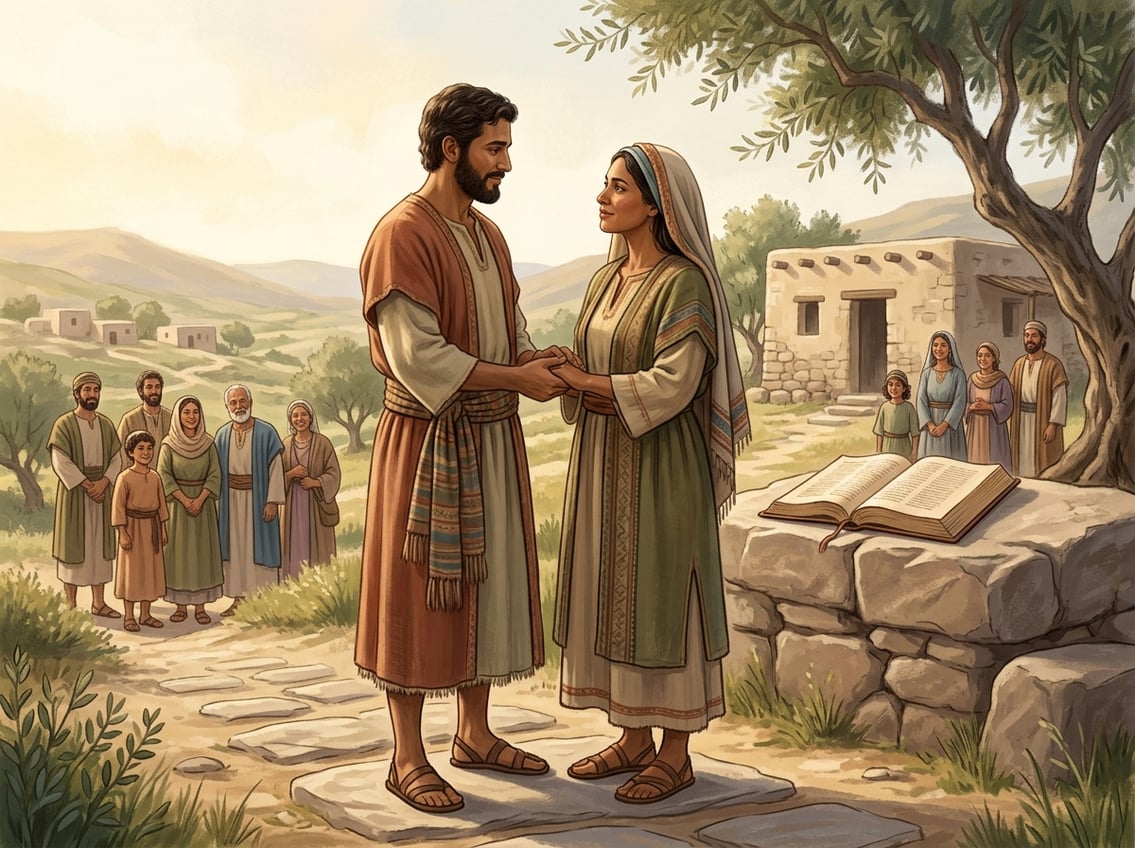
The Creation Pattern: Covenant, Companionship, and One Flesh
Genesis 2 lays out the first marriage as a covenant built on companionship, not just biology. The passage moves from God naming a problem, to God providing a solution, to God defining the union that results.
Adam and Eve as the Foundational Pair
| Verse | Text Summary | Plain-English Meaning |
|---|---|---|
| Genesis 2:18 | God says it is not good for man to be alone | Man needs a partner, not isolation |
| Genesis 2:20 | Adam names the animals but finds no suitable helper | No creature matches human companionship needs |
| Genesis 2:22 | God forms woman from the man's rib | Eve is made as his counterpart, not a separate creation |
Key facts about this pairing:
- Adam is described as needing a "helper fit for him" — a partner suited to work and live alongside him.
- Eve is the direct answer to the stated problem of aloneness.
- The pairing establishes male and female as the base unit for marriage in the creation account.
- This model is referenced again in Genesis 1:27-28, where God creates them male and female and blesses them.
Leaving, Cleaving, and Becoming One Flesh
Genesis 2:24 states the pattern that follows: a man leaves his parents, joins his wife, and the two become one flesh.
Structure of the verse:
- Leaving — the man separates from his birth family as the primary household.
- Cleaving — he holds fast to his wife in a new bond.
- One flesh — the union is described as a single physical and relational unity.
This structure is treated as God's creation ordinance for covenant union, meaning it applies beyond the first couple to marriage generally.
Related purpose: the same creation account links marriage to the command to be fruitful and multiply, tying companionship to procreation as a stated goal of the union, as outlined in the biblical purpose of marriage.
Covenant Faithfulness and Lifelong Commitment
Marriage in the Bible is treated as a binding promise made before God, not just a private arrangement between two people. This promise calls for lifelong loyalty between husband and wife and rules out divorce or adultery as options.
Marriage as a Public and Sacred Covenant
The Bible calls marriage a covenant, not a contract. A contract can end when terms change. A covenant is meant to last.
Key verse:
| Reference | Text | Meaning |
|---|---|---|
| Malachi 2:14 | God is "witness between you and the wife of your youth" | Marriage happens in God's presence, not just before people |
What this means for husband and wife:
- The relationship is witnessed by God, making it a sacred bond
- Breaking the covenant is described as "breaking faith" with a spouse
- The public nature of the vow adds weight to the promise made
This view of marriage shapes how believers see the seriousness of a marriage covenant established before God as a lifelong commitment, not a temporary agreement.
Jesus' Teaching on Unity, Divorce, and Separation
Jesus directly addressed marriage, unity, and divorce in his teaching. His words point back to the creation account and set a clear standard.
Core teachings:
| Reference | Teaching | Application |
|---|---|---|
| Matthew 19:4-6 | God made them male and female; the two become one flesh | Marriage forms a single unit, not two separate people |
| Matthew 19:5 | A man leaves his parents and is united to his wife | Marriage creates a new primary family bond |
| Matthew 19:6 | "What God has joined together, let no one separate" | Human effort should not break the marriage bond |
| Mark 10:9 | Repeats the command against separating what God joined | Reinforces permanence as God's design |
On divorce and adultery:
- Jesus taught that marriage is meant to be permanent
- He linked breaking the marital bond to adultery in certain contexts
- His teaching reflects the enduring nature of the marital bond taught by Jesus and Paul
These teachings form the foundation for viewing marriage as a lifelong, unbreakable union rather than a relationship that can be ended for convenience.
Love, Service, and Shared Responsibility
The Bible describes marriage as a relationship built on mutual submission, sacrificial love, and shared duty. These principles shape how spouses treat each other daily and how they carry responsibility together.
Mutual Submission and Honor Between Spouses
Ephesians 5:21 sets the tone for marriage by calling both spouses to mutual submission out of reverence for Christ. This is not one-sided control. It is shared respect.
Key verses on mutual honor:
| Verse | Core Instruction |
|---|---|
| Ephesians 5:31 | Husband and wife become "one flesh," a unified partnership |
| Ephesians 5:33 | Husband loves his wife; wife respects her husband |
| 1 Peter 3:7 | Husbands treat wives with understanding and honor |
| Colossians 3:18-19 | Wives submit; husbands love and avoid harshness |
| Colossians 3:19 | Husbands must not be bitter or harsh toward their wives |
These verses work together. No single verse stands alone as the full picture of marriage roles.
Plain-English meaning: Both spouses give up personal control for the good of the relationship. Honor flows in both directions, not just one.
Sacrificial Love and Respect in Daily Life
Ephesians 5:25 calls husbands to love their wives the way Christ loved the church—through sacrifice. This means putting the spouse's needs first, even at personal cost.
Core love passage for marriage:
1 Corinthians 13:4-7 describes love in action:
- Patient and kind
- Not jealous or boastful
- Not easily angered
- Keeps no record of wrongs
- Protects, trusts, hopes, and endures
Supporting principles:
- Colossians 3:14 calls love "the bond that makes everything else work together."
- Ephesians 4:3 calls for effort to keep peace and unity in relationships.
Daily application table:
| Situation | Biblical Response |
|---|---|
| Disagreement | Patience, no anger (1 Corinthians 13:4-7) |
| Stress or hardship | Understanding, honor (1 Peter 3:7) |
| Daily interaction | Kindness, unity (Ephesians 4:3) |
A healthy marriage reflects these patterns consistently, not just during easy seasons.
Sexual Intimacy, Fidelity, and the Marriage Bed
The Bible treats sexual intimacy as a gift meant only for marriage. It calls for mutual care between spouses and warns against sexual sin both inside and outside the marriage bond.
Mutual Care and Consent in 1 Corinthians 7
1 Corinthians 7 gives clear instructions on sexual duty between husband and wife.
| Verse | Instruction | Plain-English Meaning |
|---|---|---|
| 1 Corinthians 7:2 | "each man should have his own wife, and each woman her own husband" | Sex belongs inside marriage, one husband and one wife |
| 1 Corinthians 7:3 | Husband and wife owe each other marital duty | Both partners have a duty to meet each other's needs |
| 1 Corinthians 7:4 | Neither spouse has full authority over their own body | The body belongs to both partners equally |
| 1 Corinthians 7:5 | Do not deprive each other, except by agreement for a time | Withholding sex should only happen briefly and with mutual consent |
Key points:
- Sex in marriage is described as a shared duty, not a one-sided demand.
- Consent and agreement between spouses guide any pause in intimacy.
- The goal is to protect against temptation, since Paul warns that Satan may tempt those who lack self-control.
Sexual Purity Within and Outside Marriage
Hebrews 13:4 states that marriage should be honored and the marriage bed kept pure.
| Concept | Reference | Meaning |
|---|---|---|
| One flesh | Genesis 2:24 | Marriage joins husband and wife into one union |
| Marriage bed undefiled | Hebrews 13:4 | Sex is reserved only for husband and wife |
| Sexual immorality | 1 Corinthians 7:2 | Any sex outside marriage goes against God's design |
| Adultery | Hebrews 13:4 | Breaking marital fidelity brings judgment |
Sex outside marriage, including adultery, is called sexual immorality throughout scripture. Purity applies to both single and married people, though the boundaries differ:
- Married couples: Intimacy is expected and encouraged within the marriage.
- Unmarried individuals: Abstaining from sex is the standard until marriage.
- Both groups: Faithfulness and self-control are required to avoid sexual sin.
Marriage Practices in the Old Testament World
Old Testament marriage combined family duty with legal agreements. Parents arranged unions, dowries changed hands, and biblical accounts of wives and concubines describe how a household could grow and change.
Family Arrangements, Dowries, and Wedding Customs
Marriage in the Old Testament was rarely a private choice between two people. It was a family matter, often arranged by parents or other relatives.
Genesis 24 shows this clearly. Abraham sent a servant to find a wife for his son Isaac, and the servant negotiated with Rebekah's family before she ever met Isaac.
Money and goods often changed hands as part of the agreement. A dowry or bride price was paid to the woman's family, which linked the marriage to financial security for both households.
Key elements of these arrangements included:
- Parental involvement: Fathers usually selected spouses for their children.
- Bride price: A payment or gift given to the bride's family.
- Feasts: Celebrations that marked the marriage, sometimes lasting several days.
- Legal terms: Written or spoken agreements that defined each spouse's rights.
Proverbs 31:10 describes a wife of noble character as worth more than jewels, showing that a good marriage was seen as a valuable outcome of these arrangements. Proverbs 18:22 adds that finding a wife brings favor, framing marriage as a positive good rather than only a legal transaction.
Wives, Concubines, and Descriptive Biblical Narratives
The Old Testament describes households with both wives and concubines. A concubine held a lower social and legal status than a wife but was still part of the family structure.
This pattern appears in several accounts:
| Figure | Household Detail |
|---|---|
| Abraham | Had Sarah as wife and Hagar as concubine |
| Jacob | Married Leah and Rachel, with Bilhah and Zilpah as concubines |
| Solomon | Had many wives and concubines, according to the biblical record |
These accounts describe events; they do not present every practice as an ideal. Genesis and other books record what happened in these families, including tension between wives and conflict over inheritance.
Proverbs 20:6 notes that many people claim loyalty, but a faithful person is hard to find, a statement that reflects the value placed on trust within relationships, including marriage.
Discernment, Spiritual Partnership, and Gospel Hope
Choosing a spouse wisely and understanding marriage as a living picture of Christ's love for his church both point to the same truth: marriage carries a purpose bigger than the couple themselves.
Choosing a Spouse and Avoiding Unequal Yoking
The Bible gives clear guidance on picking a spouse who shares the same faith.
| Verse | What It Teaches |
|---|---|
| 2 Corinthians 6:14 | Warns against being unequally yoked with someone who does not share the same faith |
| Ecclesiastes 4:9-12 | Two people working together accomplish more than one person alone |
| Ecclesiastes 4:12 | A cord of three strands is not easily broken, showing the strength found when God is part of a marriage |
Discernment matters when choosing a spouse. A few things worth watching for:
- Shared faith and values
- Willingness to grow together spiritually
- Honesty about long-term goals
- Support from trusted people, such as family and church guidance
A biblical marriage works best when both people bring faith, patience, and honesty into the relationship.
Marriage as a Picture of Christ and the Church
Scripture often compares marriage to the bond between Christ and the church. This comparison shows what love and commitment are supposed to look like.
- Christ loves the church with sacrifice; husbands are called to love their wives the same way
- The church submits to Christ; wives are called to a similar respect toward their husbands
- Both relationships are built on loyalty, not convenience
This picture points
Frequently Asked Questions
The Bible presents marriage through specific verses, structured roles, and clear covenant terms that answer common questions about its definition, purpose, and practice today.
What is the biblical definition of marriage?
| Verse | Text | Meaning |
|---|---|---|
| Genesis 2:24 | "A man leaves his father and mother and is united to his wife, and they become one flesh." | Marriage forms a new family unit through physical and legal union. |
| Matthew 19:5-6 | "So they are no longer two, but one flesh." | Jesus confirms marriage as a permanent bond between one man and one woman, as defined in the Bible. |
| Mark 10:8 | "The two will become one flesh." | Repeats the Genesis teaching to show its lasting authority. |
Marriage in scripture is a covenant, not just a contract. It joins one man and one woman into a single unit recognized by God.
What is the purpose of marriage according to the Bible?
- Companionship – Genesis 2:18 says it is "not good for the man to be alone."
- Procreation – Genesis 1:28 instructs the couple to "be fruitful and multiply."
- Reflecting divine love – Ephesians 5:31-32 compares marriage to Christ's relationship with the church.
- Mutual support – Ecclesiastes 4:9-10 describes two people helping each other succeed.
These purposes work together. Marriage is not only personal, but also relational and symbolic in the biblical framework.