What Is a Prophet in the Bible? A Scripture Memory Method
Not all who claimed to speak for God were genuine; scripture warns of false prophets and gives ways to test their words against God's truth.
Posted by
 Eden
EdenRelated reading
Are Dinosaurs Mentioned in the Bible? A Retention Guide
The Bible does not explain how these creatures came to an end.
How Did Samuel Die in the Bible? Memory Science Guide
Samuel was buried at his own house in Ramah, the town connected to most of his life and work, according to the account of his death and burial in 1 Samuel 25.
How Did Saul Die in the Bible? Scripture Memory Method
The death of King Saul marks the end of Israel's first monarchy in the Old Testament.
TL;DR
- A prophet in the Bible is a person chosen by God to speak His messages to people, often called for repentance or warning of future events.
- The Bible names more than 130 prophets, including men and women, with roles ranging from Moses and Isaiah to lesser-known figures like Huldah and Agabus.
- Prophecy in scripture serves specific functions: revealing God's will, calling people back to faithfulness, and pointing forward to future events, including the coming of Jesus Christ.
- Biblical prophets often faced hardship, including rejection and persecution, because their messages challenged people to change.
- Not all who claimed to speak for God were genuine; scripture warns of false prophets and gives ways to test their words against God's truth.
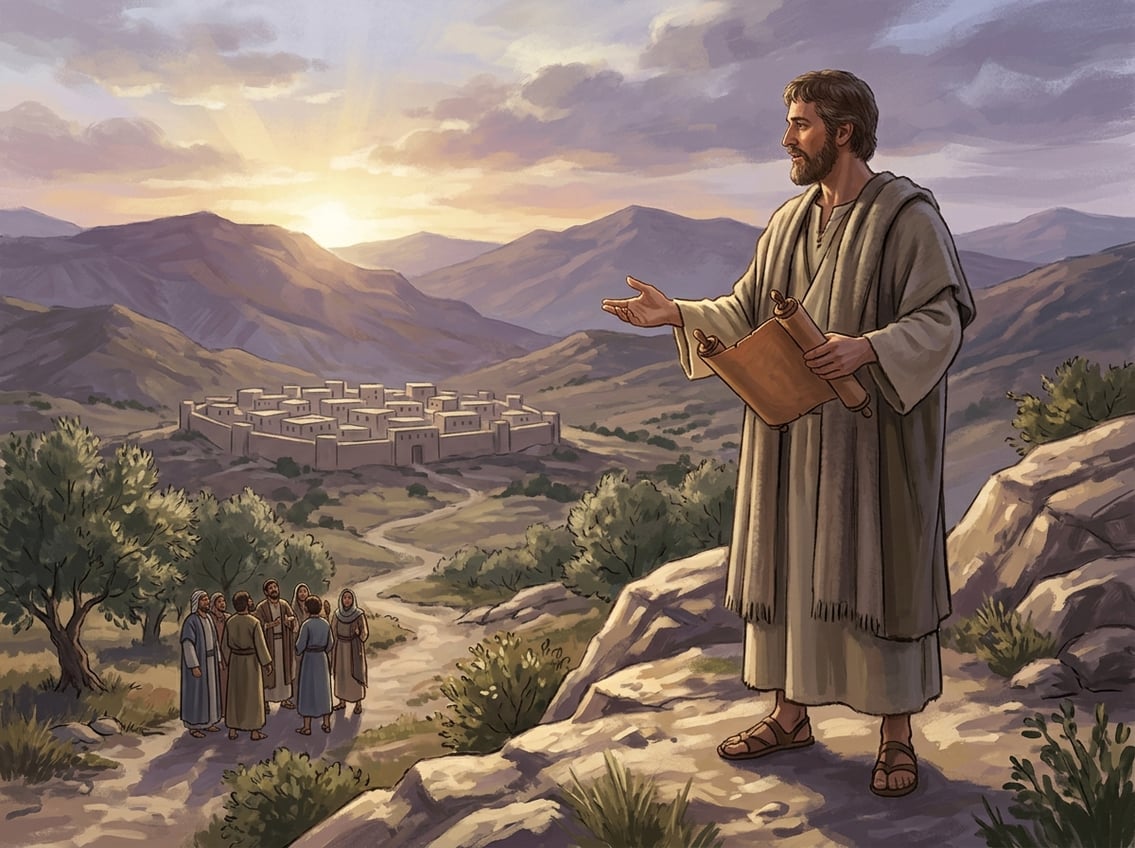
Definition, Calling, and Divine Authority
A biblical prophet is defined by three connected facts: a specific term identifies the role, a direct calling from God establishes the position, and the message delivered is not the prophet's own opinion. These three elements separate a true prophet from someone simply claiming spiritual insight.
What the Terms Navi and Prophetes Mean
The Hebrew word for prophet is navi, and the Greek word is prophetes. Both terms point to the same core idea.
| Term | Language | Basic Meaning |
|---|---|---|
| Navi | Hebrew (Old Testament) | Spokesman or one who is called |
| Prophetes | Greek (New Testament) | One who speaks on behalf of another |
Other Hebrew titles add detail to the role:
- Ro'eh – means "seer"
- Hozeh – also means "seer"
- 'Ish-ha'elohim – means "man of God"
Each term describes someone chosen to carry a message, not someone who invents one. The meaning of navi and prophetes centers on being a spokesman sent to deliver a specific message.
Speaking God's Word Rather Than Personal Opinion
A biblical prophet delivers God's word, not personal ideas or guesses about the future.
Key distinction:
| False Prophet | True Prophet |
|---|---|
| Speaks from personal imagination | Speaks only what God gives |
| Self-appointed | Directly commissioned by God |
| Message can be wrong or self-serving | Message reflects God's truth |
Jeremiah 23:16 warns against prophets who speak from their own minds instead of from God. 2 Peter 1:20-21 states that no prophecy came from personal interpretation.
This distinction matters because the authority of true prophets came from their direct calling, not from personal insight or reputation. The message itself, not the messenger's credentials, carries the weight.
How Divine Calling Shapes Prophetic Ministry
Divine calling is the starting point for every biblical prophet. Scripture shows this calling was often direct, personal, and hard to ignore.
Examples of prophetic calling:
- Moses – called at the burning bush, sent to confront Pharaoh
- Isaiah – called through a vision described in Isaiah 6:1-8
- Jeremiah – called with a specific commission in Jeremiah 1:4-10
This pattern shows that prophetic calling often involved a clear encounter with God that set the person apart for the role.
Divine calling also shapes ongoing ministry:
- God selects the person, not the reverse.
- God provides the words to speak (Deuteronomy 18:18).
- The prophet delivers the message without altering it.
- The prophet may face resistance, as Jeremiah did during his imprisonment.
Gender did not limit this calling. Deborah and Miriam both served as prophets, showing that God's calling extended to women as well as men throughout the Old Testament.
The Messages Prophets Brought
Prophets carried messages that mixed present-day instruction with future warnings, all rooted in Israel's relationship with God. Their words called people back to loyalty, exposed sin, and pointed toward what God planned to do next.
Forth-Telling, Foretelling, and Biblical Prophecy
Prophetic speech had two main forms:
- Forth-telling: Speaking God's message for the current moment, often correcting behavior or announcing His will.
- Foretelling: Predicting future events, including judgment, exile, or restoration.
Prophets often received these messages through visions or dreams. Isaiah, for example, described a vivid vision of God's throne room before he began his ministry. Ezekiel recorded detailed visions while in exile in Babylon.
| Method | Example |
|---|---|
| Vision | Isaiah 6 (throne room) |
| Dream | Daniel 2 (Nebuchadnezzar's dream) |
| Direct word | Jeremiah 1 (call to prophesy) |
This dual role—speaking to the present and the future—shaped how prophets delivered God's messages to Israel across centuries.
Covenant Faithfulness, Repentance, and Idolatry
God had made a covenant with Israel, and prophets often measured the nation against it. Their messages focused on three recurring problems:
- Broken covenant faithfulness – Israel ignoring the terms of their agreement with God.
- Idolatry – worship of false gods instead of the one true God.
- Lack of repentance – refusal to turn back after being warned.
Hosea used his own marriage as a picture of Israel's unfaithfulness to God. Jeremiah repeatedly called the nation to repentance before Jerusalem's fall. These key prophetic themes appear across both major and minor prophetic books, showing a consistent pattern of warning tied to covenant terms.
Judgment, Justice, Restoration, and Redemption
Prophetic messages balanced warning with hope. Common themes included:
- Judgment – consequences for breaking the covenant,
Prophetic Voices in the Old Testament
Prophetic voices in the Old Testament appear across many centuries, from early leaders who guided the nation to writers whose books still carry their names. These figures ranged from national leaders like Moses to court advisers, miracle workers, and writers whose short but powerful messages targeted specific nations and moments in history.
Early Leaders and Court Prophets
The earliest prophetic figures often held other major roles too.
- Abraham: called by God to leave his home and became the father of the Hebrew nation.
- Jacob: received prophetic promises about his descendants and blessed his sons before his death.
- Joseph: interpreted dreams in Egypt and predicted seven years of famine.
- Moses: led Israel out of Egypt and is often called the first major prophet in Jewish tradition.
- Joshua: succeeded Moses and led Israel into the promised land.
- Samuel: anointed both Saul and David as kings and served as Israel's last judge.
Court prophets advised kings directly. Nathan confronted David about his sin with Bathsheba. Gad served as David's seer and delivered God's judgment after David's census.
Elijah, Elisha, and Confronting Baal Worship
Elijah and Elisha stand out for their direct clashes with idol worship.
| Prophet | Key Action | Opponent |
|---|---|---|
| Elijah | Called down fire on Mount Carmel | King Ahab and prophets of Baal |
| Elisha | Performed miracles, including healing and multiplying food | Continued Baal worship in Israel |
Elijah's contest on Mount Carmel proved that Baal had no power, while the Lord answered with fire (1 Kings 18). Ahab's marriage to Jezebel brought Baal worship into Israel's royal court, which both prophets resisted.
Elisha inherited Elijah's role after Elijah was taken up in a whirlwind. He continued warning kings and performing miracles that pointed back to God's power over false gods, a theme covered in this detailed guide to Old Testament prophets.
The Major Prophets and Their Written Books
The major prophets get their name from the length of their books, not their importance.
- Isaiah: wrote about judgment and hope, including prophecies about a coming Messiah.
- Jeremiah: warned Jerusalem of coming destruction and wrote during the Babylonian crisis.
- Ezekiel: prophesied during the exile and used vivid symbolic visions.
- Daniel: served in the Babylonian and Persian courts and recorded prophecies about future kingdoms.
These four writers make up what scholars call the major prophets. Their books contain some of the longest and most detailed prophecies in scripture, including messages tied to Jerusalem's fall and later restoration, a pattern explained in this overview of prophetic literature.
The Minor Prophets and Their Shorter Messages
The minor prophets wrote shorter books, often addressing specific nations or crises.
| Prophet | Main Focus |
|---|---|
| Hosea | Israel's unfaithfulness compared to a broken marriage |
| Joel | A locust plague as a sign of judgment |
| Amos | Social injustice in Israel |
| Obadiah | Judgment against Edom |
| Jonah | A reluctant mission to Nineveh |
| Micah | Corruption among Israel's leaders |
| Nahum | The fall of Nineveh |
| Habakkuk | Questions about why evil goes unpunished |
| Zephaniah | Coming judgment on Judah |
| Haggai | Rebuilding the temple after exile |
| Zechariah | Visions of restoration and a future king |
| Malachi | Israel's neglect of proper worship |
These twelve writing prophets are grouped by length, not by lesser importance. Their messages cover a wide range of concerns, from Jonah's mission to Nineveh to Malachi's final warnings before the New Testament era, as outlined in this [breakdown of pr
Jesus and Prophecy in the New Testament
The New Testament shows prophecy moving from Old Testament prediction to real-time fulfillment in Jesus Christ. John the Baptist prepared the way, Jesus fulfilled messianic prophecies, and the early church carried prophetic gifts forward through the Holy Spirit.
John the Baptist and the Preparation for the Messiah
John the Baptist served as the last Old Testament-style prophet and the bridge to the New Testament. He announced the coming Messiah before Jesus began his public ministry.
| Person | Scripture | Role |
|---|---|---|
| John the Baptist | Matthew 3:1-3 | Announced the Messiah's arrival |
| Anna | Luke 2:36-38 | A prophetess who recognized Jesus as the Messiah at the temple |
Key facts about John the Baptist:
- He preached repentance and baptized people in the Jordan River.
- He quoted Isaiah's prophecy about "a voice crying in the wilderness."
- He identified Jesus as the one who fulfilled Old Testament prophecy about the coming prophet like Moses.
Jesus Christ as Prophet, Messiah, and Son of God
Jesus fulfilled three Old Testament roles at once: prophet, priest, and king. He spoke God's word, revealed future events, and claimed the title Son of God.
| Role | Example | Reference |
|---|---|---|
| Prophet | Predicted his own death and resurrection | Matthew 16:21 |
| Messiah | Fulfilled prophecies about the coming king | Mat |
Testing Prophetic Claims and Avoiding Deception
The Bible gives clear signs that separate a true prophet from a false one. These signs focus on accuracy, character, and loyalty to God's word.
Marks of a True Prophet
Scripture lists specific tests believers can use to check a prophetic claim.
| Test | What It Means |
|---|---|
| Accuracy | Predictions must come true every time (Deuteronomy 18:22) |
| Scripture agreement | The message cannot contradict God's revealed word |
| Christ-centered | A true message points to Jesus, not away from Him |
| Good fruit | The prophet's life and character match the message |
| Church benefit | The word builds up believers instead of causing confusion |
These four key tests work together. No single test stands alone.
A message that fails even one test should raise concern.
False Prophets in Israel and the Church
False prophets have shown up throughout biblical history. King Ahab kept 400 prophets of Baal who told him only what he wanted to hear, not God's truth.
Jesus warned His followers directly. In Matthew 7:15, He said false prophets come "in sheep's clothing" but are "ferocious wolves" underneath.
The book of Revelation describes a false prophet who will deceive people worldwide during the end times.
Common traits of false prophets include:
- Flattering words instead of hard truth
- Messages that serve personal gain
- Claims that contradict earlier scripture
- Predictions that fail to come true
Biblical prophets never showed these patterns. Their words matched what God had already said.
Why Faithfulness to Scripture Is the Essential Test
Every valid prophetic word must align with the Bible. This single standard cuts through confusion faster than any other check.
Key points:
- A true prophet never contradicts God's word
- Covenant faithfulness means staying true to what God already revealed
- New messages build on scripture, they never replace it
- Testing prophetic claims protects believers from being misled
Micaiah gave a clear example of this standard. He told King Ahab, "I can tell him only what my God says," even when it cost him popularity.
This remains the core test today. If a message lines up with scripture, it passes the first and most important check.
Reading the Prophets With Context and Care
Biblical prophecy makes the most sense when readers connect it to real events in Israel's history and understand that a single message can point to both a near event and a distant one. This background also helps readers judge claims made by prophets today.
Connecting Prophetic Books to Israel's History
Each prophetic book was written for a specific audience facing a specific crisis. Reading the text without this background often leads to confusion.
| Prophet | Approximate Time | Historical Event Addressed |
|---|---|---|
| Isaiah | 8th century BC | Assyrian threat against Judah and Jerusalem |
| Jeremiah | 7th–6th century BC | Babylonian invasion and exile of Judah |
| Ezekiel | 6th century BC | Israel's exile in Babylon |
| Hosea | 8th century BC | Northern Israel's covenant unfaithfulness |
| Haggai | 6th century BC | Rebuilding the temple after the exile |
Placing a prophetic book next to the matching section of Kings or Chronicles gives the political and social background needed to understand the message. Without this step, a reader may miss why a prophet spoke a certain warning to Jerusalem or Israel at that exact moment.
Recognizing Immediate and Future Dimensions of Prophecy
Many prophecies carry two layers of meaning: one for the prophet's own time and one for a later time.
- Immediate meaning: A warning about an enemy invasion, a call to return to God, or a judgment on a specific city or king.
- Future meaning: A pointer to a later event, such as the exile's end or the coming of the Messiah.
- Delivery method: Prophets often received messages through visions and dreams, not just direct speech.
- Confirmation pattern: God explains His plans to prophets before acting, showing His sovereignty over history.
Ezekiel's shaved beard and Isaiah's bare feet were not random acts. Each symbolic action carried a message about Jerusalem's coming judgment that unfolded in stages, first in the prophet's lifetime and later in a broader sense.
Considering What Prophets Today Can and Cannot Claim
Scripture sets a clear standard for testing a prophetic claim.
What a claim can involve:
- A call to renewed faithfulness to God
- Encouragement drawn from biblical patterns
- A warning based on moral or spiritual principles already in Scripture
What a claim cannot involve:
- New revelation equal in authority to Scripture
- A prediction that fails to happen, since a true prophetic word must come to pass
- A message that contradicts the character or commands of God
The test from Deuteronomy still applies: if a predicted event does not happen, the message did not come from God. This standard protects readers from false claims while respecting the unique role biblical
Frequently Asked Questions
These questions cover how prophets served God, how they were chosen, and how to identify true prophetic messages using patterns found across scripture.
What is the role of a prophet in the Bible?
A prophet spoke for God. This role had two main parts:
- Teaching role: Explained God's truth for the present moment
- Revealing role: Shared details about future events
Isaiah is a clear example. He spoke against the wrongdoing of his time (Isaiah 1:4) and also shared visions about Israel's future (Isaiah 25:8). This dual role helped guide the nation and build the foundation for what a prophet does in the Bible.