What Are the Beatitudes in the Bible? Memory That Sticks
Christianity treats the Beatitudes as a foundational summary of how believers are meant to live and relate to others.
Posted by
 Eden
EdenRelated reading
Are Dinosaurs Mentioned in the Bible? A Retention Guide
The Bible does not explain how these creatures came to an end.
How Did Samuel Die in the Bible? Memory Science Guide
Samuel was buried at his own house in Ramah, the town connected to most of his life and work, according to the account of his death and burial in 1 Samuel 25.
How Did Saul Die in the Bible? Scripture Memory Method
The death of King Saul marks the end of Israel's first monarchy in the Old Testament.
TL;DR
- The Beatitudes are eight (or nine, depending on how verses are grouped) blessings that Jesus spoke during the Sermon on the Mount, recorded in Matthew 5:3-12.
- Each beatitude follows a "blessed are..." pattern that names a quality, such as humility or mercy, and pairs it with a promised reward, like comfort or inheriting the earth.
- The significance of the Beatitudes comes from how they reset priorities in Christian teachings, placing character and inner posture above wealth, power, or status.
- Jesus used the Beatitudes to describe who God favors, covering traits like poverty of spirit, mourning, meekness, and peacemaking.
- Christianity treats the Beatitudes as a foundational summary of how believers are meant to live and relate to others.
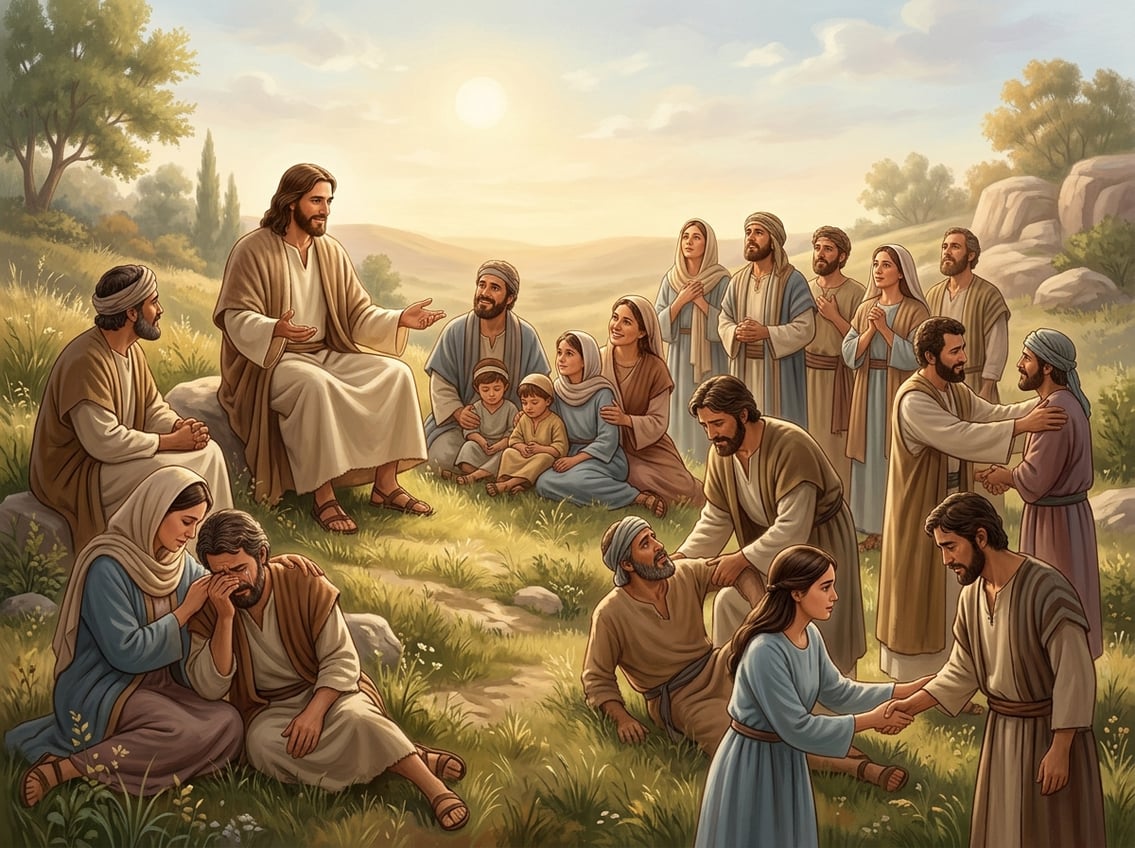
The Eight Blessings in Matthew 5
Jesus lists eight blessings in Matthew 5:3-12, each pairing a quality or condition with a specific promise. Each line follows the same pattern: "Blessed are..." followed by a reward tied to God's kingdom.
The Full Pattern of Blessing and Promise
Every beatitude follows a two-part structure: a description of a person, then a promise.
| # | Blessed Are... | The Promise |
|---|---|---|
| 1 | The poor in spirit | Theirs is the kingdom of heaven |
| 2 | Those who mourn | They will be comforted |
| 3 | The meek | They will inherit the earth |
| 4 | Those who hunger and thirst for righteousness | They will be filled |
| 5 | The merciful | They will be shown mercy |
| 6 | The pure in heart | They will see God |
| 7 | The peacemakers | They will be called sons of God |
| 8 | Those persecuted for righteousness | Theirs is the kingdom of heaven |
This pattern repeats across all eight lines. Each blessing names a trait, and each promise answers it directly.
Why Matthew 5:3–12 Is Usually Counted as Eight Beatitudes
The word "beatitude" comes from the Latin beati, meaning "blessed" or "happy." In Matthew 5:3-10, eight distinct blessings appear, each following the same short format.
Some scholars count a ninth line in verses 11-12, since Jesus adds more detail there. But most lists group these final verses as an extension of the eighth blessing, not a separate one.
This is why most teaching resources refer to eight beatitudes, even though the passage runs through verse 12.
The Closing Blessing for Those Insulted for Jesus' Sake
Matthew 5:10-12 closes the list with a blessing aimed directly at the listeners, not a general group.
The text:
- Verse 10: "Blessed are those who are persecuted for righteousness' sake, for theirs is the kingdom of heaven."
- Verse 11: "Blessed are you when others revile you and persecute you and utter all kinds of evil against you falsely on my account."
- Verse 12: "Rejoice and be glad, for your reward is great in heaven, for so they persecuted the prophets who were before you."
This shift from "blessed are those" to "blessed are you" makes the passage personal. Jesus links this suffering to the treatment of Israel's prophets, placing his followers in that same line.
Meaning of Each Beatitude
Each Beatitude names a specific quality or situation, followed by the blessing that comes with it. The list moves from inner humility to outward action, ending with the cost of living out these values.
Poor in Spirit and the Kingdom of Heaven
Verse: "Blessed are the poor in spirit, for theirs is the kingdom of heaven." (Matthew 5:3)
Meaning:
- "Poor in spirit" means recognizing a lack of spiritual resources on one's own.
- It is not about money. It is about admitting a need for God.
- The reward is direct access to the kingdom of heaven, also called the kingdom of God in other Gospel passages.
Quick contrast:
| Poor in Spirit | Not Poor in Spirit |
|---|---|
| Admits need for God | Relies only on self |
| Open to correction | Resistant to guidance |
| Seeks God's help | Trusts personal achievement |
Mourning, Comfort, and Hope
Verse: "Blessed are those who mourn, for they shall be comforted." (Matthew 5:4)
Meaning:
- Mourning here can mean grief over loss, sorrow over personal sin, or sadness about wrongdoing in the world.
- The promise is comfort, meaning God responds to genuine sorrow with support and relief.
Types of mourning covered:
- Grief over a death or loss
- Sorrow over personal mistakes or sin
- Sadness about injustice or suffering in general
Each type points to the same result: those who mourn are not ignored. They receive comfort.
Meekness and Inheriting the Earth
Verse: "Blessed are the meek, for they shall inherit the earth." (Matthew 5:5)
Meaning:
- Meekness is not weakness. It means having strength under control.
- The meek choose patience and restraint instead of forcing their way.
- The reward is to inherit the earth, meaning lasting stability and security.
Meekness compared to weakness:
| Meekness | Weakness |
|---|---|
| Controlled strength | No strength to control |
| Chosen restraint | Forced passivity |
| Confident patience | Fearful avoidance |
Meekness reflects a decision to hold back power, not an absence of power.
Hunger and Thirst for Righteousness
Verse: "Blessed are those who hunger and thirst for righteousness, for they shall be satisfied." (Matthew 5:6)
Meaning:
- Hunger and thirst after righteousness describes an intense, active desire for doing what is right.
- Righteousness relates closely to justice: treating people fairly and living according to God's standards.
- This is not passive interest. It is compared to physical hunger, a need strong enough to drive action.
Key point: The blessing goes to those who actively seek what is right, not those who simply agree it matters.
Mercy, Forgiveness, and the Merciful
Verse: "Blessed are the merciful, for they shall obtain mercy." (Matthew 5:7)
Meaning:
- Mercy means showing compassion to those who are struggling or who have done wrong.
- The merciful extend grace and forgiveness to others, rather than holding onto anger or judgment.
- The reward is a direct exchange: mercy given results in mercy received.
Ways mercy shows up:
- Forgiving someone who caused harm
- Helping someone in need without judgment
- Choosing understanding over blame
Purity of Heart and Seeing God
Verse: "Blessed are the pure in heart, for they shall see God." (Matthew 5:8)
Meaning:
- Pure in heart does not mean never having a bad thought.
- It means having a heart that is not divided, focused on one purpose instead of competing motives.
- The pure in heart are promised they will see God, meaning a closer, clearer relationship with Him.
Two parts of purity of heart:
- Undivided focus – committed to one goal, not pulled in many directions
- Clean intent – motives aligned with what is right, not hidden agendas
Peacemaking and Becoming Children of God
Verse: "
Setting Within the Sermon on the Mount
The Beatitudes open the Sermon on the Mount, a speech Jesus gave early in his ministry. The setting shapes how readers understand the audience, the message, and the roots of these teachings in Jewish scripture.
Jesus' Audience, Disciples, and the Galilean Setting
Matthew 5:1 places the sermon on a mountain in Galilee. Jesus sat down to teach, a common posture for rabbis of that time.
Key details about the setting:
| Detail | Description |
|---|---|
| Location | A mountainside near the Sea of Galilee |
| Primary audience | Jesus' disciples |
| Secondary audience | Large crowds from Galilee, Judea, and Jerusalem |
| Posture | Jesus sat, a formal teaching position |
The crowd came from a wide area. This shows Jesus' growing reputation before he reached Jerusalem.
His words targeted disciples first. But the message reached anyone willing to listen, including future followers still deciding whether to commit to discipleship.
How the Blessings Introduce the Rest of the Sermon
The Beatitudes work as an opening statement. They set the tone for everything that follows in Matthew 5-7.
The blessings introduce themes Jesus expands later in the sermon:
- Poor in spirit connects to teachings on humility and reliance on God
- Those who mourn links to comfort promised throughout the sermon
- Meekness ties to later instructions on non-retaliation
- Hunger for righteousness points to Jesus' fulfillment of the law
- Mercy and purity of heart connect to teachings on judgment and motives
Right after the blessings, Jesus calls his followers salt of the earth and light of the world. These images build directly on the Beatitudes. They tell disciples how to live out the qualities just described.
Old Testament Background and the Prophetic Tradition
The Beatitudes draw on ideas found throughout the Old Testament. They echo language used by Hebrew prophets, especially in passages about comfort and justice for the poor.
Isaiah 61 contains similar themes:
| Isaiah 61 Theme | Beatitude Connection |
|---|---|
| Good news to the poor | Blessed are the poor in spirit |
| Comfort for mourners | Blessed are those who mourn |
| Binding up the brokenhearted | Blessed are the meek |
Jesus also positioned himself in relation to Moses, who delivered the law from a mountain. By teaching from a mountainside, Jesus echoed that pattern.
His teaching often contrasted with the scribes and Pharisees, religious leaders known for strict legal interpretation. The Beatitudes present a different kind of righteousness, one based on inner character rather than external rule-keeping.
What "Blessed" Means in Biblical Context
The word "blessed" in the Bible points to a state of divine favor, not a fleeting emotion. It connects to God's kingdom values, grace, and a person's standing before God rather than circumstances.
| Term | Language | Core Meaning |
|---|---|---|
| Makarios | Greek | Fortunate, blessed, favored by God |
| Ashrey | Hebrew | "The good life," a state of flourishing |
| Barukh | Hebrew | Blessing that comes directly from God |
Divine Favor Rather Than Temporary Happiness
"Blessed" does not mean happy in the everyday sense. It describes divine favor that exists regardless of a person's mood or situation.
Key contrast:
- Happiness – depends on outside events, comes and goes
- Blessedness – depends on a person's relationship with God, stays constant
Jesus used this word to describe people who are poor in spirit, who mourn, or who are persecuted. None of these states feel good on the surface. Yet Jesus calls them blessed because God's favor rests on them in a way that outside conditions cannot change.
Present Belonging and Future Fulfillment
The Beatitudes describe a two-part promise. Some blessings apply now. Others point to what is coming.
Present blessings:
- Belonging to God's kingdom
- Receiving comfort in the middle of grief
- Peace with God through faith
Future blessings:
- Full inheritance of the earth
- Complete satisfaction for those who hunger for righteousness
- Seeing God face to face
This structure matches what is seen in James 1:12, where blessing includes both present endurance and a future reward. The blessed life is not only a future hope. It is also a present reality tied to devotion to God.
Grace, Salvation, and Dependence on God
Being blessed is tied to grace, not personal achievement. The Beatitudes reward humility and dependence on God, not self-righteousness or pride.
What the Beatitudes reject:
- Self-reliance
- Moral pride
- Confidence in personal strength
What the Beatitudes affirm:
- Reliance on the grace of God
- Faith as the path to blessing
- Truth about human need for salvation
Jesus reverses the world's usual standards. Instead of praising the strong, he praises the meek and the poor in spirit. This reflects a consistent biblical pattern in which blessing follows grace, not human effort.
Major Themes and Interpretive Questions
The Beatitudes raise questions about how they function, how personal faith connects to public action, and how Matthew's version compares to Luke's shorter form. These questions shape how readers apply the teachings to daily life.
Character Description, Command, or Promise
Scholars debate whether each Beatitude describes a type of person, gives an order to follow, or states a future reward.
| View | What It Means | Example |
|---|---|---|
| Description | Shows what a believer already looks like | "Blessed are the merciful" describes existing character |
| Command | Tells the reader what to do | "Be poor in spirit" as an instruction |
| Promise | States a future result | "They will be comforted" points to what comes later |
Most Bible teachers read the Beatitudes as a mix of all three. They describe true believers and their character, while also pointing forward to reward and pointing toward action. This makes them a guide for righteous living, not just a list of feelings.
Personal Holiness and Social Justice
The Beatitudes connect inner faith to outward action toward others.
- Personal holiness: being poor in spirit, pure in heart, and meek
- Social justice: hungering for righteousness, showing mercy, working for peace
These two ideas work together. A person's private faith is meant to show up in how they treat others.
Digiwander notes that God's kingdom operates by reversal, lifting up those the world often ignores. This reversal ties personal character to social justice, since caring for the poor and mourning is part of christian ethics. The Beatitudes do not separate private belief from public compassion.
Mercy, Reconciliation, and Love of Enemies
Several Beatitudes focus on how people treat those who wrong them.
- Mercy – "Blessed are the merciful, for they will be shown mercy" (Matthew 5:7)
- Peacemaking – "Blessed are the peacemakers, for they will be called children of God" (Matthew 5:9)
- Persecution – "Blessed are those who are persecuted because of righteousness" (Matthew 5:10)
These themes connect to Luke 6:36, where Jesus says, "Be merciful, just as your Father is merciful." This verse ties mercy directly to reconciliation and love, including love for enemies.
The Beatitudes call for compassion even toward people who cause harm. This reflects the character of the Holy Spirit working in a believer's life, producing patience and forgiveness instead of revenge.
Matthew's Account Compared With Luke's Sermon on the Plain
Matthew 5:3-12 and Luke 6:20-23 both record Beatitudes, but they differ in setting, length, and tone.
| Feature | Matthew's Sermon on the Mount | Luke's Sermon on the Plain |
|---|---|---|
| Location | On a mount |
Practicing the Beatitudes in Daily Discipleship
The Beatitudes work best when they move from memorized text to daily action. Believers can use a simple retention method, turn each blessing into prayer, and track growth without turning grace into a scorecard.
A Simple Scripture-Retention Framework
A short, repeatable process helps disciples hold onto the Beatitudes over time.
- Read one Beatitude aloud each morning (Matthew 5:3-12).
- Repeat it three times, dropping one word each round.
- Apply it to one interaction that day—an act of mercy, a moment of humility, or a choice for peace.
- Review the full verse again before bed.
| Method | Best For | Limit |
|---|---|---|
| Verse cards | Quick daily review | No context |
| Bible app reminders | Consistency | Passive reading |
| Word-removal drills | Long-term recall | Needs repetition |
This cycle builds retention through repeated encoding and recall, not just reading.
Turning Each Blessing Into Reflection and Prayer
Each Beatitude can become a short prayer focused on a specific trait of discipleship.
- Poor in spirit — Pray for humility and dependence on God.
- Those who mourn — Ask for comfort and honesty about pain.
- The meek — Request patience instead of control.
- Hunger for righteousness — Pray for a stronger desire to live rightly.
- The merciful — Ask for a heart quick to forgive.
- Pure in heart — Pray for honesty in thought and action.
- Peacemakers — Ask for wisdom to reduce conflict.
- Persecuted for righteousness — Pray for steady faith under pressure.
This structure keeps prayer
Frequently Asked Questions
The Beatitudes raise practical questions about their number, location, meaning, and purpose. The answers below cover count, location in scripture, plain-language meaning, and how they compare to other biblical teachings.
How many Beatitudes are there in the Bible?
Most scholars count eight Beatitudes, though the exact number is debated.
| Count | Reasoning |
|---|---|
| Seven | Groups verses 10-12 as a single closing statement |
| Eight (most common) | Treats verses 10-12 as one beatitude about persecution |
| Nine or Ten | Splits verses differently based on translation or emphasis |
The eight declarations of blessedness appear in Matthew 5:3-12, each starting with "Blessed are."