Who Wrote Proverbs in the Bible? Memory Retention Method
Proverbs functions as a collection rather than a single unified text, blending multiple voices into one book of biblical wisdom.
Posted by
 Eden
EdenRelated reading
Are Dinosaurs Mentioned in the Bible? A Retention Guide
The Bible does not explain how these creatures came to an end.
How Did Samuel Die in the Bible? Memory Science Guide
Samuel was buried at his own house in Ramah, the town connected to most of his life and work, according to the account of his death and burial in 1 Samuel 25.
How Did Saul Die in the Bible? Scripture Memory Method
The death of King Saul marks the end of Israel's first monarchy in the Old Testament.
TL;DR
- King Solomon is credited as the primary author of the Book of Proverbs, based on the opening verse identifying him as its source.
- Proverbs is part of the Old Testament's wisdom literature, a category focused on practical guidance for daily living.
- The book includes contributions beyond Solomon, including sections attributed to Agur, King Lemuel, and unnamed "wise" writers.
- Scholars and scribes under King Hezekiah later compiled and added to Solomon's original material.
- Proverbs functions as a collection rather than a single unified text, blending multiple voices into one book of biblical wisdom.
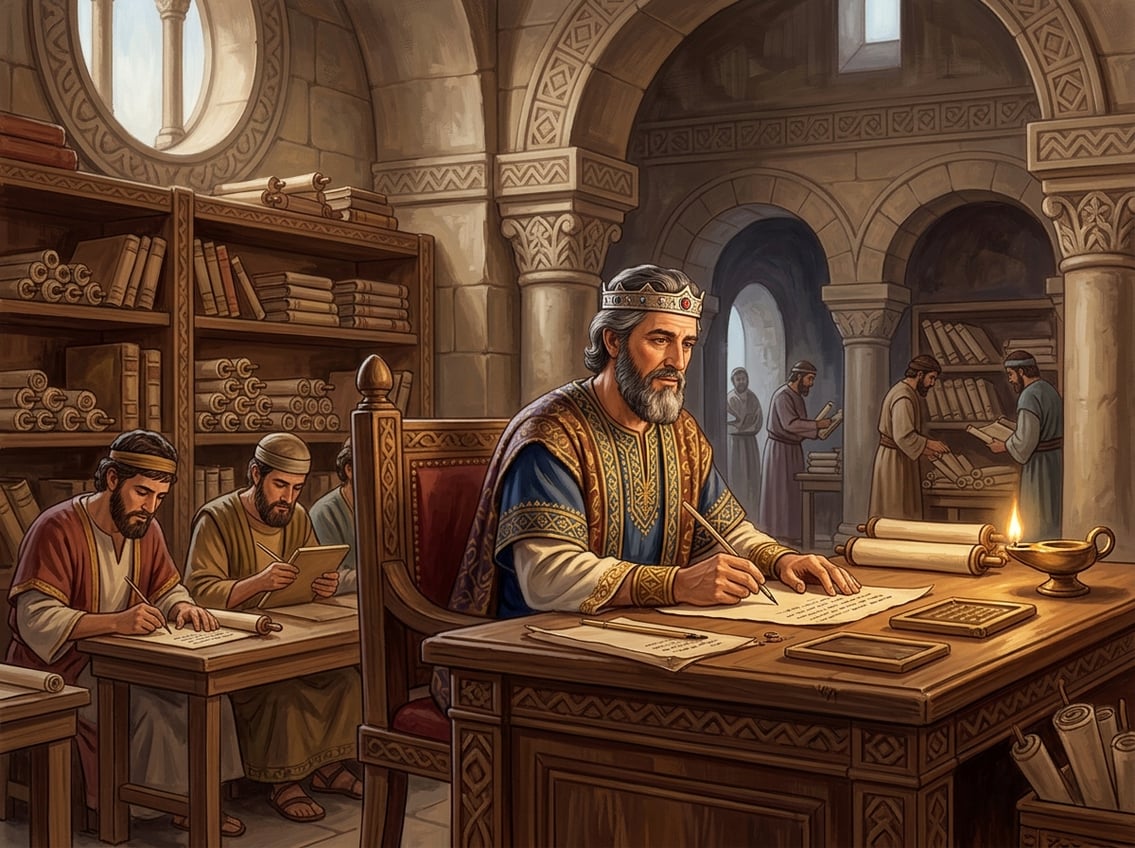
The Short Answer: Solomon Wrote Much, Not All
King Solomon is credited with most of the material in the Book of Proverbs, but he is not the only contributor. The text names other authors and editors, making Proverbs a compiled work rather than a single-author document.
What Proverbs 1:1 Says About Solomon
Proverbs 1:1 opens with a direct claim: "The proverbs of Solomon, son of David, king of Israel."
This verse sets the tone for the entire book. It identifies three key facts:
| Detail | Information |
|---|---|
| Author named | Solomon |
| Family line | Son of David |
| Role | King of Israel |
Proverbs 10:1 repeats this claim: "The proverbs of Solomon." This heading marks the start of a new section, one built from short, standalone sayings rather than longer poems.
Together, these two verses anchor Solomon as the primary voice behind most of the Proverbs. His role connects to his reputation as a wise king in Israel's history.
Why Multiple Attributions Matter
Solomon's name appears at key points, but Proverbs includes other voices too.
Attributed sections in Proverbs:
- Proverbs 1–9: Solomon, longer poetic instruction
- Proverbs 10:1–22:16: Solomon, short standalone sayings
- Proverbs 22:17–24:34: Likely compiled by Solomon from other wise sayings, not fully original to him
- Proverbs 25–29: Solomon, copied later by "the men of Hezekiah"
- Proverbs 30: Agur, a separate named author
- Proverbs 31: King Lemuel, another separate named author
This structure shows that Proverbs functions as a collection, not a single unified text. Solomon supplied the bulk of the material, but editors organized it over time, adding other voices along the way.
Solomon’s Wisdom and Historical Setting
King Solomon’s reputation for wisdom did not come from nowhere. It began with a direct request to God and shaped how Proverbs came to be written and understood.
Solomon’s Request for Understanding
In 1 Kings 3, God appears to Solomon in a dream and offers him anything he wants. Solomon does not ask for wealth or long life. He asks for understanding.
Here is what Solomon requested and what God gave him:
| Solomon Asked For | God Provided |
|---|---|
| An understanding heart | Wisdom and discernment |
| The ability to judge right from wrong | Knowledge beyond his years |
| Judgment to lead Israel well | Riches and honor as a bonus |
1 Kings 3:12 records God's direct response, granting Solomon a wise and discerning heart unlike anyone before or after him. This request set the stage for Solomon’s later works, including his contribution to Proverbs.
The Biblical Record of His Proverbs
Solomon’s output of wise sayings was large by any standard.
1 Kings 4:32 states that Solomon spoke 3,000 proverbs and wrote 1,005 songs. This scale explains why the book carries his name.
The opening line of Proverbs reads, "The proverbs of
The Other Named Voices in the Collection
Proverbs includes wisdom from several named contributors beyond Solomon. Each voice adds a distinct style and focus to the book.
| Contributor | Bible Reference | Main Focus |
|---|---|---|
| The Wise | Proverbs 22:17; 24:23 | General life instruction |
| Agur son of Jakeh | Proverbs 30:1 | Riddles and humility before God |
| King Lemuel | Proverbs 31:1 | Royal advice from his mother |
| Unnamed poet | Proverbs 31:10-31 | Description of a virtuous woman |
The Sayings of the Wise
This section starts at Proverbs 22:17 and runs through chapter 24.
Key facts:
- The text calls these "words of the wise" (22:17)
- Proverbs 24:23 repeats this label, marking a new set of sayings
- No single author is named
- Many scholars link this section to Solomon, since he often gathered wisdom from other sources
The style shifts here. Instead of short, single-line sayings, this section uses longer teaching passages. Each one gives clear instruction on a specific topic, like honesty or self-control.
Agur Son of Jakeh and Proverbs 30
Proverbs 30:1 names Agur son of Jakeh as the author of this chapter. Little else is known about him.
What the text reveals:
- He came from a place or clan called Massa
- He described himself as lacking wisdom, not having it
- He asked God two direct requests: keep him from lies, and give him neither poverty nor riches (30:7-9)
- His writing style uses number patterns, like "three things... four things"
Agur's tone stands apart from Solomon's confident teaching style. He focuses on human limits and dependence on God. This makes the sayings of Agur one of the more personal and humble sections in the book.
King Lemuel and His Mother's Instruction
Proverbs 31:1 introduces King Lemuel and says his mother taught him these words.
Details from the text:
- Lemuel is linked to Massa, the same place tied to Agur
- His identity outside this passage is not confirmed in other parts of the Bible
- The chapter opens with his mother's direct instruction on leadership, wine, and justice for the poor
This passage is framed as a mother passing down guidance to her son, a king. It reads like practical advice for someone about to rule, focused on self-control and fair treatment of others.
The Virtuous Woman Poem
Proverbs 31:10-31 closes the book with a poem about a capable, hardworking woman. The author is not named separately from Lemuel's mother, so many link this poem to the same source.
Key features:
- Written as an acrostic, where each verse starts with a new letter of the Hebrew alphabet
- Describes her work, business skill, care for her family, and respect from her community
- Ends with the idea that "fear of the Lord" matters more than beauty (31:30)
This poem gives a full picture of a woman's daily life and value. It works as a summary of the practical wisdom found throughout the rest of Proverbs.
How Scribes Preserved and Arranged Proverbs
Solomon may have spoken thousands of proverbs, but scribes did the work of writing them down, sorting them, and passing them on. Their editorial activity shaped Proverbs into the layered book found in the Hebrew Bible today.
The Men of Hezekiah and Proverbs 25
Proverbs 25:1 names a specific group: "the men of Hezekiah king of Judah" copied out sayings attributed to Solomon.
Key facts about this group:
- They worked roughly 200 years after Solomon's reign.
- Their task was copying, not composing new proverbs.
- Their work produced Proverbs 25-29, a distinct block within the book.
- Hezekiah ruled Judah during a period of religious reform, which likely motivated interest in preserving wisdom texts.
This superscription is direct textual evidence of scribal collection and transmission rather than a single author writing the whole book at once.
A Collection of Collections Rather Than One Book Draft
Proverbs reads less like one continuous composition and more like a set of smaller collections joined together.
| Section | Attributed Source | Notes |
|---|---|---|
| Chapters 1-9 | Solomon (introductory instructions) | Long discourses, not short sayings |
| Chapters 10-22:16 | Solomon | Bulk of short, two-line proverbs |
| Chapters 22:17-24:34 | "Words of the wise" | Parallels to Instruction of Amenemope |
| Chapters 25-29 | Solomon, copied by Hezekiah's scribes | Second Solomonic collection |
| Chapter 30 | Agur | Separate named author |
| Chapter 31 | King Lemuel | Separate named author |
This layout shows why Proverbs functions as wisdom sayings gathered over time, not a draft written in one sitting.
Traditional Attribution and Scholarly Questions
Jewish and Christian tradition credits Solomon with most of the content, based on the superscriptions in Proverbs 1:1, 10:1, and 25:1.
Scholars raise several points for discussion:
- The multiple named authors (Solomon, Agur, Lemuel) suggest deliberate editorial layering.
- Repeated verses across sections (such as parallels also found in Psalms) point to scribes retaining duplicate material rather than removing it.
- Similarities to Egyptian wisdom texts suggest scribes drew on, or were aware of, broader biblical wisdom literature traditions in the ancient Near East.
- Debate continues over when the final compiled version was assembled, with estimates ranging from the 8th century BC to the postexilic period.
Regardless of exact dating, the text itself credits scribes with organizing and preserving these sayings into their current form.
Reading Proverbs According to Its Purpose
Proverbs was written to give practical wisdom for everyday life, not just religious rules. The book teaches how to make good choices, avoid harm, and live with good judgment.
Wisdom and Instruction for Daily Decisions
Proverbs 1–9 lays out the goal of the whole book in plain terms.
Key purposes listed in Proverbs 1:2-4:
- To know wisdom and instruction
- To understand words of insight
- To gain wise dealing in righteousness, justice, and equity
- To give prudence and discretion to the simple and young
How to apply this:
| Situation | Proverbs Focus |
|---|---|
| Making a hard choice | Seek wise counsel before acting (Proverbs 15:22) |
| Handling money | Avoid debt and quick riches (Proverbs 22:7) |
| Speaking to others | Choose words with care (Proverbs 15:1) |
| Dealing with anger | Slow down before reacting (Proverbs 14:29) |
Proverbs 2 and 6 give direct instruction on avoiding foolish paths and building good habits early.
The Fear of the Lord as the Foundation
Proverbs 1:7 states the theme of the whole book: "The fear of the Lord is the beginning of knowledge." This idea repeats in Proverbs 9:10, tying wisdom directly back to fear of God.
What "fear of the Lord" means in Proverbs:
- Respect for God as creator and ruler
- Trust in His authority over daily life
- Humility before His commands
- Recognition that all wisdom starts with Him, not human effort alone
Quick contrast:
| Without Fear of the Lord | With Fear of the Lord |
|---|---|
| Pride and self-reliance | Humility and trust |
| Rejects instruction | Accepts correction |
| Chases short-term gain | Seeks lasting good |
This theme connects wisdom to creation itself, since Proverbs 3:19-20 says God used wisdom to form the world.
Wise and Foolish Paths
Proverbs constantly compares two types of people to make its point clear.
Common contrasts in Proverbs:
- Wise man vs. fool
- Righteous vs. wicked
- Good vs. evil
- Diligent vs. lazy
Traits of each path:
| Wise Path | Foolish Path |
|---|---|
| Listens to correction | Ignores advice |
| Speaks with care | Speaks without thinking |
| Plans ahead | Acts on impulse |
| Seeks justice | Causes harm to others |
The book of Proverbs frequently pairs Solomon's wisdom sayings with contrasts between right and wrong choices, making the two paths easy to spot throughout the text.
Why Proverbs Are Principles Rather Than Guarantees
Proverbs gives general truths about how life usually works, not fixed promises for every situation.
Key point: A proverb states what is normally true, not what will happen 100% of the time.
Example:
- Proverbs 22:6 says training a child in the right way will keep them on that path later in life.
- This describes a common outcome, not an unbreakable rule for every family.
Why this matters:
- Life includes exceptions and unexpected outcomes
- Wisdom literature speaks in patterns, not legal contracts
- Proverbs offers practical guidance for handling life's different situations rather than strict formulas
Readers get the most benefit by applying proverbs as guides for good judgment, not as guaranteed formulas for specific results.
Placing Proverbs Within Biblical Wisdom Literature
Proverbs does not stand alone. It works alongside other Old Testament wisdom books to give a fuller picture of how faith and daily life connect.
How Job and Ecclesiastes Add Necessary Perspective
Proverbs, Job, and Ecclesiastes form the core of Old Testament wisdom literature. Each book asks a different question about life.
| Book | Main Question | Core Message |
|---|---|---|
| Proverbs | How should a person live wisely? | Good choices usually lead to good outcomes |
| Job | Why do good people suffer? | Suffering does not always mean punishment |
| Ecclesiastes | What is the point of life? | Life has limits; true meaning comes from God |
Proverbs offers general rules for wise living. It says wise choices bring good results most of the time.
Job pushes back on that idea. It shows a righteous man suffering without a clear reason, proving that life does not always follow neat patterns.
Ecclesiastes adds another layer. It questions whether human effort and knowledge can ever fully satisfy, pointing instead to trust in God as the real source of meaning.
Together, these three books balance each other. Readers get practical guidance from Proverbs, a check against oversimplified thinking from Job, and a reminder of life's limits from Ecclesiastes.
Christian Reading and the Teaching of Jesus
Christian readers often connect Proverbs to the teaching of Jesus in the New Testament. Both use short, memorable sayings to teach moral lessons.
Key connections:
- Jesus' parables function like extended proverbs, using everyday images to teach spiritual truth
- Both Proverbs and Jesus stress the value of humility, honesty, and self-control
- The New Testament writers quote Proverbs directly, showing it carried authority in early Christian teaching
Role of the Holy Spirit in application:
- Many Christians read Proverbs as Spirit-inspired instruction meant for ongoing use, not just ancient advice
- The Holy Spirit is often seen as the one who helps readers apply Proverbs to present situations
- This view treats wisdom literature as part of a living, active Bible rather than a historical record only
This reading approach places Proverbs within a larger arc. It moves from Old Testament instruction to New Testament fulfillment, with knowledge and understanding functioning as ongoing gifts rather than one-time lessons.
Frequently Asked Questions
The Book of Proverbs names several authors across its 31 chapters, with King Solomon credited as the main writer. Different sections come from different sources, and the text itself marks these changes with clear headings.
Who is traditionally credited with writing the Book of Proverbs?
King Solomon holds the primary credit for writing Proverbs. The opening verse states this directly: "The proverbs of Solomon, son of David, king of Israel."
This claim is rarely challenged by scholars, unlike authorship questions for some other biblical books.
Quick facts:
- Solomon reigned as Israel's third king.
- He was known for wisdom, wealth, and building the temple in Jerusalem.
- His name appears at the start of multiple sections within Proverbs.
Did King Solomon write all of Proverbs?
No. Solomon wrote most of the book, but not every verse.
| Claim | Fact |
|---|---|
| Solomon wrote 100% of Proverbs | False |
| Solomon wrote the majority of Proverbs | True |
| Other named authors contributed sections | True |
| The book includes later editorial additions | True |
The text itself names additional contributors beyond Solomon, and includes signs of editing that happened after his lifetime.
Who wrote Proverbs 1 through 24?
This large section splits into two main parts, both linked to Solomon.
Breakdown:
- Proverbs 1-9: Poetic teachings and fatherly advice, mainly credited to Solomon.
- Proverbs 10-22:16: Short sayings on topics like honesty, work, and speech, also from Solomon.
- Proverbs 22:17-24:34: A shorter set of sayings, sometimes called "words of the wise."
These sections form the core of the book's structure, moving from longer teachings to brief, standalone sayings.